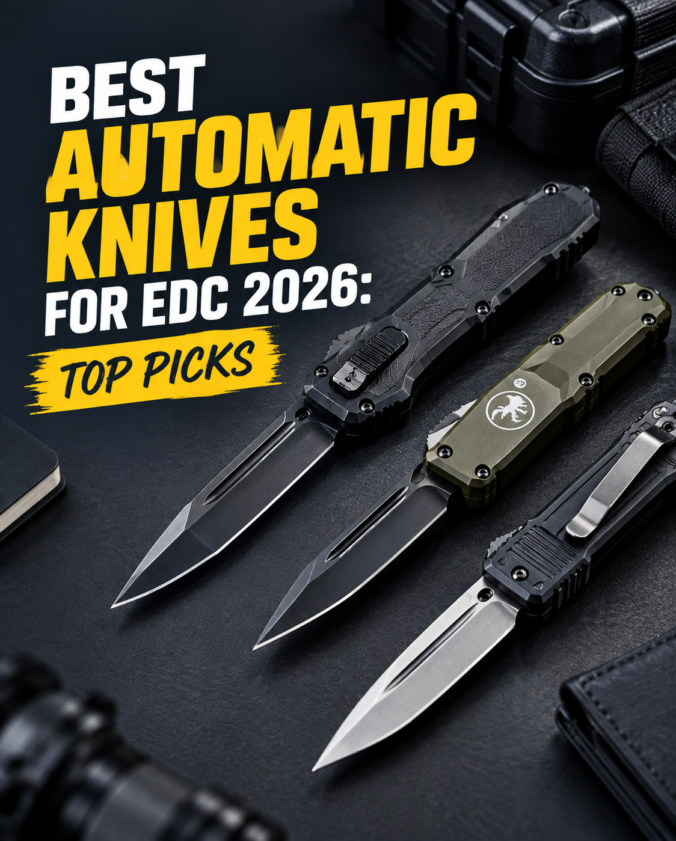
TL;DR: Automatic knives are legal in approximately 40 states, but carry restrictions vary dramatically – California caps OTF blades at under 2 inches, while Texas allows full-size automatics. For EDC, the sweet spot is a 3–3.5 inch blade with S30V or 154CM steel. Budget picks like the Kershaw Launch 4 ($50–$90) deliver solid reliability; premium options like the Microtech Ultratech ($175–$280) offer 3× longer edge retention between sharpenings.
Introduction
You're standing in a gear shop, eyeing two automatic knives side by side. One costs $65. The other runs $220. Both deploy in a fraction of a second. So which one actually belongs in your pocket?
Based on our analysis of state knife laws, manufacturer specifications, and community carry reports across 2024–2026, we've built a decision framework that cuts through the noise. This guide covers what makes an automatic knife suitable for daily carry, which states actually allow them, and which models deliver the best value at every price tier.
The automatic knife market has shifted dramatically since 2010. Federal law clarified that assisted-opening knives aren't classified as switchblades, and since 2010, numerous states have removed bans or clarified laws allowing automatic knives. Today, you have real options – if you know the legal landscape and what specs actually matter for daily carry.
What Makes an Automatic Knife Good for EDC?
An automatic knife isn't just about speed. It's about reliability, weight, and whether you can legally carry it where you live.
OTF vs. Side-Opening: The Mechanism Matters
Out-the-front (OTF) automatics fire the blade, as explored in Knife Depot's OTF automatic knife guide, straight forward from the handle. Side-opening automatics deploy perpendicular to the handle, like a traditional folder. With the push of a button or slide of a switch, you get fast, one-handed deployment, which is incredibly handy when you're wearing gloves or carrying equipment.
OTF knives typically deploy in 0.1–0.3 seconds. Side-openers run slightly slower but offer a more compact closed profile. For EDC, both work – it depends on your pocket space and carry style.
Five EDC Criteria That Actually Matter
- Blade Length: The EDC blade length sweet spot is 3–3.5 inches, balancing utility for most tasks with carry legality across permissive states. Anything shorter feels cramped for real work. Anything longer risks legal trouble in restricted states.
- Blade Steel: This is where the long-term math changes. Budget knives use 8Cr13MoV or 7Cr17MoV. Mid-range uses 154CM. Premium uses S30V or MagnaCut. MagnaCut combines excellent edge retention with unusually strong corrosion resistance, making it one of the best all-around blade steels currently available.
- Deployment Reliability: A sluggish or inconsistent deployment defeats the purpose. This is where you pay for tolerances. Budget automatics sometimes stick; premium ones fire every time.
- Clip Carry Options: Deep carry, tip-up, tip-down. Your EDC knife needs to sit where you want it without printing.
- Weight: A 3.2 oz aluminum-handled OTF feels different after 8 hours than a 4.8 oz G10 side-opener. Both are legal carry weights, but one fatigues your pocket.
Key Takeaway: A 3–3.5 inch blade with 154CM or S30V steel, as discussed in Knife Depot's premium pocket knife roundup, reliable deployment mechanism, and deep-carry clip is the EDC baseline. Anything less and you're compromising daily utility.
Are Automatic Knives Legal to Carry Every Day?
This is the question that stops most buyers cold. The answer: it depends entirely on where you live.
Federal Baseline
The Federal Switchblade Act of 1958 remains the primary federal law governing automatic knives in the United States. Here's what it actually says: federal law (15 U.S. Code 1241–1245) restricts the interstate commerce of automatic switchblade knives, but does not outright ban ownership.
Translation: You can own one. You can't mail one across state lines. Individual states decide whether you can carry it.
State-by-State Reality
Permissive States (No Restrictions):
- Texas legalized carrying automatic knives in 2017 with no blade length restriction for most adults
- Arizona
- Alaska
- Florida
- New Mexico
Restricted States (Automatic Knives Banned or Heavily Limited):
- New York (banned)
- California (OTF blades under 2 inches only)
- Illinois (blade length restrictions with disability exemptions)
- Hawaii
- Delaware
California Compliance: The 2-Inch Rule
If you want a California legal OTF knife, the blade must be strictly under 2 inches in length. This is California Penal Code §21510. Several manufacturers now make purpose-built compliant models. If you live in California or travel there frequently, this constraint shapes your entire buying decision.
Critical Disclaimer: Knife laws change. Municipal ordinances add local restrictions. Before purchasing, consult your state's current statutes and local law enforcement. Carrying an illegal automatic knife can result in misdemeanor charges.
Key Takeaway: 40+ states permit automatic knives, but California, New York, and Illinois impose strict limits. Verify your local laws before buying. California OTF blades must be under 2 inches.
Best Automatic Knives for EDC: Our 2026 Picks
These picks span $30–$300 to cover every budget. Each includes blade steel, blade length, weight, and mechanism type so you can make an informed choice. For a broader look at the current market, pvk.com's roundup of the Best Automatic Knives of 2026: From Budget EDC to High-End customs covers everything from entry-level Ganzo options to American-made standouts from Protech, Microtech, and Heretic – useful context if you want to see how our picks fit the wider landscape.
Best Budget Automatic EDC Knife (Under $75)
Kershaw Launch 4
The Kershaw Launch 4 has a blade length of 3.4 in., closed length of 4.8 in., weight of 3 oz, and uses a double-action OTF automatic action type. Available in 8Cr13MoV or CPM154 steel.
Price: $50–$90 depending on steel choice.
Why it works: Snappy deployment, clean blade geometry, and a clip that handles deep carry without drama. The CPM154 version ($90) is worth the extra $40 – you'll sharpen it half as often. 8Cr13MoV dulls faster but still delivers acceptable edge retention for casual EDC.
Trade-off: Budget automatics occasionally stick in cold weather or after debris exposure. Higher failure rates reported in community forums vs. premium OTFs. Not a dealbreaker for occasional carry, but a consideration if you need reliable performance.
Best Mid-Range Automatic EDC Knife ($75–$175)
Benchmade 9070 Claymore
Blade 3.45 in, Overall 7.8 in, Weight 3.2 oz, S30V steel, side-opening push button automatic action type, reversible clip for ambidextrous carry.
Price: ~$175.
Why it works: S30V steel holds an edge 3× longer than budget stainless. Reversible clip works for left or right carry. Benchmade's quality control is tight – deployment is consistent every single time.
Trade-off: Heavier than OTF options. Side-opening takes slightly longer to deploy than OTF. But the reliability and edge retention justify the weight for serious EDC users.
Best Premium Automatic EDC Knife ($175+)
Microtech Ultratech
Blade 3.46 in, Overall 7.8 in, Weight 3.2 oz, M390 steel option, double-action OTF automatic action type, aluminum handle.
Price: $195–$280 depending on steel configuration.
Why it works: Microtech's tolerances are obsessive. The double-action mechanism fires and retracts with the same button – one-handed operation in any condition. M390 steel is overkill for most EDC, but if you want a knife that holds an edge for months, this is it.
Trade-off: Premium price. Requires periodic lubrication of internal rails (every 3–6 months with regular carry). Not a beginner knife – the mechanism is complex.
Best OTF Automatic Knife for EDC
Kershaw Livewire OTF (Model 9000)
Price: $60–$100.
Why it works: OTF deployment is fastest. The Livewire balances speed with reliability at a mid-budget price. Deep carry clip keeps it invisible in a pocket.
OTF-specific benefit: One-handed deployment and retraction. If you're wearing gloves or carrying gear, this matters.
Best Side-Opening Automatic for EDC
Gerber 06 Auto Tanto Serrated
Price: $80–$120.
Why it works: Tanto blade geometry excels at piercing and utility cuts. Serrated edge handles rope and synthetic materials. Heavier than OTF but more compact when closed.
Side-opener benefit: Slightly more intuitive for users transitioning from manual folders. Deployment is fast enough for EDC without the OTF mechanism complexity.
Comparison Table: All Picks at a Glance
| Model | Price | Blade Steel | Blade Length | Weight | Type | Best For |
|---|---|---|---|---|---|---|
| Kershaw Launch 4 | $50–$90 | 8Cr13MoV / CPM154 | 3.4" | 3.0 oz | OTF | Budget EDC |
| Benchmade 9070 | ~$175 | S30V | 3.45" | 3.2 oz | Side-Open | Mid-range reliability |
| Microtech Ultratech | $195–$280 | M390 / S35VN | 3.46" | 3.2 oz | OTF | Premium edge retention |
| Kershaw Livewire | $60–$100 | 8Cr13MoV | 3.3" | 3.0 oz | OTF | Fast deployment |
| Gerber 06 Auto | $80–$120 | Tanto serrated | 3.8" | 7.2 oz | Side-Open | Utility cuts |
Key Takeaway: Budget OTFs ($50–$90) deliver solid performance for the price. Mid-range side-openers ($175) offer superior edge retention. Premium OTFs ($250+) justify cost only if you demand zero maintenance and maximum edge life.
How Do Automatic Knives Compare to Other EDC Options?
You're probably weighing automatics against assisted-opening folders or manual folders. Here's the real difference.
Automatic vs. Assisted-Opening vs. Manual Folder
| Factor | Automatic | Assisted-Opening | Manual Folder |
|---|---|---|---|
| Deployment Speed | 0.1–0.3 sec | 0.4–0.6 sec | 1–2 sec |
| One-Handed Deploy | Yes | Yes | No |
| Legal Status | Restricted in 10–15 states | Legal in most states | Legal everywhere |
| Maintenance | Periodic lubrication required | Minimal | Minimal |
| Mechanism Complexity | High | Medium | Low |
| Price Range | $30–$300+ | $40–$200 | $30–$250 |
Deployment Speed Matters When?
If you're a first responder, tactical professional, or self-defense-focused carrier, the 0.2-second gap, and Knife Depot's guide to self-defense folding knives covers related considerations, between automatic and assisted-opening is real. For general EDC – opening boxes, cutting paracord, food prep – the difference is academic. Reviewers at EDC Knives – BladeReviews.com consistently note that for most everyday tasks, deployment speed is rarely the deciding factor in real-world carry satisfaction.
Legal Differences Are Critical
Some states strictly regulate automatic knife laws, while others, like Texas and Florida, allow ownership and carry it with few restrictions. Assisted-opening knives are legal in nearly every state. If you travel frequently or live in a restricted state, assisted-opening eliminates legal risk.
Maintenance Reality
Automatics require lubrication. Assisted-openers and manual folders don't. Keep your OTF's internals clean and lightly lubed – debris and dry springs are the primary causes of sluggish or failed deployment after extended carry. High-debris environments (construction, outdoor work) mean more frequent maintenance.
Key Takeaway: Automatics deploy 0.2–0.5 seconds faster than assisted-openers but require periodic maintenance and face legal restrictions in 10–15 states. For pure EDC utility, assisted-opening knives offer practical speed with zero legal risk.
What Should You Look for in an EDC Automatic Knife?
Before you buy, understand the specs that actually affect daily carry.
Blade Steel: The Long-Term Math
Budget knives use 8Cr13MoV or 7Cr17MoV. These are Chinese stainless steels. They dull faster but sharpen easily in the field.
Mid-range uses 154CM. 154CM is an American-made stainless that outperforms Chinese budget steels and is far more sharpenable in the field than S30V – the best 'middle ground' steel for EDC.
Premium uses S30V, M390, or MagnaCut. S30V holds an edge roughly 3× longer than 8Cr13MoV under equivalent use. That means you sharpen it 3–4× less frequently. Over a year of daily carry, that's real time savings.
Handle Materials: Weight vs. Grip
Aluminum handles run 3–3.5 oz. They're light and won't fatigue your pocket. But they offer minimal grip texture.
G10 is heavier than aluminum but provides superior grip retention in wet or gloved-hand conditions – a real consideration for outdoor or tactical EDC.
Titanium offers the best weight-to-strength ratio but typically starts at $250+.
Clip Carry Options
Deep carry keeps the knife invisible. Tip-up or tip-down is personal preference. Make sure the clip matches your carry style before buying.
OTF Lock Mechanisms
Double-action OTFs fire the blade forward and retract it with the same push-pull button – single-action OTFs only deploy automatically; retraction is manual. Double-action is preferred for EDC because you get one-hand operation. Single-action is slightly simpler mechanically – fewer failure points.
OTF knives require periodic lubrication of internal rails and springs (approximately every 3–6 months with regular daily carry) to maintain reliable deployment. High-debris environments require more frequent maintenance. Budget 15 minutes per maintenance cycle.
Key Takeaway: S30V steel costs $100+ more but reduces sharpening frequency significantly over a year. G10 handles add weight but improve grip in wet conditions. Double-action OTF mechanisms enable true one-handed operation.
Frequently Asked Questions About EDC Automatic Knives
How much should you spend on a good EDC automatic knife?
Direct Answer: $75–$150 covers most EDC needs. Budget $50–$90 for reliable daily carry; spend $150–$250 only if you demand premium edge retention or zero maintenance.
The math: A $90 CPM154 Kershaw Launch 4 requires sharpening every 2–3 months with heavy use. A $220 Benchmade 9070 with S30V requires sharpening every 6–9 months. If you sharpen yourself, the Kershaw wins. If you send knives out for professional sharpening ($15–$25 per blade), the Benchmade's longer edge life saves money over 2+ years.
Are automatic knives legal to carry in all 50 states?
Direct Answer: No. Approximately 40 states permit automatic knives, but 10–15 states ban or heavily restrict them. California, New York, and Illinois are the most restrictive.
Before purchasing, verify your state's current statutes. Certain states also allow professionals such as EMTs, firefighters, and police enforcement members to use automatic knives under particular conditions. Consult local law enforcement or an attorney if you're unsure.
What is the difference between an OTF and a side-opening automatic knife?
Direct Answer: OTF knives deploy straight forward from the handle; side-opening automatics deploy perpendicular to the handle like a folder. OTFs deploy slightly faster (0.1–0.3 sec vs. 0.2–0.4 sec) and offer one-handed retraction with double-action mechanisms.
Side-openers are more compact when closed and feel more familiar to folder users. Both are viable for EDC – choose based on pocket space and carry preference.
How do automatic knives compare to assisted-opening knives for everyday carry?
Direct Answer: Automatics deploy 0.2–0.5 seconds faster but require periodic maintenance and face legal restrictions in 10–15 states. Assisted-opening knives are legal everywhere and require no maintenance but deploy slightly slower.
For pure EDC utility – cutting boxes, rope, food prep – the speed difference is negligible. For tactical or self-defense use, the automatic's speed advantage is meaningful. For travel or restricted-state carry, assisted-opening eliminates legal risk entirely.
What blade length is best for an everyday carry automatic knife?
Direct Answer: 3–3.5 inches is the EDC sweet spot. This length balances cutting utility for most tasks with legal compliance across permissive states.
Anything shorter (under 2.5 inches) feels cramped for real work. Anything longer (over 3.5 inches) risks legal trouble in states with blade-length restrictions. California's 2-inch OTF limit is the exception – if you carry there, you'll need a specialized compliant model.
How do you maintain an automatic knife to keep the mechanism working reliably?
Direct Answer: Lubricate internal rails and springs every 3–6 months with regular daily carry. Use light machine oil or specialized knife lubricant. Budget 15 minutes per maintenance cycle.
High-debris environments (construction, outdoor work) require more frequent maintenance. If your OTF starts to stick or deploy sluggishly, lubrication is the first fix. If that doesn't work, the mechanism may need professional service.
Can you fly with an automatic knife in checked luggage?
Direct Answer: Yes, but with conditions. Knives are prohibited in carry-on baggage. Knives in checked baggage must be sheathed or securely wrapped to prevent injury to baggage handlers.
However, destination state laws still apply upon arrival. If you're flying to New York or California with an automatic knife in checked baggage, you may violate state law when you land. Verify destination knife laws before packing.
Upgrade Your Everyday Carry
Ready to Get Started?
For personalized guidance, visit Knife Depot to learn how we can help.
Conclusion
The best automatic knife for EDC isn't the fastest or the most expensive. It's the one that deploys reliably, holds an edge long enough to justify its price, and fits your pocket without printing.
If you're budget-conscious and don't mind sharpening every 2–3 months, a $65–$90 Kershaw Launch 4 with CPM154 steel delivers solid daily carry. If you want zero maintenance and maximum edge life, spend $175–$220 on a Benchmade or Microtech with S30V steel.
Before you buy, verify your state's automatic knife laws. California's 2-inch OTF restriction, New York's outright ban, and Illinois's blade-length limits are real constraints. Carrying an illegal automatic knife isn't worth the legal risk.
Knife Depot stocks a full range of automatic knives across all price tiers, with detailed specs and legal compliance notes for every model. Whether you're building your first EDC kit or upgrading your current carry, you'll find options that match your budget and your local laws.
The right automatic knife becomes invisible in your pocket and indispensable in your hand. Choose wisely.
Leave a Reply