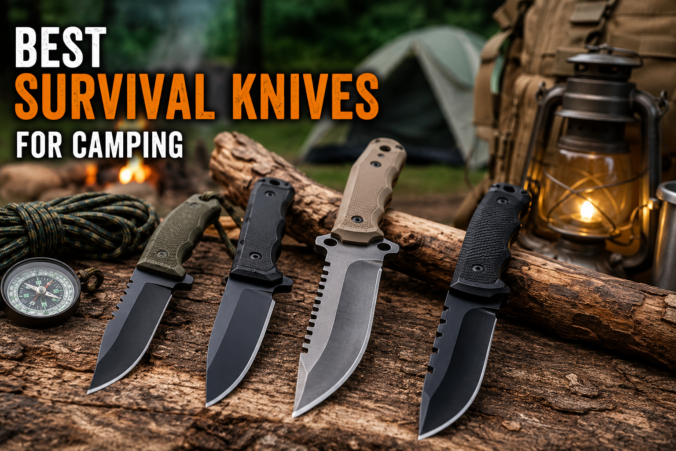
TL;DR: – Full-tang fixed blades in 1095 carbon or 420HC steel dominate the $50–$120 sweet spot for most campers
- The 4–5 inch blade length covers ~90% of camping tasks while remaining legal in most U.S. jurisdictions
- Field sharpening ease diverges sharply: 1095 carbon resharpens in under 3 minutes on a basic whetstone; S30V requires 8–12 minutes with diamond equipment
What Makes a Great Survival Knife for Camping?
Before you drop cash on a blade, you need to know what actually matters in the field. (Tsa.gov) A great camping survival knife isn’t about flashy aesthetics or brand hype – it’s about reliability when you’re 10 miles from the trailhead for wilderness hiking.
Here’s the foundation: you’re evaluating four core criteria. Blade steel determines how long your edge lasts and how easily you can sharpen it in camp. Tang type – whether the steel runs fully through the handle (full tang) or partway (partial tang) – affects durability for heavy tasks like batoning wood. Blade length balances utility with legality and pack weight. Handle ergonomics keep your grip secure in wet, cold conditions.
According to REI’s expert advice, a full tang knife is stronger and more durable than a partial tang. If the handle breaks, you can still use the blade – critical for survival situations involving heavy tasks. The trade-off? Full tang knives weigh more. For ultralight backpackers, that matters.
REI also notes that for most campers, a blade between 3.5 and 5 inches is the most versatile option – long enough for camp tasks but within most legal limits. Anything shorter and you’re compromising on food prep and fire processing. Anything longer and you’re carrying unnecessary weight and running into legal restrictions in certain states.
Handle materials matter more than most guides admit. G10 and Micarta maintain grip when wet and don’t become brittle in cold; rubber handles stiffen noticeably below freezing. If you’re camping in winter or wet climates, bare aluminum or steel handles conduct cold rapidly and pose contact risk below 20°F.
Key Takeaway: A full-tang fixed blade, 4–5 inches, in carbon or stainless steel, with a G10 or Micarta handle covers 90% of camping scenarios. Everything else is optimization.
How Do Blade Steels Compare for Camping Survival Knives?
This is where most listicles fall flat. They’ll name a steel type and move on. You need to understand the practical tradeoffs in the field.
1095 Carbon Steel is the workhorse. According to Blade HQ’s steel guide, 1095 is one of the easiest steels to sharpen and is very tough, making it a top choice for survival and bushcraft knives despite lower corrosion resistance. You can resharpen it in under 3 minutes on a basic whetstone or even a river stone. The catch? It rusts. In humid environments, you’ll need to oil it regularly with food-grade mineral oil if you’re using it for food prep.
S30V Stainless Steel is the premium option. S30V’s vanadium carbides make it very wear resistant but also difficult to sharpen without diamond or CBN abrasives. Field sharpening typically takes 8–12 minutes with proper equipment. You’ll need to invest $25–$45 in a diamond rod to maintain it in camp. The upside? Exceptional corrosion resistance and edge retention. If you’re camping in wet climates and don’t mind the maintenance burden, S30V justifies the cost.
D2 Tool Steel sits in the middle. D2 is a semi-stainless tool steel with high wear resistance – harder to sharpen than simple carbon steels and has moderate corrosion resistance, better than 1095 but worse than true stainless. It’s a solid compromise if you want better corrosion resistance than carbon without the sharpening headache of S30V.
420HC Stainless Steel is the budget-friendly stainless option. 420HC is tough and corrosion resistant, but not known for exceptional edge retention – it’s easy to sharpen and a good choice for wet or marine environments. Heat treatment quality varies significantly by manufacturer, so budget knives using 420HC may perform poorly.
Here’s the cost-of-ownership math: A 1095 carbon knife at $65 vs. an S30V knife at $185. The $120 difference buys better corrosion resistance but requires a diamond sharpener ($25+) to maintain in the field. For most weekend campers, 1095 wins. For serious bushcrafters in wet climates, S30V’s convenience justifies the premium.
| Steel Type | Sharpening Ease | Corrosion Resistance | Edge Retention | Best For | Cost Impact |
|---|---|---|---|---|---|
| 1095 Carbon | Excellent (3 min) | Poor | Very Good | Budget, dry climates | Baseline ($50–$80) |
| 420HC | Excellent (3 min) | Excellent | Fair | Wet environments | +$10–$20 |
| D2 | Good (5–7 min) | Good | Excellent | Balanced approach | +$15–$30 |
| S30V | Poor (8–12 min) | Excellent | Excellent | Premium, wet use | +$80–$120 |
Key Takeaway: 1095 carbon resharpens in 3 minutes with a basic stone; S30V requires diamond equipment and 8–12 minutes. The $120 price difference buys convenience, not necessity, for most campers.
Best Survival Knives for Camping: 7 Top Picks (2026)
Let’s cut through the noise. These seven knives represent the real-world sweet spots across price tiers and camping styles.
Budget Pick (Under $60)
Morakniv Companion (1095 Carbon or Stainless)
- Blade steel: 1095 carbon or 420HC stainless
- Blade length: 4.1 inches
- Weight: 3.2 oz
- Price: $15–$25
- Best for: Ultralight backpackers, beginners, bushcraft fundamentals
The Mora Companion is arguably the best value knife on the market – for under $20, it offers a Scandinavian grind, decent steel, and a sheath, outperforming knives 5x its price for bushcraft tasks. The Scandi grind excels at wood carving and fire prep. The trade-off? Partial tang construction means it’s not ideal for heavy batoning. But for food prep, shelter work, and fire processing, it’s unbeatable at the price.
Pros:
- Exceptional value; proven 130-year Swedish manufacturer
- Scandi grind ideal for wood carving
- Available in carbon or stainless
Cons:
- Partial tang limits heavy-duty use
- Carbon version requires regular oiling
- Smaller handle may not fit larger hands comfortably
Best Mid-Range Picks ($60–$120)
ESEE-4 (1095 Carbon)
- Blade steel: 1095 high carbon
- Blade length: 4.5 inches
- Weight: 7.2 oz
- Price: $100–$115
- Best for: Base camp camping, general survival, proven reliability
The ESEE-4 is one of the most field-tested survival knives available – built from 1095 high carbon steel with a powder coat, it’s proven in military survival schools and backed by a lifetime warranty. Full tang construction means it handles heavy tasks without hesitation. The powder coat protects the blade but may impede ferro rod use – test or strip the spine coating if fire-starting is critical.
Pros:
- Full tang; proven in tactical use and survival training
- Lifetime warranty
- Excellent edge retention with 1095 steel
Cons:
- Powder coat may prevent ferro rod sparking
- Heavier than ultralight options
- Requires regular maintenance in wet conditions
Mora Garberg (14C28N Stainless)
- Blade steel: 14C28N Sandvik stainless
- Blade length: 4.3 inches
- Weight: 5.9 oz
- Price: $100–$160
- Best for: Wet climates, bushcraft, balanced performance
The Mora Garberg is Morakniv’s first full tang fixed blade – a significant upgrade for heavy use with 14C28N steel and a comfortable handle, bridging budget and mid-range performance convincingly. Stainless steel means less maintenance than carbon. The full tang gives you confidence for batoning and heavy camp tasks.
Pros:
- Full tang with stainless corrosion resistance
- Lighter than ESEE-4
- Excellent value for full tang construction
Cons:
- 14C28N is slightly softer than 1095 carbon
- Stainless is harder to sharpen than carbon
- Less proven track record than ESEE-4
Best High-Performance Picks ($120–$200)
Benchmade Steep Country (S30V)
- Blade steel: CPM-S30V
- Blade length: 3.6 inches
- Weight: 4.8 oz
- Price: $180–$200
- Best for: Hunters, dry climates, premium edge retention
The Steep Country is a premium hunting knife with CPM-S30V steel – edge retention is exceptional but field sharpening requires proper tools, a ceramic rod at minimum, diamond preferred. This is the knife for campers who prioritize edge retention over sharpening convenience. S30V holds an edge 2–3x longer than 1095 carbon.
Pros:
- Exceptional edge retention
- Excellent corrosion resistance
- Premium fit and finish
Cons:
- Requires diamond sharpening equipment
- Smaller blade may limit heavy tasks
- High price point
Cold Steel Recon Scout (AUS-8A)
- Blade steel: AUS-8A stainless
- Blade length: 4.5 inches
- Weight: 6.1 oz
- Price: $120–$150
- Best for: Balanced performance, wet environments, value hunters
AUS-8A is a Japanese stainless steel that balances edge retention with sharpening ease. It’s tougher than S30V but holds an edge better than 420HC. Full tang construction and a comfortable handle make it reliable for extended camp use.
Pros:
- Balanced steel performance
- Full tang; proven design
- Comfortable handle for extended use
Cons:
- Less premium than S30V
- Requires ceramic or diamond for optimal sharpening
- Mid-range performance across all metrics
Premium Pick (Over $200)
Benchmade Bushcrafter (S30V)
- Blade steel: CPM-S30V
- Blade length: 4.4 inches
- Weight: 5.2 oz
- Price: $220–$250
- Best for: Serious bushcrafters, premium collections, extreme durability
This is the top-tier option. Full tang, S30V steel, and Benchmade’s legendary quality control. If you’re planning a month-long wilderness expedition and want zero doubt about your blade, this is it. The cost is high, but the reliability is unquestionable.
Pros:
- Premium materials and construction
- Lifetime warranty
- Proven in extreme conditions
Cons:
- Highest price point
- Requires diamond sharpening
- Overkill for casual camping
Best Lightweight Pick for Backpackers
Mora Companion Carbon (1095)
- Weight: 3.2 oz
- Price: $15–$20
For thru-hikers and ultralight backpackers, the Mora Companion carbon is unbeatable. At 3.2 oz, it adds negligible weight to your pack. Over a 50-mile thru-hike, a 7 oz vs. 12 oz knife is a 0.31 lb difference – meaningful when combined with other gear decisions. The Mora’s Scandi grind handles 90% of camp tasks.
Best Bushcraft-Focused Pick
Mora Garberg (14C28N)
- Weight: 5.9 oz
- Price: $100–$160
Full tang, stainless steel, and a proven Scandinavian design make it ideal for wilderness bushcraft outings. It handles batoning, carving, and food prep without compromise.
Best All-Around Pick
ESEE-4 (1095 Carbon)
If you’re buying one knife and want to cover all bases, the ESEE-4 is it. Full tang, proven reliability, and excellent edge retention. The maintenance burden is worth the peace of mind.
| Knife | Steel | Blade Length | Weight | Price | Best For |
|---|---|---|---|---|---|
| Mora Companion | 1095 Carbon | 4.1″ | 3.2 oz | $15–$25 | Ultralight backpackers |
| ESEE-4 | 1095 Carbon | 4.5″ | 7.2 oz | $100–$115 | Base camp, general survival |
| Mora Garberg | 14C28N Stainless | 4.3″ | 5.9 oz | $100–$160 | Wet climates, bushcraft |
| Benchmade Steep Country | S30V | 3.6″ | 4.8 oz | $180–$200 | Hunters, premium edge retention |
| Cold Steel Recon Scout | AUS-8A | 4.5″ | 6.1 oz | $120–$150 | Balanced performance |
| Benchmade Bushcrafter | S30V | 4.4″ | 5.2 oz | $220–$250 | Premium bushcraft |
Key Takeaway: The $60–$120 tier captures approximately 80–90% of real-world camping knife performance vs. $200+ premium knives for most users – the gains from $150–$300 knives are real but incremental.
Which Survival Knife Should You Choose for Your Camping Style?
Here’s the decision framework. Your camping style determines which knife makes sense.
Ultralight Backpacking (day hikes, 1–3 nights)
- Recommendation: Mora Companion (carbon or stainless)
- Reasoning: At 3.2 oz, weight is negligible. Scandi grind handles food prep and fire work. Partial tang is acceptable for light use. Cost ($15–$25) means you won’t panic if you lose it.
Base Camp Camping (established campsite, 3–7 nights)
- Recommendation: ESEE-4 or Mora Garberg
- Reasoning: You’re stationary, so weight matters less. Full tang handles heavy tasks – batoning firewood, processing game, shelter work. ESEE-4 for dry climates; Garberg for wet. Both are proven and reliable.
Bushcraft (wilderness skills focus, extended trips)
- Recommendation: Mora Garberg or Benchmade Bushcrafter
- Reasoning: You’re doing serious wood carving, fire prep, and shelter building in the backcountry. Full tang is non-negotiable. Stainless (Garberg) for wet environments; S30V (Bushcrafter) for premium edge retention and minimal maintenance.
Emergency Preparedness (vehicle kit, bug-out bag)
- Recommendation: ESEE-4 or Benchmade Steep Country
- Reasoning: You want maximum reliability and durability. Full tang, proven steel, lifetime warranty. Cost is secondary to reliability.
Blade length guidance: 4–5 inches covers ~90% of camping tasks. Shorter blades (3–3.5 inches) suit ultralight backpackers but compromise on food prep and fire processing. Longer blades (5.5+ inches) are overkill for camping and run into legal restrictions in California, New York, and Massachusetts.
Key Takeaway: Match your camping style to blade weight and tang type. Ultralight backpackers prioritize ounces; base campers prioritize durability. Bushcrafters need full tang; emergency kits need proven reliability.
How to Maintain Your Camping Survival Knife in the Field
A sharp knife is a safe knife. A rusty knife is a useless knife. Here’s the three-step field maintenance routine.
Step 1: Coarse Sharpening (if edge is dull) Use a coarse whetstone (1000–2000 grit) or a basic ceramic rod. For 1095 carbon, this takes 2–3 minutes. Angle the blade at 15–20 degrees and use smooth, controlled strokes. You’re not trying to polish – you’re restoring the edge.
Step 2: Fine Sharpening (maintenance) A fine whetstone (4000–6000 grit) or leather strop maintains the edge between coarse sessions. This takes 1–2 minutes and keeps your blade sharp for the rest of your trip. For S30V, you’ll need a diamond rod (8000+ grit equivalent) – ceramic won’t cut it.
Step 3: Stropping (daily maintenance) A leather strop or even a piece of cloth realigns the edge microscopically. Do this every evening. It takes 30 seconds and extends your edge life significantly.
Rust Prevention for Carbon Steel: Use food-grade mineral oil to protect carbon steel blades used in food prep; petroleum-based oils like WD-40 are not food safe and shouldn’t contact edible items. After each use, wipe the blade dry and apply a thin coat of mineral oil. Store it in a dry sheath. In humid environments, check daily for rust spots and oil immediately.
Sheath Care: Leather sheaths absorb moisture. In wet conditions, let them air dry completely before storing. Re-oil a leather sheath every 2–3 months with mink oil or similar. Plastic sheaths are lower maintenance – just rinse and dry.
Ferro Rod Compatibility: Many survival knives have coated spines which won’t produce sparks on a ferro rod – you need bare, sharp 90-degree spine to get a good spark. If your knife has a powder coat or black oxide finish on the spine, test it before your trip. If it doesn’t spark, carefully strip the coating from the spine with sandpaper or a file.
Key Takeaway: Field sharpening takes 3–5 minutes for carbon steel, 8–12 minutes for S30V. Oil carbon steel daily in humid conditions. Test ferro rod compatibility before your trip.
Frequently Asked Questions About Camping Survival Knives
How much should I spend on a good camping survival knife?
Direct Answer: $60–$120 captures 80–90% of real-world camping performance for most users. Mid-range knives ($75–$150) offer nearly identical field performance to premium options – the gains from $150–$300 knives are real but incremental.
Budget picks under $30 (like the Mora Companion) are excellent for beginners and ultralight backpackers. Premium picks over $200 are justified only if you’re doing serious bushcraft or need absolute reliability in extreme conditions. Most weekend campers should target the $80–$120 range.
Is a fixed blade or folding knife better for camping survival?
Direct Answer: Fixed blades are more reliable for survival use; folding mechanisms can fail under heavy use, accumulate debris, and become stiff in freezing temperatures.
Fixed blades are more reliable in survival scenarios – no moving parts to fail, easier to clean, and stronger for heavy tasks. Folders are better as secondary EDC tools. For your primary camping knife, choose fixed blade. A folding knife makes sense as a secondary option in your pack.
What blade length is best for a camping survival knife?
Direct Answer: For most campers, a blade between 3.5 and 5 inches is the most versatile option – long enough for camp tasks but within most legal limits.
Shorter blades (3–3.5 inches) suit ultralight backpackers but compromise on food prep and fire processing. Longer blades (5.5+ inches) are overkill and run into legal restrictions in certain states. The 4–5 inch sweet spot covers ~90% of camping tasks.
Which blade steel is easiest to sharpen in the field?
Direct Answer: 1095 carbon steel resharpens in under 3 minutes on a basic whetstone or river stone; S30V requires 8–12 minutes with diamond equipment.
1095 is one of the easiest steels to sharpen and is very tough, making it a top choice for survival and bushcraft knives despite lower corrosion resistance. If field sharpening convenience is your priority, choose 1095 carbon or 420HC stainless. If you’re willing to carry diamond sharpening equipment, S30V’s edge retention justifies the maintenance burden.
Are survival knives legal to carry while camping?
Direct Answer: Knives are not allowed in carry-on bags and must be placed in checked baggage. State and local laws apply at your destination.
California law prohibits carrying a fixed blade knife concealed on your person – dirks and daggers must be carried openly in a sheath. New York and Massachusetts have stricter restrictions. Always verify your destination’s knife laws before traveling. A 4–5 inch blade is legal in most U.S. jurisdictions for open carry in a sheath.
What is a full tang knife and why does it matter for survival use?
Direct Answer: A full tang knife has blade steel that extends fully through the handle. A full tang knife is stronger and more durable than a partial tang – if the handle breaks, you can still use the blade, critical for survival situations involving heavy tasks.
Partial tang knives (where the steel only extends partway into the handle) are lighter and cheaper but risk handle failure under heavy batoning or prying. For survival use, full tang is the safer choice.
Can I use the same knife for bushcraft and general camping?
Direct Answer: Yes, but the ideal knife differs slightly. A full-tang fixed blade in 1095 carbon or stainless steel, 4–5 inches, handles both general camping and bushcraft tasks.
For pure bushcraft (wood carving, fire prep, shelter building), a Scandi grind excels. For general camping (food prep, fire processing), a flat or convex grind is more versatile. The Mora Garberg and ESEE-4 are true dual-purpose knives that don’t force you to compromise.
Ready to Upgrade Your Camp Knife?
You’ve got the framework. Now it’s time to choose.
If you’re a weekend camper on a budget, start with the Mora Companion ($15–$25). You’ll learn what you actually need in a blade without breaking the bank. If you’re ready to commit to serious camping, jump to the ESEE-4 ($100–$115) or Mora Garberg ($100–$160). Both are proven, reliable, and will last decades with basic maintenance.
For premium performance and minimal maintenance, the Benchmade Steep Country or Bushcrafter ($180–$250) are worth the investment – but only if you’re doing serious bushcraft or extended wilderness trips.
The math is simple: a $100 knife used 20 times per year costs $5 per trip. A $200 knife used 20 times per year costs $10 per trip. The difference is negligible if the knife performs better and lasts longer.
Conclusion
The best survival knife for camping isn’t the most expensive or the most famous. It’s the one that matches your camping style, fits your budget, and stays sharp when you need it.
Start with the evaluation criteria: blade steel, tang type, blade length, and handle ergonomics. Match your camping style to the decision framework. Then choose based on your budget and maintenance tolerance.
The Mora Companion proves that you don’t need to spend $200 to get a reliable blade. The ESEE-4 shows that $100 buys proven, field-tested reliability. The Benchmade options demonstrate that premium materials and construction justify their cost – but only if you’re using them seriously.
Your next camping trip is the perfect time to test your choice. Bring your new knife, use it for real camp tasks, and learn what works. The best knife is the one you’ll actually carry and use.
Leave a Reply