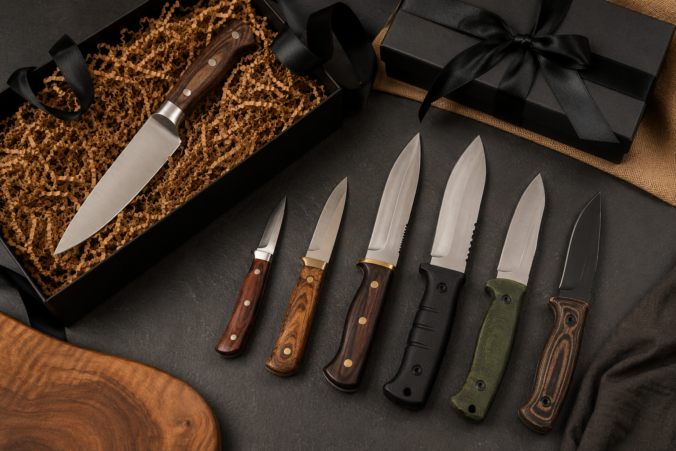
TL;DR: – Blade length determines task fit and legal carry: 3–3.5 inches for EDC, 4–6 inches for hunting, 6–8 inches for kitchen use
- Handle material governs grip, durability, and maintenance: G10 and Micarta excel outdoors; wood and bone score highest for gift aesthetics but require care
- Match recipient type to blade + handle pairing: hunters need fixed blades with Micarta; home cooks prefer pakkawood handles; EDC users want lightweight G10 folders
Why Blade Length and Handle Material Matter Most When Gifting a Knife
You’re standing in front of a knife display, and the options feel endless. Should you buy that beautiful Damascus blade with bone scales? The tactical folder with the aggressive G10 handle? Here’s the reality: a gorgeous knife that doesn’t fit your recipient’s hand or isn’t legal to carry becomes a shelf ornament, not a gift they’ll actually use.
Blade length and handle material are the two decisions that determine whether your gift gets carried daily or tucked away in a drawer. Blade length dictates what tasks the knife can handle and whether it’s legal to carry in your recipient’s state or city. According to knife experts, a 2.75 to 3.25 inch blade covers roughly 90 percent of daily tasks, from opening packages to slicing food, without becoming bulky in a pocket.
Handle material affects comfort during use, how long the knife lasts, and how much maintenance it requires. A wood handle looks premium but needs periodic oiling. G10 feels tactical and grips well when wet but can feel abrasive. Micarta improves with age and handles moisture beautifully. The wrong pairing – say, a high-maintenance wood handle for someone who won’t oil it, or a 5-inch fixed blade for someone who needs a pocket knife – means your gift disappoints.
Key Takeaway: Blade length and handle material are the two non-negotiable factors that determine gift success. A $40 folding knife with the right specs beats a $120 decorative knife the recipient never carries.
What Blade Length Should You Choose for a Knife Gift?
Blade length isn’t arbitrary – it’s the primary factor that determines what a knife can actually do and whether it’s legal to own and carry. Think of it like shoe sizing: a beautiful pair that doesn’t fit is useless.
Research shows that a blade length of 3 inches strikes a good balance between functionality and portability, making it the sweet spot for everyday carry. But the right length depends entirely on what your recipient will use the knife for.
Here’s how to think about it:
Under 3 inches: Pocket clips, key-chain knives, and ultra-compact folders. These are perfect for someone who prioritizes portability over cutting power – think office workers or minimalists. Legal in virtually all US jurisdictions.
3–3.5 inches: The EDC (everyday carry) goldilocks zone. A 2.75 to 3.5 inch drop point blade in a steel like S30V, D2, or 154CM, paired with a liner lock or frame lock and a Micarta or G10 handle, covers most everyday carry, work, and outdoor needs without overspending. Legal in most states for concealed carry.
4–6 inches: Hunting, camping, and field work. A fixed blade between 4 and 6 inches handles the majority of hunting tasks – from skinning to camp cooking – without the weight and bulk of a larger blade. This is where fixed blades dominate. Legal in most states but check local ordinances.
6–8 inches: Kitchen chef knives. A well-balanced chef’s knife can handle 90% of kitchen work efficiently, and blade length: 18–20 cm is ideal for most users. These are folding or fixed kitchen tools, not carry knives.
10+ inches: Cleavers, specialty blades, and collector pieces. Not practical for most recipients unless they’re serious cooks or collectors.
Blade Length by Recipient Type
| Recipient | Blade Length | Type | Why |
|---|---|---|---|
| EDC/Office Worker | 2.75–3.5″ | Folding | Pocket-friendly, legal everywhere, handles daily tasks |
| Hunter/Outdoorsman | 4–6″ | Fixed | Skinning, batoning, camp prep; legal in most states |
| Home Cook | 6–8″ | Chef/Kitchen | Handles 90% of kitchen work; aesthetic appeal |
| Hiker/Camper | 3–4″ | Folding | Lightweight, legal, versatile for camp tasks |
| Collector/Traditionalist | 4–6″ | Fixed | Display value, premium materials, heirloom potential |
Are There Legal Limits on Blade Length to Know Before You Buy?
This is critical: blade length laws vary dramatically by state and city. A knife legal in Texas might be illegal in New York City. Before you buy, verify your recipient’s location.
Most US states don’t set a specific maximum blade length for ordinary folding knives. However, many cities and counties restrict blades over 3 inches in public carry. Some municipalities go stricter – certain areas limit concealed carry to 2.5 inches or less.
Fixed blades face tighter restrictions than folding knives in many jurisdictions. Automatic and switchblade knives are illegal in some states entirely, so avoid those unless you’ve verified your recipient’s local law.
The safest approach: if you’re gifting a fixed blade over 4 inches or an automatic knife, ask your recipient about their state and city laws first. It takes 30 seconds and prevents a gift that creates legal liability.
Key Takeaway: Most US states allow folding knives under 3.5 inches without restriction. Fixed blades and automatics face stricter rules. Verify your recipient’s local law before purchasing anything over 4 inches.
Which Handle Material Is Right for Your Recipient?
Handle material is where your gift either feels premium or feels cheap – and where maintenance requirements can make or break the relationship between recipient and knife.
The handle of a knife has a considerable impact on its performance. The handle is the user’s contact with the blade, influencing control, comfort, and overall functionality. Let’s break down the six most common materials and who they’re actually right for.
Natural Handle Materials: Wood, Bone, and Stag
Wood handles photograph beautifully and feel warm in the hand. They’re the classic choice for traditional and collector knives. But here’s the catch: wood is porous and can absorb moisture and food particles, making it potentially less hygienic than other handle materials. Wood handles need to be oiled periodically to prevent cracking and should never be soaked in water or put in a dishwasher, which will warp or split the scales.
Wood is an excellent gift choice if your recipient is a traditionalist or collector who will care for the knife. It’s a poor choice if they’re low-maintenance or will use the knife hard in wet conditions.
Bone and stag handles add $30–$80 to the retail price versus G10 at equivalent steel grades. They’re decorative, traditional, and highly prized by collectors. But they’re fragile – bone can crack if dropped, and stag is porous. These are display knives, not working knives.
Stabilized wood (also called pakkawood) solves the maintenance problem. Stabilized hardwood handles are strengthened by resin and made to endure the elements. It looks like natural wood but resists moisture and warping. This is the sweet spot for kitchen knives under $100 – you get the aesthetic appeal without the fussy maintenance.
Synthetic Handle Materials: G10, Micarta, and Rubber
G10 is the tactical standard. G10 is a fiberglass-based laminate, stiffer and lighter than Micarta, with the same non-porous construction. It’s virtually maintenance-free, grips well in most conditions, and costs less than natural materials. The downside: it can feel abrasive on bare skin during extended use, and it’s purely utilitarian – not pretty.
G10 is ideal for EDC users, hunters, and anyone who prioritizes function over aesthetics. It’s a poor choice for collectors or traditionalists.
Micarta is the outdoor enthusiast’s favorite. Micarta is produced from layers of linen, canvas, or paper saturated in phenolic resin and compressed under heat. It becomes grippier when wet, develops a patina with use, and feels more refined than G10. It’s also maintenance-free.
Micarta is perfect for hunting, camping, and field work. It’s also excellent for gift appeal – it looks better than G10 but performs like a working tool.
Rubber and Kraton provide the best slip-resistance in wet or cold conditions but rank lowest for aesthetics. The best handles are typically made from ergonomically shaped plastics or rubberized materials, which reduce hand fatigue and help prevent slipping. These are appropriate for fishing, hunting in rain or cold, or professional use. They’re a poor choice for collector or display gifts.
Stainless steel handles look sleek and modern but have a critical flaw: metal handles can become extremely hot or cold when exposed to extreme temperatures, making them uncomfortable to hold. They’re also slippery when wet unless textured. Best for minimalist aesthetics; avoid for outdoor use.
Key Takeaway: G10 and Micarta are maintenance-free and ideal for working knives. Wood and bone look premium but require care. Pakkawood splits the difference for kitchen knives under $100. Match handle material to your recipient’s willingness to maintain the knife.
How to Match Blade Length and Handle Material to the Right Recipient
This is where most gift guides fail. They recommend “an 8-inch chef knife” without considering hand size, experience, or whether the recipient already owns knives. Here’s a framework that actually works.
Profile 1: The Hunter/Outdoorsman
What they need: A fixed blade that handles skinning, batoning, and camp cooking without excessive weight.
Blade + Handle: 4–5 inch fixed blade with Micarta or G10 handle.
Why: A fixed blade between 4 and 6 inches handles the majority of hunting tasks – from skinning to camp cooking – without the weight and bulk of a larger blade. Micarta improves with use and grips when wet. G10 is lighter and maintenance-free.
Budget: $60–$150. A quality fixed blade with full-tang construction and proven steel (D2, 154CM, or better) in this range is a working tool, not a display piece.
Profile 2: The Home Cook
What they need: A chef knife that handles 90% of kitchen tasks and looks good on the counter.
Blade + Handle: 6–8 inch chef blade with pakkawood or stabilized wood handle.
Why: A well-balanced chef’s knife can handle 90% of kitchen work efficiently. Pakkawood looks like natural wood but resists moisture and warping. It’s the dominant handle material in the $50–$150 kitchen knife segment because it balances aesthetics and durability.
Budget: $50–$150. This is the sweet spot for kitchen knives. Avoid high-carbon steel unless your recipient is experienced – it requires hand-drying and oiling. Stainless or stainless-clad blades are more forgiving.
Profile 3: The EDC Everyday Carry User
What they need: A lightweight folding knife that fits in a pocket and is legal to carry everywhere.
Blade + Handle: 3–3.5 inch compact utility pocket knife with G10 or aluminum handle.
Why: A 2.75 to 3.25 inch blade covers roughly 90 percent of daily tasks, from opening packages to slicing food, without becoming bulky in a pocket. G10 is lightweight, grips well, and is virtually maintenance-free. Aluminum is even lighter but less grippy.
Budget: $30–$120. A quality EDC folder with a proven lock (liner lock, frame lock, or axis lock) and mid-range steel (154CM, D2, or better) is a daily-use tool.
Profile 4: The Collector/Traditionalist
What they need: A knife with heirloom appeal – premium materials, traditional aesthetics, and display value.
Blade + Handle: 4–6 inch blade with bone, stag, or premium stabilized wood handle.
Why: Collectors value aesthetics and craftsmanship over pure function. Natural handles add $30–$80 to the price but signal quality and care. These knives are meant to be admired and preserved.
Budget: $100–$300+. Premium materials, hand-finishing, and limited production justify the higher price. Damascus blades add another $40–$120 for aesthetic value.
Key Takeaway: Match recipient type to blade length and handle material together. A hunter needs a 4–5 inch Micarta fixed blade; a home cook needs a 6–8 inch pakkawood chef knife; an EDC user needs a 3–3.5 inch G10 folder. The pairing matters more than the brand.
What Are the Most Common Knife Gifting Mistakes to Avoid?
Mistake 1: Buying decorative only. A knife with a stag handle and poor steel won’t get used. It will sit in a drawer because it’s too pretty to risk or too dull to cut effectively. Prioritize steel quality and functionality over aesthetics.
Mistake 2: Ignoring blade length laws. Some states restrict blades over 3.5 inches in public carry. Gifting a 5-inch fixed blade to someone in a restrictive jurisdiction creates legal liability. Verify your recipient’s local law first.
Mistake 3: Choosing handle material for looks only. Rubber grips are ugly but safest for outdoor use. Wood handles are beautiful but require oiling. If your recipient won’t maintain the knife, choose G10 or Micarta instead.
Mistake 4: Not considering maintenance requirements. High-carbon steel requires hand-drying after each use and periodic oiling to prevent rust; stainless steel requires significantly less maintenance. High-carbon knives are poor gifts for low-maintenance recipients.
Mistake 5: Gifting a fixed blade when recipient needs a folding knife (and vice versa). A fixed blade is useless if it doesn’t fit in a pocket. A folding knife is frustrating for camp cooking. Match the knife type to the use case.
Mistake 6: Assuming bigger is better. Lightweight folders in the 2 to 3 ounce range disappear in a pocket and suit anyone carrying a knife alongside a phone and wallet all day. A 6-ounce fixed blade is a burden for EDC.
Key Takeaway: A $40 folding knife with G10 handle and 3-inch blade beats a $120 decorative knife the recipient never carries. Prioritize function and maintenance fit over aesthetics.
Knife Gift FAQ
How much should you spend on a knife as a gift?
Direct Answer: Budget $40–$80 for a quality EDC folder, $60–$150 for a hunting fixed blade, and $50–$150 for a kitchen chef knife. Collector knives run $100–$300+.
The price reflects steel quality, handle materials, and construction. A $40 knife with proven steel and full-tang construction is a better gift than a $120 knife with poor steel and decorative handles. Don’t confuse price with quality.
What blade length is best for an everyday carry knife gift?
Direct Answer: 3–3.5 inches is the EDC sweet spot. A 2.75 to 3.25 inch blade covers roughly 90 percent of daily tasks, from opening packages to slicing food, without becoming bulky in a pocket.
Anything under 3 inches is too small for most tasks. Anything over 3.5 inches becomes noticeable in a pocket and may violate local carry laws. Stick with 3–3.5 inches for EDC.
Is a wood handle or G10 handle better for outdoor use?
Direct Answer: G10 is better for outdoor use. It’s moisture-resistant, maintenance-free, and grips well when wet. Wood requires periodic oiling and can warp in wet conditions.
If your recipient will use the knife in rain, snow, or wet environments, choose G10 or Micarta. If they’re willing to maintain a wood handle and want traditional aesthetics, wood is acceptable for dry conditions.
Are fixed blade knives or folding knives better gifts?
Direct Answer: It depends on the use case. Fixed blades are better for hunting and camping. Folding knives are better for EDC and pocket carry.
A fixed blade is useless if it doesn’t fit in a pocket. A folding knife is frustrating for camp cooking. Match the knife type to the recipient’s primary use case.
What handle material requires the least maintenance?
Direct Answer: G10 and Micarta require zero maintenance. Wood requires periodic oiling. Bone and stag require careful handling.
If your recipient is low-maintenance or won’t oil a knife regularly, choose G10 or Micarta. If they’re willing to care for the knife, wood and bone are acceptable.
Can you legally gift a knife with a blade over 4 inches?
Direct Answer: It depends on your recipient’s state and city. Most US states allow folding knives of any length, but many cities restrict blades over 3 inches in public carry. Fixed blades face stricter restrictions.
Before gifting a blade over 4 inches, ask your recipient about their local laws. It takes 30 seconds and prevents a gift that creates legal liability.
Which knife handle material looks most impressive as a gift?
Direct Answer: Bone and stag handles look most impressive, followed by premium stabilized wood. They signal quality and craftsmanship.
However, they also add $30–$80 to the price and require careful handling. If your recipient is a collector or traditionalist, bone or stag is worth the premium. If they’re a working user, G10 or Micarta is more practical.
Conclusion
Choosing a knife gift comes down to two decisions: blade length and handle material. Get those right, and you’ve given a tool your recipient will actually use. Get them wrong, and you’ve given a shelf ornament.
Start by asking yourself: What will my recipient actually use this knife for? Is it EDC, hunting, cooking, or collecting? Then match the blade length to the task and the handle material to their willingness to maintain it. A 3.5-inch G10 folder for an office worker. A 5-inch Micarta fixed blade for a hunter. A 7-inch pakkawood chef knife for a home cook.
When you’re ready to shop, Knife Depot carries over 10,000 knives across all these categories and price points. Whether you’re looking for a budget EDC folding knife, a premium hunting blade, or a collector’s piece, you’ll find options that match your recipient’s needs and your budget.
The best knife gift is the one that gets carried, used, and appreciated. Make it count.
Current alternatives at Knife Depot: Browse the current Knife Depot catalog. Check each product page for its exact configuration, current price, and availability.

Leave a Reply