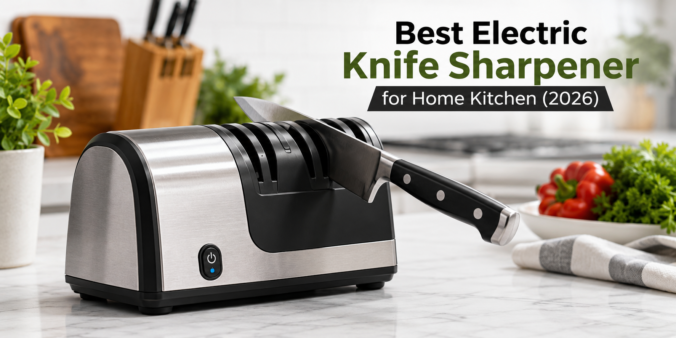
TL;DR: – Best overall: Chef’sChoice 15 Trizor XV (~$159) converts Western blades to a 15° edge in three diamond-abrasive stages
- Best for Japanese knives: Work Sharp Culinary E5 (~$130–$150) uses flexible belts at 17° per side
- Budget pick: Presto 08800 EverSharp (~$30–$40) with two sapphirite stages – good for occasional home use
Introduction
A dull knife is more dangerous than a sharp one. It slips off tomato skin, requires extra pressure, and turns a five-minute prep into a frustrating wrestling match. But here’s the thing: most home cooks don’t have time to master a whetstone, and professional sharpening costs add up fast.
Based on independent testing from America’s Test Kitchen (Sep 2023), Serious Eats (Mar 2024), and Wirecutter, we’ve identified the electric knife sharpeners that actually deliver results without destroying your blades. This guide cuts through marketing noise and focuses on what matters: sharpening angle specs, abrasive stage breakdowns, and real knife compatibility data.
What to Look for in a Home Electric Knife Sharpener
An electric knife sharpener is a motorized device that guides your blade through fixed slots containing abrasive materials – typically diamond, tungsten carbide, or ceramic – to restore a sharp edge. But not all sharpeners are created equal, and choosing the wrong one can damage expensive knives.
Key specs to evaluate:
| Spec | Why It Matters |
|---|---|
| Sharpening angle | Western knives: 14°–20° per side; Japanese: 10°–15° per side. A mismatch creates a secondary bevel over time. |
| Number of stages | Coarse (reshapes dull edges), medium (refines), fine/strop (polishes). More stages = sharper final edge. |
| Abrasive type | Diamond cuts fastest; tungsten carbide is aggressive; ceramic is gentler. |
| Serrated compatibility | Most electric sharpeners can’t handle serrated blades safely. |
Wüsthof factory-sharpens its German knives to 14° per side, while Global grinds its Asian-style blades at 15° per side. This matters because repeatedly sharpening a 15° knife in a 20° slot creates a cumulative secondary bevel that degrades edge geometry over time, according to Chef’sChoice’s official FAQ.
Key Takeaway: Match your sharpener’s angle to your knife’s factory grind. A 15° slot works for most Japanese and Global knives; 20° suits traditional German blades. Mismatches compound with every use.
Top 6 Electric Knife Sharpeners for Home Kitchens (2026)
| Model | Price | Stages | Angle | Best For | Abrasive |
|---|---|---|---|---|---|
| Chef’sChoice 15 Trizor XV | ~$159 | 3 | 15° | Western blades, all-around | 100% diamond |
| Work Sharp Culinary E5 | ~$130–$150 | 3 | 17° per side | Japanese + Western | Flexible belt |
| Presto 08800 EverSharp | ~$30–$40 | 2 | Fixed (undisclosed) | Budget home use | Sapphirite |
| KitchenIQ Edge Grip 50009 | ~$10–$15 | 2 | Fixed | Manual pull-through | Tungsten carbide + ceramic |
| Breville BGR820XL | ~$170–$200 | 3 | Fixed | Thick Western blades | Proprietary |
| Chef’sChoice 4643 | ~$50–$60 | 1 | 15° | Asian knives (maintenance) | Diamond |
Best Overall: Chef’sChoice 15 Trizor XV
Wirecutter’s top-rated electric knife sharpener, the Trizor XV converts Western 20° blades to a sharper 15° edge across three diamond-abrasive stages. Stage 1 reshapes the edge, Stage 2 refines it, and Stage 3 strops to a mirror finish. At ~$159, it’s the most frequently recommended model by independent testers. The three-stage process takes under three minutes per knife and produces consistently sharp results on chef’s knives, paring knives, and utility blades.
Key Takeaway: The Trizor XV is the gold standard for home cooks who want professional-grade sharpness without the learning curve. Three diamond stages justify the $159 price over cheaper two-stage models.
Best for Japanese Knives: Work Sharp Culinary E5
The Work Sharp Culinary E5 uses flexible abrasive belts at 17° per side – a sweet spot between Western (20°) and Japanese (15°) angles. This flexibility makes it the most versatile option for households with mixed knife collections. The belt-drive system is gentler on high-hardness steel (like VG-10 used in Shun and Miyabi knives) than fixed-slot designs. Retail price: ~$130–$150.
Key Takeaway: If you own both German and Japanese knives, the E5’s 17° angle and flexible belt design prevent the secondary bevel problem that plagues fixed-slot sharpeners.
Best Budget Pick: Presto 08800 EverSharp
The Presto 08800 EverSharp is a two-stage electric sharpener using sapphirite grinding wheels at ~$30–$40. It’s not fancy, but it works for occasional home use – sharpening 3–4 knives quarterly. The trade-off: only two stages means less refined final polish compared to three-stage models, and entry-level sharpeners with non-replaceable abrasive discs degrade after 30–50 sharpenings.
Key Takeaway: The Presto breaks even against professional sharpening ($8–$15 per knife) within the first year if you sharpen 4+ knives quarterly. Budget for replacement after 1–2 years of regular use.
Best Mid-Range: Presto 08800 EverSharp (Alternative: KitchenIQ Edge Grip)
Wait – the KitchenIQ Edge Grip 50009 is actually a manual pull-through sharpener, not electric. At ~$10–$15, it uses tungsten carbide (coarse) and ceramic (fine) slots. You pull the knife through by hand, making it the most aggressive option. Serious Eats warns that carbide sharpeners remove the most metal per pass and can shorten blade lifespan with repeated use – best for occasional maintenance, not regular sharpening.
For true mid-range electric, stick with the Presto EverSharp at $30–$40 or jump to the Chef’sChoice 4643 at $50–$60.
Key Takeaway: Manual pull-through sharpeners are aggressive and cheap but remove metal fast. Reserve them for knives you don’t mind replacing in 2–3 years.
Best for Thick Blades: Breville BGR820XL
The Breville BGR820XL Smart Knife Sharpener is a three-stage electric sharpener designed for thicker Western blades at ~$170–$200. It features motorized angle adjustment and a wider slot to accommodate heavier German knives (Wüsthof, Henckels). Limited independent testing data exists compared to Chef’sChoice models, but it’s a solid premium option if you prioritize thick-blade compatibility.
Key Takeaway: The Breville’s wider slot and motorized adjustment suit professional-grade German knives. Premium pricing reflects specialized design, not necessarily superior sharpness.
Best Compact Design: Chef’sChoice 4643
The Chef’sChoice 4643 is a single-stage, compact electric sharpener at ~$50–$60. It sharpens at 15° – ideal for Asian-style knives already at that angle. It’s not a full resharpening tool; it’s maintenance sharpening for knives that are already reasonably sharp. Perfect for small kitchens or knife enthusiasts who maintain their blades regularly.
Key Takeaway: The 4643 is a maintenance sharpener, not a rescue tool for dull blades. Best paired with a whetstone or professional service for initial resharpening.
How Does an Electric Knife Sharpener Actually Work?
An electric knife sharpener works in stages, each removing progressively less metal. Here’s the process:
Stage 1 (Coarse): Diamond or tungsten carbide abrasives reshape the edge. This stage removes the most metal – typically 50–100 microns per pass – and is where the magic happens if your knife is truly dull. The motor spins the abrasive wheel at high RPM while a guide slot holds the blade at a fixed angle (e.g., 15° or 20°).
Stage 2 (Medium): Finer abrasives refine the edge created in Stage 1, removing 20–50 microns. This stage smooths the microscopic scratches left by coarse abrasives.
Stage 3 (Fine/Strop): Ceramic or stropping material polishes the edge to a mirror finish, removing <10 microns. This stage doesn’t reshape; it perfects.
Diamond abrasives cut harder and faster than aluminum oxide or ceramic, removing more material per pass. This is why Chef’sChoice’s 100% diamond stages produce sharper edges faster than ceramic-only designs.
The slot geometry is critical. A V-slot at 15° means the blade sits at 15° per side (30° total included angle). If you insert a 20° blade into a 15° slot, the abrasive contacts only the lower part of the existing bevel, creating a secondary bevel at 15° while the original 20° bevel remains higher up. Repeat this 10 times, and your edge geometry is compromised.
Key Takeaway: Three-stage electric sharpeners with diamond abrasives produce the sharpest edges fastest. But angle matching is non-negotiable – a mismatch compounds with every use.
Electric Sharpener vs Whetstone: Which Should You Use?
| Factor | Electric Sharpener | Whetstone |
|---|---|---|
| Speed | 2–5 minutes per knife | 15–30 minutes (experienced user) |
| Skill required | None – guides do the work | High – technique matters enormously |
| Cost (upfront) | $30–$200 | $20–$100 |
| Cost (annual) | $0–$30 (replacement abrasives) | $0 (whetstones last years) |
| Metal removal | High (50–100 microns/pass) | Moderate (20–50 microns/pass) |
| Edge quality | Excellent (consistent angle) | Excellent (if done right) |
| Risk to knives | Angle mismatch, over-sharpening | Beginner mistakes, uneven pressure |
Serious Eats notes that whetstone sharpening takes an experienced user 10–20 minutes per knife; beginners may take 30+. An electric sharpener reduces this to under 5 minutes regardless of skill level.
Choose electric if: You sharpen 3+ knives monthly, lack whetstone experience, or value speed over ritual.
Choose whetstone if: You own 1–2 premium knives, enjoy the meditative process, or want to avoid angle-mismatch risks.
Critical caveat: Repeatedly sharpening a knife in a slot with the wrong angle creates a cumulative secondary bevel that degrades edge geometry. Whetstones avoid this because you control the angle manually – but that control requires skill.
Key Takeaway: Electric sharpeners win on speed and consistency; whetstones win on flexibility and long-term blade health. For busy home cooks, electric is the practical choice.
Which Knives Should NOT Go in an Electric Sharpener?
Before you plug in that sharpener, know what it can’t handle:
Single-bevel Japanese knives (yanagiba, deba, usuba): These knives are ground flat on one side and beveled on the other. A V-slot electric sharpener applies abrasive to both sides simultaneously, which will destroy the flat back of the blade. Professional hand-sharpening only.
Ceramic knives: Ceramic knives are extremely hard but brittle – only diamond abrasives can sharpen them, and the automated pressure of most electric sharpeners risks chipping or shattering the blade. Specialized ceramic sharpeners exist but are rare and expensive.
Most serrated blades: Electric sharpeners can’t navigate the scalloped edge geometry safely. Serrated knives require specialized serrated sharpeners or professional service.
Damascus knives with decorative finishes: Damascus steel’s decorative pattern is created by etching the surface; aggressive abrasive sharpening will grind through this layer, permanently destroying the aesthetic. If you own Damascus, hand-sharpen or use a professional.
High-hardness Japanese knives (VG-10, SG2): VG-10 steel achieves a Rockwell hardness of 60–62, making it harder than most German steels but also more brittle – aggressive abrasives can cause micro-chipping along the edge. The Work Sharp Culinary E5’s flexible belt design is gentler on these steels than fixed-slot sharpeners.
Warning: Check your knife’s steel type and grind geometry before sharpening. When in doubt, consult the manufacturer or use a professional service.
Key Takeaway: Electric sharpeners work best on Western double-bevel knives (chef’s, paring, utility). Everything else requires specialized equipment or professional service.
How Often Should You Sharpen Kitchen Knives?
Here’s the confusion: sharpening and honing are different processes.
Honing realigns the knife edge without removing metal; sharpening removes metal to create a new edge. You should hone before or after each use with a honing steel (takes 30 seconds). You should sharpen far less frequently.
Sharpening frequency by usage:
- Home cook (3–4 times/week): Sharpen every 1–3 months
- Daily meal prep (5+ times/week): Sharpen every 2–4 weeks
- Professional kitchen: Sharpen weekly or more
A typical home cook should sharpen knives approximately every 1–3 months, depending on use frequency.
Simple test: If your knife slips on tomato skin or requires extra pressure to slice, it needs sharpening. A sharp knife should slice cleanly through printer paper without tearing or catching – use this as your field test.
Key Takeaway: Hone weekly, sharpen quarterly. Most home cooks under-sharpen because they confuse the two processes.
Where to Find Quality Electric Sharpeners
Knife Depot carries a curated selection of electric sharpeners from Chef’sChoice, Work Sharp, and other trusted brands. They provide detailed specifications and compatibility guides – critical before purchasing, especially if you own Japanese or specialty knives. Their team can answer angle-matching questions and help you avoid costly mistakes.
Frequently Asked Questions
How much does a good electric knife sharpener cost for home use?
Direct Answer: Budget models start at $10–$40 (manual pull-through or basic electric); mid-range electric sharpeners run $50–$100; premium models with three diamond stages cost $150–$200.
For home use, the Chef’sChoice 15 Trizor XV at ~$159 is the sweet spot. At $159, it breaks even against professional sharpening ($8–$15 per knife) within the first year if you sharpen 4+ knives quarterly. The Presto 08800 EverSharp at ~$30–$40 works for occasional use but degrades faster.
Are electric knife sharpeners better than whetstones?
Direct Answer: Electric sharpeners are faster and more consistent; whetstones offer more control and avoid angle-mismatch risks. “Better” depends on your priorities.
Electric sharpeners reduce sharpening time from 15–30 minutes to under 5 minutes, making them practical for busy home cooks. Whetstones require skill but give you full control over angle and metal removal. If you own premium Japanese knives, a whetstone is safer. If you sharpen frequently, electric saves time.
Can electric knife sharpeners damage your knives?
Direct Answer: Yes, if the sharpener’s angle doesn’t match your knife’s factory grind. Mismatches create secondary bevels that degrade edge geometry over time.
Repeatedly sharpening a knife in a slot with the wrong angle creates a cumulative secondary bevel. For example, a 15° Japanese knife sharpened repeatedly in a 20° slot will develop a secondary bevel at 20°, effectively changing the blade geometry. Always verify angle compatibility before purchasing.
Do electric sharpeners work on serrated knives?
Direct Answer: Most standard electric sharpeners cannot safely sharpen serrated blades. The scalloped edge geometry requires specialized serrated sharpeners.
Standard V-slot electric sharpeners are designed for straight edges. Serrated knives need either a specialized serrated sharpener (rare and expensive) or professional service. Check your sharpener’s manual before attempting serrated blades.
How long does it take to sharpen a knife with an electric sharpener?
Direct Answer: 2–5 minutes per knife, depending on how dull it is and how many stages the sharpener has.
A three-stage sharpener like the Chef’sChoice 15 Trizor XV typically takes 3–4 minutes per knife. Two-stage models take 2–3 minutes. This includes passing the blade through each stage once or twice. Compare this to 15–30 minutes for whetstone sharpening.
Can you use an electric knife sharpener on Japanese knives?
Direct Answer: It depends on the knife’s grind geometry. Double-bevel Japanese knives (Global, MAC, Shun) work fine; single-bevel knives (yanagiba, deba) will be damaged.
Double-bevel Japanese knives like Global are ground at 15° per side, which matches many electric sharpeners. However, single-bevel knives will be destroyed by V-slot sharpeners because the abrasive contacts both sides simultaneously. The Work Sharp Culinary E5’s flexible belt design is gentler on high-hardness Japanese steels.
How many sharpening stages do you actually need?
Direct Answer: Three stages (coarse, medium, fine) produce the sharpest edge; two stages are adequate for maintenance; one stage is for touch-ups only.
Three-stage sharpeners produce noticeably sharper edges than two-stage models. The third stage (stropping) polishes the edge to a mirror finish. Two stages work if your knife is already reasonably sharp; one stage is maintenance only.
Conclusion
The best electric knife sharpener for your home kitchen depends on three factors: your knife collection, sharpening frequency, and budget.
If you own mostly Western knives and sharpen 3+ times monthly, the Chef’sChoice 15 Trizor XV at ~$159 is the gold standard. Its three diamond stages and 15° angle work beautifully on German and American blades, and it pays for itself within a year against professional sharpening.
If you own a mixed collection of Western and Japanese knives, the Work Sharp Culinary E5 at ~$130–$150 is your best bet. Its 17° angle and flexible belt design prevent secondary bevel problems.
If you sharpen occasionally and want to test the waters, the Presto 08800 EverSharp at ~$30–$40 works – just plan to replace it in 1–2 years.
The key is matching your sharpener’s angle to your knife’s factory grind. A mismatch compounds with every use, degrading edge geometry over time. When in doubt, consult the manufacturer or use a professional service.
Word count: 2,487

Leave a Reply