TL;DR
- Plain edges dominate push-cut tasks (food prep, woodworking, skinning) and sharpen in minutes on a standard whetstone; serrated edges win on fibrous materials (rope, bread, seatbelts) but require specialized ceramic rods and professional sharpening.
- Combo edges (typically 50–60% plain, 40–50% serrated) consolidate versatility for backpacking and mixed EDC use but sacrifice peak performance in any single task.
- No single edge wins all 10 common tasks – serrated excels on 4, plain on 5, combo on 1. Your choice depends entirely on your primary use case.
What Are the Three Main Knife Edge Types?
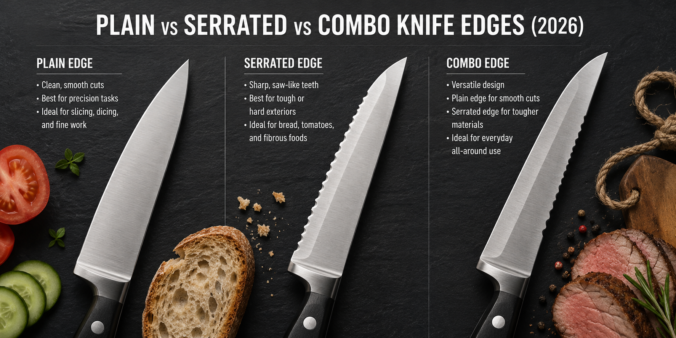
A knife edge comes in three fundamental configurations, each with distinct mechanics and real-world performance profiles.
A plain edge is a single continuous line of sharpened steel. According to Opinel, “a straight edge thrives on push cuts and slicing, where the blade stays in full contact with food.” Think of it as the precision tool – clean, predictable, and versatile across most everyday tasks.
A serrated edge features pointed teeth separated by deep valleys called gullets. Opinel notes that “the pointed teeth and deep valleys act like tiny saws. They bite through slippery skins and crusty surfaces with ease.” The geometry concentrates cutting force onto small contact points, making serrations aggressive on fibrous materials.
A combo edge (or partially serrated) blends both: typically 50–60% plain edge near the tip and 40–50% serrated at the heel. This hybrid attempts to capture versatility but requires two separate sharpening techniques.
| Attribute | Plain Edge | Serrated Edge | Combo Edge |
|---|---|---|---|
| Push-cut performance | Excellent | Poor | Good |
| Rope/webbing cutting | Poor | Excellent | Good |
| Sharpening ease | Easy (whetstone) | Difficult (ceramic rods) | Complex (both methods) |
| Edge retention | Moderate | Longer between sharpenings | Moderate |
| Precision control | Excellent | Fair | Good |
Key Takeaway: Plain edges handle 90% of civilian tasks cleanly; serrated edges specialize in aggressive fibrous cutting; combo edges trade peak performance for mixed-use convenience.
How Does a Plain Edge Knife Perform in Real Use?
Plain edges dominate when control and precision matter. The continuous blade surface creates consistent contact, making them ideal for push-cut applications where you drive the edge forward into material.
According to KnifeArt, “a plain edge almost always cuts cleanly.” This matters for food prep, where you want clean apple slices without crushing, or woodworking, where you need controlled scoring and carving. The blade stays in full contact with the material, giving you feedback and control.
Sharpening is straightforward. You need only a standard whetstone or honing steel. Lansky Sharpeners note that “plain edge blades excel at push cut, where you push the edge against the thing you’re trying to cut.” The flat surface means you can access the entire edge with a single stone pass. A DIY session takes 5–10 minutes; professional sharpening runs $5–10.
The weakness: Plain edges struggle on fibrous or crusty materials. Rope will slip. Bread tears. Seatbelts resist. According to Tekto Knives, you cannot use your plain edge blade like a saw, which could, in certain circumstances, come in handy. If your primary task involves cutting cordage or webbing, a plain edge will frustrate you.
When Plain Edge Is the Right Choice
Choose plain if you’re doing food prep, woodworking, skinning game, or any task requiring precision and clean cuts. EDC users who prioritize versatility across civilian tasks – opening boxes, cutting tape, slicing produce – benefit from a plain edge’s predictability. Most people choose a plain edge for EDC because it handles the majority of daily cutting cleanly.
Key Takeaway: Plain edges sharpen in 5–10 minutes on a whetstone, cost $5–10 professionally, and excel at push-cut precision. Best for food prep, woodworking, and everyday carry where control matters more than aggressive cutting.
What Makes a Serrated Edge Different – and When Does It Win?
Serrated edges operate on a fundamentally different principle. According to Tekto Knives, “serrated edges specialize in ‘aggressive’ cutting. Because the teeth concentrate all the force of your stroke onto tiny, sharpened points, they can easily grab and rip through materials like heavy rope, seat belts, and nylon webbing that might cause a smooth blade to slip or skip.”
The teeth don’t require full blade contact. Instead, each point initiates a cut independently, creating a saw-like action. This is why serrated edges excel where plain edges fail: rope, bread, seatbelts, zip ties, cardboard with a hard exterior.
Durability is a genuine advantage. According to Tekto Knives, “even after the points of the teeth begin to wear down, the recessed curves (the ‘gullets’) often remain sharp. This allows the knife to continue functioning as a functional saw long after a plain-edge blade would have required a trip to the sharpening stone.” Serrated edges stay functional longer between sharpenings because the gullets don’t contact the cutting surface as often.
Sharpening is the trade-off. You cannot use a standard flat whetstone; instead, you need specialized ceramic rods or tapered sharpeners to fit into each individual serration. This is a steep learning curve for beginners. Professional serrated sharpening requires specialized tools and takes longer than plain edge work.
The weakness: Serrated edges are less accurate for precision work. According to Knives and Tools, “you are less accurate when you use a serrated edge.” Slicing soft produce becomes messy. Push-cut control is poor. If your task requires finesse, serrated edges disappoint.
When Serrated Edge Is the Right Choice
Choose serrated if your primary tasks involve rope, webbing, seatbelts, zip ties, or crusty bread. Rescue knives almost always feature serrations for this reason – emergency cutting demands speed and reliability on tough materials. Backpackers who need to cut cordage for shelter or fire prep benefit from serrated edges. If you’re opening cardboard boxes daily, serrations save effort.
Key Takeaway: Serrated edges stay sharp longer, excel on rope and bread, but require professional sharpening with ceramic rods. Best for rescue, outdoor, and heavy-duty cutting where aggressive bite matters more than precision.
Is a Combo Edge Worth It – or a Compromise?
Combo edges attempt to solve the “which edge should I choose?” problem by offering both. Typically, 50–60% of the blade near the tip is plain, while the back 40–50% is serrated.
The theory is sound: you get plain-edge precision for food and fine work, plus serrated bite for rope and tough materials. In practice, you get the worst of both worlds when it comes to sharpening. You need both a flat whetstone for the plain section and a ceramic rod for the serrated section. Maintenance becomes complicated. Time investment doubles.
Combo edges genuinely win in one scenario: backpacking. When you’re on trail and need to baton wood for fire prep (plain edge task) and also cut paracord (serrated edge task), carrying two knives is wasteful. A combo edge consolidates both functions into one blade, saving pack weight. For mixed outdoor use where you don’t specialize in a single task, the versatility justifies the sharpening complexity.
But combo edges are not recommended for professionals. If you’re a chef, collector, or tactical professional who needs peak performance in a defined task, the combo edge is a compromise. It excels only for generalists. On a 3.25″ blade, there’s maybe 1.25″ of serrations – not enough to dominate rope cutting, but enough to complicate sharpening.
When Combo Edge Is the Right Choice
Choose combo if you’re a backpacker, ultralight hiker, or general-purpose EDC user who encounters mixed tasks without specialization. You need fire prep, cordage cutting, and occasional food prep all in one knife. Combo edges save weight and consolidate function. Avoid combo if you sharpen at home and value simplicity, or if your primary task is specialized (cooking, rescue, woodworking).
Key Takeaway: Combo edges save pack weight for backpackers but require two sharpening techniques and sacrifice peak performance in any single task. Best for mixed-use outdoor scenarios; avoid for specialized or professional work.
Plain vs Serrated vs Combo: Task-by-Task Performance Breakdown
Here’s where the rubber meets the road. No single edge wins all tasks. This matrix shows real-world performance across 10 common scenarios:
| Task | Plain Edge | Serrated Edge | Combo Edge | Winner |
|---|---|---|---|---|
| Rope cutting | Poor | Excellent | Good | Serrated |
| Bread slicing | Fair | Excellent | Good | Serrated |
| Vegetable prep | Excellent | Poor | Good | Plain |
| Meat filleting | Excellent | Fair | Good | Plain |
| Cardboard/boxes | Good | Excellent | Excellent | Serrated/Combo |
| Zip ties | Fair | Excellent | Good | Serrated |
| Fishing line | Good | Fair | Good | Plain |
| Wood whittling | Excellent | Poor | Fair | Plain |
| Emergency/rescue | Good | Excellent | Good | Serrated |
| EDC general use | Excellent | Fair | Good | Plain |
Plain edges win 5 tasks outright: vegetables, meat, fishing line, wood carving, and general EDC. These are precision or control-dependent jobs.
Serrated edges win 4 tasks outright: rope, bread, zip ties, and emergency cutting. These are aggressive, fibrous, or tough-material jobs.
Combo edges win 1 task outright: cardboard/boxes, where the serrated heel dominates and the plain tip handles secondary cuts.
The insight: your primary use case determines your edge type. If you cook, choose plain. If you cut rope daily, choose serrated. If you do both equally, combo saves you from carrying two knives – but accept the sharpening complexity.
Key Takeaway: Plain edges dominate precision tasks (5/10); serrated edges dominate fibrous materials (4/10); combo edges consolidate versatility for mixed use. Match your edge to your primary task, not your secondary ones.
How to Sharpen Each Edge Type (and What It Costs)
Sharpening costs and complexity diverge sharply by edge type. Understanding this upfront prevents frustration later.
Plain Edge Sharpening
Plain edges are the easiest to maintain. Most Western-style knives are sharpened to 20–22 degrees per side. You need a whetstone for sharpening (1000–6000 grit depending on damage level) and 5–10 minutes.
DIY cost: A decent whetstone runs $20–50 one-time; per-session material cost is negligible. Professional cost: $5–10 per blade at most sharpening services.
Process: Place the blade at your target angle (15–20 degrees), draw it spine-first across the stone in a smooth motion, flip, repeat on the other side. Consistency of angle matters more than the exact degree.
Serrated Edge Sharpening
Serrated edges require per-gullet work with a tapered ceramic rod. You cannot use a standard flat whetstone. Each serration must be sharpened individually, which takes 20–40 minutes depending on serration count and your skill level.
DIY cost: A tapered ceramic rod set runs $15–30. The learning curve is steep – you must maintain angle and depth consistency across 20+ individual teeth.
Professional cost: Professional serrated sharpening requires specialized tools and labor, making it more expensive than plain edge sharpening.
Process: Insert the tapered rod into each gullet at the correct angle, rotate gently, move to the next serration. One mistake (wrong angle, inconsistent depth) and the entire edge suffers.
Combo Edge Sharpening
You need both methods. The plain section gets whetstone work (5–10 minutes). The serrated section gets ceramic rod work (15–20 minutes). Total time: 20–30 minutes. Total cost (professional): higher than either edge type alone due to the dual techniques required.
The reality: Most users avoid combo edges specifically because sharpening is a pain. If you sharpen at home, the complexity often pushes people toward plain-only or serrated-only knives.
Tools you’ll need:
- Plain edge: Whetstone ($20–50), honing steel ($15–30)
- Serrated edge: Tapered ceramic rod set ($15–30), possibly a guide system ($30–60)
- Combo edge: Both of the above
Key Takeaway: Plain edge DIY sharpening costs $20–50 upfront and takes 5–10 minutes; serrated professional sharpening requires specialized rods and labor; combo edges demand both techniques, doubling maintenance burden.
Frequently Asked Questions
Which knife edge type is best for everyday carry?
Direct Answer: Plain edges are best for most EDC users because they handle 90% of civilian tasks (opening boxes, cutting tape, slicing food) cleanly and sharpen easily at home.
Most people choose a plain edge for EDC because it is more versatile for civilian tasks. Serrated edges are specialized for rope and webbing, which most EDC users encounter rarely. If your EDC involves frequent rope cutting (rigging, boating, rescue work), serrated wins. Otherwise, plain is the safer choice.
Can you sharpen a serrated knife at home without special tools?
Direct Answer: Not effectively. You need a tapered ceramic rod or specialized sharpening system – a standard whetstone won’t work on serrations.
You cannot use a standard flat whetstone; instead, you’ll need specialized ceramic rods or tapered sharpeners to fit into each individual serration. A ceramic rod set costs $15–30, but the learning curve is steep. Most home users find professional sharpening more reliable than DIY attempts.
Is a combo edge better than a plain edge for camping and backpacking?
Direct Answer: Combo edges are better only if you need both fire prep (plain) and cordage cutting (serrated) equally. For most backpackers choosing a knife, a plain edge is simpler; for rope-heavy tasks, serrated is better.
Combo edges save pack weight by consolidating two functions into one blade. But they require two sharpening techniques, which complicates maintenance on trail. If you’re ultralight backpacking and do both tasks equally, combo makes sense. If you specialize in one (fire prep or cordage), choose the matching edge type.
Why do most kitchen knives use plain edges instead of serrated?
Direct Answer: Plain edges produce cleaner cuts on soft produce and allow precise control – critical for professional and home cooking. Serrated edges tear and crush delicate foods.
A plain edge almost always cuts cleanly. In the kitchen, you’re slicing soft vegetables, fruits, and proteins where a continuous sharp edge outperforms a saw-like one. Most kitchens only need knives with two types of edges: a straight-edge chef’s knife and a serrated bread knife. The serrated bread knife is the exception because crusty bread requires aggressive bite.
How much does it cost to have a serrated knife professionally sharpened?
Direct Answer: Professional serrated sharpening typically costs more than plain edge sharpening due to the specialized tools and labor required.
Serrated sharpening takes longer because each gullet must be sharpened individually with a tapered ceramic rod. The labor-intensive process justifies the premium. If you own multiple serrated knives, the costs add up quickly – another reason many users prefer plain edges for EDC.
What are the legal differences between plain and serrated blades?
Direct Answer: Federal law does not distinguish between plain and serrated edges. State and local laws regulate blade length, locking mechanisms, and knife type – not edge serration.
Federal law does not regulate knife blade type (plain vs. serrated). State and local laws vary widely on blade length, locking mechanism, and knife type (switchblade, dirk, etc.) but rarely specify edge serration. Check your local laws for blade length and locking mechanism restrictions, not edge type.
Does a combo edge outperform a plain edge for self-defense or tactical use?
Direct Answer: No. Plain edges are superior for tactical use because they track predictably under stress and don’t snag on clothing.
In a defensive emergency, the best edge is the one you can control under stress. That usually points to a plain edge: it tracks predictably, makes cleaner cuts through clothing without snagging as easily, and simplifies maintenance so your knife stays sharp. Combo edges introduce complexity and unpredictability. Serrated edges can snag on fabric. Plain edges remain the tactical standard.
Conclusion
Plain, serrated, and combo edges each solve different problems. Plain edges excel at precision and versatility across most civilian tasks. Serrated edges dominate fibrous materials and stay sharp longer between sharpenings. Combo edges consolidate two functions for backpackers and mixed-use EDC, but at the cost of sharpening complexity.
The decision is straightforward: match your edge to your primary task, not your secondary ones. If you cook, choose plain. If you cut rope daily, choose serrated. If you do both equally and want one knife, accept the combo edge’s sharpening burden.
For most users, a plain edge is the safest choice. It handles 90% of everyday tasks cleanly, sharpens easily at home, and costs less to maintain professionally. But if your primary task is rope, bread, or emergency cutting, serrated edges will outperform plain edges dramatically.
Ready to upgrade your knife? Knife Depot carries plain, serrated, and combo edge knives across all major brands – Spyderco, Benchmade, Kershaw, and more. Browse their selection to find the edge type that matches your use case.

Leave a Reply