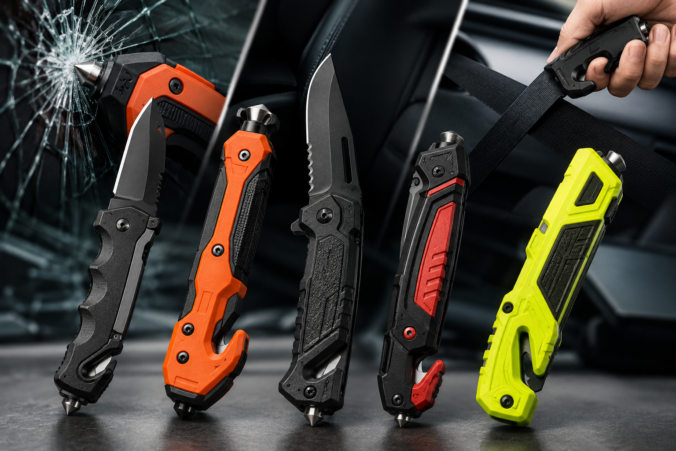
A rescue knife combines an everyday cutting blade with features such as a separate belt cutter and a glass breaker. The exact model matters: a familiar product name does not establish which emergency features it includes.
This guide compares the exact rescue knives and tools linked below, with details on their cutting edges, separate cutters and glass breakers. It is based on product specifications and published sources, not hands-on emergency testing by Knife Depot.
Shop rescue knives available at Knife Depot
Looking for a rescue knife you can order now? These exact models had available stock when checked on September 17, 2026. Follow each link for current pricing, availability and complete specifications.
- Smith & Wesson First Response SWFRSCP: A 3.3-inch partially serrated drop-point blade with a separate seatbelt cutter and glass breaker.
- Smith & Wesson First Response SWFR: The plain-edge option, with a separate strap cutter and glass breaker.
- Smith & Wesson First Response SWFR2S: A partially serrated tanto blade, rubber-coated aluminum handle, integrated seatbelt cutter and glass breaker.
- Kershaw Funxion EMT 8100: An assisted-opening rescue folder with a 3-inch partially serrated blade, separate cord cutter and carbide glass breaker.
- SOG Escape FF25-CP: A partially serrated blade, aluminum handle, separate line/seatbelt cutter and glass breaker. This is the Escape FF25-CP, a different model from the Escape FL.
Prefer a compact dedicated rescue tool? The SOG Rapid Rescue SOG-26-30-04-43 in black/red combines a seatbelt cutter and glass breaker in a keychain/lanyard tool. It is a separate option from the folding knives above.
Smith & Wesson First Response SWFRSCP: partially serrated option

The SWFRSCP has a 3.3-inch partially serrated blade, a liner lock, a separate belt cutter and a glass breaker. The handle combines stainless steel with G10 inserts. The serrations distinguish this version from the plain-edge SWFR; check the model number before ordering.
This is a practical comparison point if you want one pocket tool for ordinary cutting and a separate strap-cutting feature. The main blade still has an exposed point, so its rescue features do not make it harmless around a person or turn it into medical shears.
Smith & Wesson First Response SWFR: plain-edge option

The SWFR retains the belt cutter and glass breaker while using a plain cutting edge. Choose between these two First Response models according to the edge you prefer for everyday work; do not assume a photo or review of one describes the other.
Both are manually opened folders. Neither should be described as spring-assisted or automatic on the strength of the First Response name alone.
SOG Escape FF25-CP: aluminum handle and lockback

The SOG Escape FF25-CP combines a 3.4-inch blade, an aluminum handle and a lockback. SOG’s published catalog specifies 9Cr18MoV steel, a separate line/belt cutter and a carbide glass breaker. It also lists a wire stripper and a spare cutter blade stored under the handle slab. This is the Escape FF25-CP, a different model from the Escape FL. Source: SOG product catalog (Escape, pages 24–25).
Compare its handle shape, size and pocket access with the First Response models. A feature list alone cannot tell you which tool is easiest for you to reach and operate.
Glass type matters more than a “glass breaker” label
A glass breaker is not a universal vehicle-exit tool. In AAA’s testing, four of six escape tools broke tempered side glass, while none penetrated laminated glass. Some side windows are laminated, too. Check your vehicle’s window markings or manufacturer information instead of assuming that every side or rear window can be broken with a punch. Source: AAA vehicle escape-tool testing.
Those results do not certify the three knives in this guide. Follow the tool and vehicle manufacturers’ instructions and keep the tool secured where it can be reached. No performance guarantee is implied by a carbide tip, a product name or a photograph.
How to compare a rescue knife
- Separate cutter: Identify the hook or recessed cutter in the exact product’s specifications. A serrated main blade is not the same feature.
- Opening and lock: Decide whether you can comfortably operate the actual mechanism. Manual, assisted and automatic openings are different.
- Access and retention: Consider how the clip or storage position works with your clothing and normal seated position. A loose tool can be difficult to find.
- Edge choice: A combination edge provides different cutting sections; a plain edge offers one continuous cutting surface. Neither replaces the separate belt cutter.
- Maintenance: Follow the maker’s cleaning, sharpening and inspection instructions. Check that moving parts and the separate cutter remain serviceable.
What about the Benchmade Tactical Triage 917SBK?
The Tactical Triage 917SBK remains a useful comparison model, but Knife Depot’s listing was not available to purchase at this check. Its main blade is S30V and it uses a manual AXIS lock; it is not a SpeedSafe-assisted knife. The separate hook and carbide glass breaker should not be confused with the main blade. Source: Tactical Triage product fact sheet.
The automatic Triage 9170 is a different model. Check the full model number rather than transferring its specifications to the 917.
Frequently asked questions
Does every rescue knife have both a belt cutter and a glass breaker?
No. Confirm both features on the exact model and variant. A rounded blade tip, serrations or a survival-oriented name does not establish that either feature is present.
Can I use a rescue knife as my everyday pocket knife?
Consider its size, edge, lock and carry requirements in the same way you would any pocket knife. If you only need an everyday cutter, compare our EDC pocket-knife guide as well.
Is a manual rescue knife legal everywhere?
Do not rely on a general claim that one opening type is universally legal. Check the rules that apply to the exact model and where you intend to buy, possess and carry it.
Next step: Compare the partially serrated SWFRSCP, plain-edge SWFR and SOG Escape FF25-CP product pages for current availability and complete specifications.


Leave a Reply