The official blog of Knife Depot

Author: Glenn (Page 5 of 134)

Spyderco Pocket Knives Buying Guide: Models, Steel & Locks

TL;DR: – Spyderco has dominated pocket knife innovation since 1976, and choosing the right model depends on steel type, lock mechanism, and intended use.

  • Budget picks like the Tenacious ($45) work for casual tasks; mid-tier models like the Para 3 ($130) suit everyday carry; premium options like the Para Military 2 ($180) justify their cost through superior edge retention.
  • Steel choice matters most: VG-10 excels in corrosion resistance for coastal use, while S45VN offers 3× better edge retention than budget 8Cr13MoV under identical cutting tasks.

Why Choose Spyderco for Your Pocket Knife?

Spyderco was founded in 1976 by Sal Glesser in Golden, Colorado, and the company fundamentally changed how folding knives work. Before Spyderco, pocket knives were largely utilitarian afterthoughts. Then came three innovations that became industry standard: the pocket clip (so you could actually carry a knife without it disappearing into your pocket), the round thumb-hole opener (letting you deploy the blade one-handed), and factory-serrated edges on production folders. These weren't luxury features – they were practical solutions that every knife maker now copies.

What makes Spyderco worth considering today? The brand spans roughly $30 to $500+ depending on model and materials, so there's genuine range. You're not locked into premium pricing. But here's the thing: Spyderco's reputation rests on consistent quality across price tiers. A $45 Tenacious and a $180 Para Military 2 both feel like knives made by people who actually use knives. That matters when you're carrying something daily.

The brand also maintains manufacturing across multiple facilities – USA production in Golden, Colorado for premium models, Japanese production in Seki City for mid-tier folders, and budget lines from Taiwan and China. This gives you transparency about where your knife comes from and what that means for quality and price.

Key Takeaway: Spyderco's 50-year track record of innovation combined with transparent manufacturing and pricing across $30–$500 makes it the most accessible entry point for serious pocket knife buyers.

What Are the Main Spyderco Model Categories?

Spyderco's catalog can feel overwhelming – they make over 100 models. But they organize into four clear categories that match different carry styles and budgets.

Lightweight EDC (under $100) includes the Delica 4 and Dragonfly series. These are your "I carry this every day and barely notice it's there" knives. The Delica 4 in VG-10 with FRN handle typically retails around $75–$85 and is manufactured in Seki City, Japan. It's compact, weighs almost nothing, and the VG-10 steel resists surface rust better in salt air due to higher chromium content, making it practical for coastal carry.

Mid-Range Workhorses ($80–$150) are where most serious users land. The Para 3 in S30V retails for approximately $120–$135 and uses the Compression Lock – a mechanism that lets you close the blade safely with one hand without fingers crossing the blade path. The Native 5 in S35VN typically retails around $110–$125 and is USA-made in Golden, Colorado. These are the knives that balance performance, durability, and price without compromise.

Premium/Collector ($150–$300+) includes the Para Military 2 in CPM-S45VN, typically retailing between $165 and $185, and the Manix 2. These are for people who use their knives hard or want to own something they'll keep for decades. The jump in steel quality and manufacturing precision is real.

Tactical models like the Shaman and Sage series sit across price tiers but emphasize aggressive blade shapes and robust construction for outdoor and professional use.

Category Key Models Price Range Best For
Lightweight EDC Delica 4, Dragonfly $30–$85 Pocket carry, minimal weight
Mid-Range Para 3, Native 5, Endura 4 $80–$150 Daily work, outdoor tasks
Premium Para Military 2, Manix 2 $150–$250 Heavy use, collectors
Tactical Shaman, Sage series $100–$200 Bushcraft, professional use

Key Takeaway: Spyderco's four main categories let you match budget to use case in under 5 minutes – lightweight EDC for pocket carry, mid-range for daily work, premium for durability, tactical for outdoor intensity.

How Do Spyderco Steel Types Affect Performance and Price?

Steel choice is the single biggest performance variable in any pocket knife, and it's also the most confusing part of buying. Here's why it matters: the steel determines how long your blade stays sharp, whether it rusts, and how hard it is to sharpen. Get this wrong, and you'll either be sharpening constantly or fighting rust.

Budget steels like 8Cr13MoV (used in the Tenacious at ~$45) offer adequate corrosion resistance but significantly lower edge retention than premium options. Think of 8Cr13MoV as the "gets the job done" steel – it's easy to sharpen, won't rust in normal conditions, and costs almost nothing. But under equivalent cutting tasks, S45VN holds an edge roughly 3× longer than 8Cr13MoV between sharpenings. If you're cutting cardboard or rope weekly, that matters.

Mid-tier steels like S30V and S35VN ($80–$200 price range) represent the real-world sweet spot. S30V offers meaningfully better edge retention than VG-10 in most head-to-head tests while remaining a stainless steel, though it is somewhat harder to sharpen. S35VN improves on S30V with added niobium for better toughness and easier sharpening while sacrificing minimal edge retention. The Para 3 uses S30V; the Native 5 uses S35VN. Both are excellent choices for everyday carry.

Premium steels like M4 and Maxamet ($150–$400+) are for specialists. M4 has outstanding wear resistance and edge retention but contains only ~4% chromium, making it essentially a non-stainless steel that requires active maintenance to prevent rust. Maxamet reaches approximately 70 HRC and offers exceptional wear resistance, but its near-zero corrosion resistance and sharpening difficulty make it a specialty choice for experienced users. These aren't for humid climates or saltwater carry unless you're willing to oil your knife after every use.

Steel Hardness (HRC) Edge Retention Corrosion Resistance Typical Price Tier Best For
8Cr13MoV 57–59 Low Good Under $80 Budget EDC, casual use
VG-10 60–61 Medium Excellent $75–$100 Coastal carry, food prep
S30V 61–62 High Very Good $100–$180 Serious EDC, outdoor work
S35VN 61–62 High Very Good $100–$150 Balanced performance, USA-made
S45VN 62–63 Very High Excellent $150–$200 Heavy use, long intervals between sharpening
M4 64–65 Exceptional Poor $150–$300 Specialty use, active maintenance required

Here's a practical scenario: you're carrying a knife for coastal hiking. VG-10 resists surface rust better in salt air due to higher chromium content (15% vs 14% in S30V), making the Delica 4 a practical beach EDC even though it's a budget model. But if you're doing heavy cutting tasks inland, the Para 3's S30V will outperform the Delica 4 significantly over time.

Key Takeaway: Steel choice drives total cost of ownership: 8Cr13MoV requires frequent sharpening but costs $45; S45VN costs $180 but holds an edge 3× longer, breaking even after 5–7 sharpenings.
How Do Spyderco Steel Types Affect Performance and Price?

Spyderco Lock Mechanisms: Which One Is Right for You?

Lock mechanism is the second-most important decision after steel, because it affects safety, one-handed operation, and legal carry in your jurisdiction. Spyderco uses four main lock types, and each has real trade-offs.

Compression Lock (Para 3, Para Military 2) is Spyderco's signature mechanism that allows one-handed blade closing without fingers crossing the blade path. The spring sits on the spine of the handle – you press it, the lock collapses, and the blade closes safely. This is widely regarded as one of the most secure locking mechanisms on production folders, with lateral strength that exceeds most liner lock implementations. The real-world advantage: you can close the blade in under 2 seconds with one hand while the other hand is occupied with rope, wood, or whatever you're cutting.

Back Lock (Endura 4, Delica 4) is one of the strongest lock mechanisms ever designed – simple, proven, and nearly impossible to fail. The catch: it requires two hands to close or deliberate technique to disengage safely. If you're wearing gloves or your hands are wet, closing a back lock takes longer. This is a real limitation for trade and outdoor work.

Ball Bearing Lock (Manix 2) uses a captive ball cage in the handle that's actuated from either side. The Manix 2's Ball Bearing Lock is one of the only truly ambidextrous lock mechanisms Spyderco offers, making it ideal if you're left-handed or want maximum flexibility. It's strong and smooth, though slightly more complex than a back lock.

Wire Clip/Liner Lock (entry-level models) is the traditional folding knife lock – a spring-loaded bar on the blade's spine. It works, it's simple, and it's found on budget models. It's not as strong as the other three, but for light EDC use, it's perfectly adequate.

A critical note: many U.S. cities restrict blade lengths to 3 inches or under for pocket knife carry, and the Para Military 2's 3.44" blade exceeds this in restricted jurisdictions. The Delica 4's 2.87" blade falls under the most common municipal knife carry length restrictions across U.S. cities. Always verify local carry laws before purchasing.

Lock Type One-Hand Close Ambidextrous Strength Rating Example Models
Compression Yes No Excellent Para 3, Para Military 2
Back Lock No No Exceptional Endura 4, Delica 4
Ball Bearing Yes Yes Excellent Manix 2
Liner Lock Yes No Good Budget models, Byrd series

Key Takeaway: Compression Lock enables one-handed closing (real advantage for outdoor work); Back Lock is strongest but requires two hands; Ball Bearing Lock is the only truly ambidextrous option. Check local carry laws – blade length restrictions vary sharply by city.

Top Spyderco Pocket Knives by Budget and Use Case (2026)

This is where theory meets reality. Here are the models that actually deliver value at each price tier, matched to what you'll actually do with them.

Under $80: The Tenacious and Delica 4

The Spyderco Tenacious retails for approximately $45–$55 and uses 8Cr13MoV steel with a G-10 handle. It's manufactured in China. This is your "I want a real Spyderco without spending much" knife. The blade is a full flat grind, meaning it thins from spine to edge, reducing wedging and excelling at slicing tasks like food prep and box cutting. You'll sharpen it more often than premium models, but at this price, you can afford to learn sharpening without guilt.

The Delica 4 in VG-10 with FRN handle typically retails around $75–$85 and is manufactured in Seki City, Japan. FRN (Fiberglass Reinforced Nylon) is textured bi-directionally and performs surprisingly well in wet conditions despite being lighter and cheaper than G-10. The back lock is strong, the blade is compact, and the Japanese manufacturing shows in the fit and finish. This is the gold standard of lightweight EDC.

$80–$150: The Para 3 and Native 5

The Para 3 in S30V retails for approximately $120–$135 and uses the Compression Lock. It's a compact version of the Para Military 2, meaning you get that one-handed closing advantage in a smaller package. S30V holds an edge significantly longer than budget steels, and the full flat grind excels at real-world cutting tasks.

The Native 5 in S35VN typically retails around $110–$125 and is USA-made in Golden, Colorado. S35VN is slightly easier to sharpen than S30V while maintaining excellent edge retention. The leaf-shaped blade is a classic design that works for almost any cutting task. If you want American manufacturing and balanced performance, this is it.

$150–$250: The Para Military 2 and Manix 2

The Para Military 2 in CPM-S45VN typically retails between $165 and $185. This is Spyderco's flagship production EDC. S45VN is a meaningful upgrade over S35VN – better edge retention, better corrosion resistance. The Compression Lock is smooth and strong. The full flat grind is aggressive. This is the knife that justifies its price through performance over years of use.

The Manix 2 sits in the same price range and offers the Ball Bearing Lock's ambidextrous advantage. If you're left-handed or want maximum operational flexibility, the Manix 2 is worth the premium.

Blade Shape Matters

Drop point (Para Military 2, Para 3) is versatile – good for slicing, piercing, and general work. Leaf shape (Native 5) is classic and balanced. Wharncliffe (flat edge with upswept tip) excels at precise cutting and food prep. Choose based on what you'll actually cut.

Handle Material Comparison

FRN is lightweight and affordable but less durable than G-10. G-10 is textured, grippy in wet conditions, and lasts longer. Titanium is premium – lighter than G-10, corrosion-proof, and expensive. For most users, G-10 is the practical choice.

Use Case Recommended Model Steel Price Why
Pocket carry, minimal weight Delica 4 VG-10 $80 Weighs almost nothing, excellent corrosion resistance
Daily work, outdoor tasks Para 3 S30V $130 One-handed close, excellent edge retention
Heavy use, long intervals between sharpening Para Military 2 S45VN $180 Best-in-class edge retention, proven design
Left-handed carry, ambidextrous operation Manix 2 S90V $200 Ball Bearing Lock works from either side
Budget EDC, casual cutting Tenacious 8Cr13MoV $45 Affordable, adequate performance, easy to sharpen

Key Takeaway: Para 3 ($130) is the entry point to serious EDC; Para Military 2 ($180) justifies its cost through 3× better edge retention than budget models; Delica 4 ($80) is the best lightweight option for coastal or minimal-carry use.

How to Maintain and Care for Your Spyderco Knife

You've bought the knife. Now keep it working. Basic maintenance takes under 10 minutes and extends blade life significantly.

Cleaning and Disassembly

After heavy use, disassemble the knife if you're comfortable doing so. Most Spyderco folders have a pivot screw that lets you separate the blade from the handle. Rinse the blade and handle under warm water with a soft brush to remove dirt and debris. Dry everything thoroughly – moisture is the enemy of non-stainless steels like M4.

Lubrication

Tuf-Glide pen applicator and Nano-Oil are among the most recommended lubricants in the Spyderco community for pivot maintenance and corrosion prevention. Apply a tiny amount to the pivot and blade spine. A little goes a long way – over-lubrication attracts dirt.

Sharpening

The Tri-Angle Sharpmaker is designed for 15° and 20° edge angles, accommodating most Spyderco production knives which are factory sharpened at approximately 15–20° per side. The Sharpmaker retails for approximately $70 and breaks even against professional sharpening ($10–$15/session) after approximately 5–7 uses. If you carry a Spyderco regularly, owning a Sharpmaker is the rational long-term choice.

Pivot Maintenance

Check the pivot screw occasionally. If the blade is loose, tighten it slightly – but don't over-tighten, which can bind the blade. If the blade is too tight, loosen it until it swings freely.

Storage

Avoid prolonged moisture contact for non-stainless steels. If you carry an M4 knife in a humid climate, wipe it down and oil it after use. Stainless steels like S30V and S35VN are more forgiving but still benefit from occasional oiling.

Frequency

Light EDC use (cutting rope, opening packages): clean monthly, sharpen every 3–4 months. Heavy use (outdoor work, daily cutting): clean weekly, sharpen monthly.

Key Takeaway: Invest $70 in a Sharpmaker, clean your knife monthly, and oil the pivot occasionally. This routine takes 10 minutes and keeps your blade sharp for years.

Frequently Asked Questions About Spyderco Pocket Knives

How much should I spend on my first Spyderco pocket knife?

Direct Answer: Start with a $75–$130 model like the Delica 4 or Para 3. This price range gives you genuine Spyderco quality without the premium cost, and it's high enough that you'll actually use the knife instead of treating it as a collectible.

Budget models under $50 work if you want to test the waters, but you'll quickly outgrow them. Premium models over $200 are worth it only if you know exactly what you want and plan to carry the knife daily for years. The mid-tier sweet spot lets you learn what features matter to you before committing to a premium purchase.

How does the Spyderco Para Military 2 compare to the Para 3?

Direct Answer: The Para Military 2 is larger with a 3.44" blade; the Para 3 is compact with a 2.87" blade. Both use the Compression Lock and full flat grind. The Para Military 2 in S45VN ($180) has better edge retention than the Para 3 in S30V ($130), but the Para 3 is easier to carry and pocket-friendly.

Choose the Para Military 2 if you want maximum cutting power and don't mind the size. Choose the Para 3 if you want serious performance in a compact package that disappears in your pocket. The Para 3 is the better choice for urban EDC; the Para Military 2 is better for outdoor work.

Direct Answer: It depends on your jurisdiction. Many U.S. cities restrict blade lengths to 3 inches or under, and the Para Military 2's 3.44" blade exceeds this in restricted jurisdictions. Always verify local carry laws before purchasing.

The Delica 4's 2.87" blade falls under the most common municipal knife carry length restrictions, making it a safer choice for urban carry. Check your city and state statutes – knife laws vary sharply by location, and ignorance isn't a defense.

Which Spyderco steel is best for outdoor and bushcraft use?

Direct Answer: S35VN or S45VN for stainless performance, or M4 if you're willing to maintain it actively. S35VN improves on S30V with added niobium for better toughness without significant edge retention loss, making it ideal for outdoor and bushcraft use. M4 has outstanding wear resistance and edge retention but requires active maintenance to prevent rust.

For coastal or humid environments, stick with S35VN or S45VN. For dry climates where you can oil your knife regularly, M4 offers exceptional edge retention.

How often does a Spyderco knife need sharpening?

Direct Answer: Light EDC use (cutting rope, opening packages): every 3–4 months. Heavy use (outdoor work, daily cutting): monthly. The exact interval depends on what you're cutting and your steel choice – S45VN lasts roughly 3× longer between sharpenings than 8Cr13MoV.

If you sharpen monthly, the $70 Sharpmaker breaks even against professional sharpening ($10–$15/session) after approximately 5–7 uses. For regular users, owning a Sharpmaker is cheaper than professional service over time.

What is the Spyderco Compression Lock and why does it matter?

Direct Answer: The Compression Lock allows one-handed blade closing without fingers crossing the blade path. You press a spring on the spine of the handle, the lock collapses, and the blade closes safely. This is a genuine safety advantage over liner locks and makes the knife practical for outdoor work when one hand is occupied.

The Compression Lock is widely regarded as one of the most secure locking mechanisms on production folders, so you're not sacrificing strength for convenience. It matters because it changes how you actually use the knife in real-world scenarios.

Are Spyderco knives worth the price compared to cheaper alternatives?

Direct Answer: Yes, if you plan to use the knife regularly. The Para Military 2 in S45VN ($180) holds an edge roughly 3× longer between sharpenings than the Tenacious in 8Cr13MoV ($45) under equivalent cutting tasks. Over a year of daily use, you'll sharpen the Tenacious 12+ times and the Para Military 2 maybe 4 times. Factor in sharpening time and cost, and the Para Military 2 becomes the rational choice.

Spyderco's reputation for quality, innovation, and customer service justifies the price if you're buying a knife you'll actually carry. If you want a collectible that sits in a drawer, cheaper alternatives exist. If you want a tool that works reliably for years, Spyderco delivers.

Conclusion

Choosing a Spyderco pocket knife doesn't require expertise – it requires matching your budget and use case to the right model. Spyderco's 50-year track record of innovation combined with transparent manufacturing and pricing across $30–$500 makes it the most accessible entry point for serious pocket knife buyers.

Start with the Delica 4 if you want lightweight EDC, the Para 3 if you want serious performance in a compact package, or the Para Military 2 if you're ready to invest in a knife that will last decades. Understand your steel choice – it drives total cost of ownership more than anything else. Check your local carry laws before purchasing. And if you're going to use the knife regularly, invest in a Sharpmaker.

Ready to find your next carry? Knife Depot stocks the full Spyderco lineup with detailed product information and competitive pricing. Browse their Browse Spyderco knives to compare models side-by-side and find the right knife for your needs.
Upgrade Your Everyday Carry
Built for performance. Designed to stand out. Shop knives ready for everyday carry, the outdoors, or your collection.
Free ground shipping on eligible continental U.S. orders over $99. Cannot be combined with other discounts. See shipping terms.
Browse Spyderco knives

Fixed Blade Hunting Knives Review: Top Picks for 2026

TL;DR: – Full-tang construction and blade steel grade are your two biggest purchase variables; VG-10 at 60–61 HRC holds an edge through 5–6 field dressing sessions vs. 1095 carbon requiring touch-up after 2–3.

  • Budget picks ($50–$80) use 440C stainless; mid-tier ($150+) step up to D2 or VG-10 with noticeably better edge retention.
  • Fixed blades outperform folders in field conditions because they lack the pivot mechanism that traps blood and weakens under torque.

What Makes a Fixed Blade Knife Worth Buying for Hunting?

You're choosing a fixed blade because you need reliability when it matters most – when you're field dressing game in cold, wet conditions where a folding knife's pivot point becomes a liability. The right fixed blade combines four non-negotiable specs: full-tang construction, proven blade steel, handle material that grips when bloody, and a sheath that won't fail under pack pressure.

Full-tang construction means the blade and tang are one continuous piece of steel, eliminating the weakest point of partial-tang designs. This matters because quartering an elk applies lateral torque that can snap a partial tang. You're not just buying a blade – you're buying structural integrity.

Blade steel grade determines edge retention and maintenance burden. According to Knife Steel Nerds, VG-10 stainless at 60–61 HRC outperforms 1095 carbon in edge retention testing, holding a usable edge through approximately 5–6 field dressing sessions before needing a strop, versus 1095 requiring touch-up after 2–3 sessions. The tradeoff: 1095 is easier to sharpen in camp with a stone, while VG-10 demands a strop or professional sharpening.

Handle material determines whether your knife stays in your hand when it's coated in blood and rain. G10 and Micarta maintain grip when wet; wood becomes slippery and cracks with repeated moisture exposure without treatment. Rubber handles offer maximum wet grip but can degrade with petroleum-based product exposure.

Sheath quality is a co-equal component of field performance. Kydex sheaths retain the blade securely under pack pressure and draw silently, while leather sheaths expand when wet and can allow accidental draw. If your sheath fails, your knife becomes a liability.

Key Takeaway: Prioritize full tang, stainless or semi-stainless steel (VG-10, D2), G10/Micarta handles, and Kydex sheaths. These four specs eliminate 80% of low-quality options before you even compare brands.

How Do These Hunting Knives Compare? Full Specs Table

Here's where most reviews fail you: scattered specs across different websites, no HRC hardness data, and no task-specific suitability ratings. Below is a centralized comparison of six production fixed blades with blade length, steel type, hardness, weight, and price range.

Knife Blade Steel HRC Blade Length Overall Length Weight (oz) Price Range Full Tang
Buck 119 Special 420HC 58 6" 10.75" 7.1 $80–$120 Yes
Benchmade Hidden Canyon Hunter CPM-S30V 59–60 2.67" 6.2" 2.7 $150–$180 Yes
ESEE-6 1095 Carbon 55–57 6.5" 11.75" 9.9 $120–$150 Yes
Mora Companion HD Carbon Steel 56–58 4.1" 9.1" 4.1 $20–$30 Stick Tang
Ontario RAT-7 1095 Carbon 55–57 7" 12.5" 11.5 $60–$80 Yes
Boker Arbolito El Heroe DIN 1.4116 57–59 4.13" 8.5" 5.2 $80–$120 Yes

Why HRC matters: Hardness directly correlates to edge retention in cold, wet hunting conditions. A blade at 57 HRC will dull faster on bone contact than one at 60 HRC, but it's easier to sharpen in camp with a basic stone. Higher HRC (59–61) means fewer touch-ups in the field but requires a strop or professional sharpening.

The Mora Companion HD uses stick-tang construction (the handle is attached to a tang that doesn't extend the full width), which is robust for its $20–$30 price tier but not equivalent to full tang under lateral stress during quartering.

Key Takeaway: The Buck 119 Special and Ontario RAT-7 offer the best full-tang value under $100. The Benchmade Hidden Canyon Hunter is the lightest option at 2.7 oz – ideal for backcountry where every ounce counts. The ESEE-6 is the heaviest at 9.9 oz but excels at hard camp tasks.

Top Fixed Blade Hunting Knives Reviewed (2026)

Best Overall: Buck 119 Special

The Buck 119 Special is the hunting knife that works for 90% of hunters because it doesn't specialize – it generalizes. The 420HC stainless blade at 58 HRC is not premium-tier, but it holds an edge through 3–4 field dressing sessions before needing a strop. The 6-inch blade length is long enough for deer and elk but short enough to control in tight gutting cuts. Full tang, genuine leather sheath, and a price point under $100 make this the no-regrets choice if you're buying your first fixed blade.

Best for: Deer and elk field dressing, general camp use, hunters who want simplicity over specialization.

Limitation: 420HC doesn't match VG-10 or D2 in edge retention. You'll strop more frequently than with premium steels.

Rating: ★★★★★ Field dressing | ★★★★☆ Skinning | ★★★★☆ Camp chores

Best Budget Pick (Under $80): Ontario RAT-7

At $60–$80, the Ontario RAT-7 is the best value hard-use hunting and camp knife. The 1095 carbon steel at 55–57 HRC trades some edge retention for toughness – it resists chipping on bone or rock better than higher-HRC blades. The 7-inch blade is long and heavy (11.5 oz total), optimized for camp processing and heavy-duty tasks like splitting kindling or quartering large game.

Best for: Hunters who process their own game, backcountry camp work, anyone who needs a knife that can handle abuse.

Limitation: 1095 corrodes rapidly when exposed to blood and moisture. You must oil and dry it immediately after use in wet conditions. Not ideal for wet-climate hunts without daily maintenance.

Rating: ★★★★☆ Field dressing | ★★★☆☆ Skinning | ★★★★★ Camp chores

Best for Skinning and Field Dressing: Benchmade Hidden Canyon Hunter

The Benchmade Hidden Canyon Hunter is a specialist's knife. At 2.67 inches and 2.7 oz, it's the lightest production fixed blade reviewed here. CPM-S30V steel at 59–60 HRC holds an edge exceptionally well – you'll get 6–7 field dressing sessions before needing a strop. The short blade gives you surgical control when separating hide from muscle.

Best for: Upland bird hunting, small-game processing, backcountry hunts where weight matters, hunters who value precision over power.

Limitation: At 2.67 inches, this blade is insufficient for elk or large-game field dressing. You need leverage that only a 5+ inch blade provides. This is a specialist tool, not a general-purpose knife.

Rating: ★★★★★ Skinning | ★★★★☆ Field dressing (small game) | ★★☆☆☆ Camp chores

Best Heavy-Duty Camp and Hunt Combo: ESEE-6

The ESEE-6 is built for hunters who process their own game and spend weeks in the backcountry. The 1095 carbon steel at 55–57 HRC is intentionally softer than premium steels – this trades edge retention for toughness and ease of field sharpening. The 6.5-inch blade and 9.9 oz weight make it a serious tool for splitting wood, quartering elk, and camp chores.

Best for: Backcountry hunters, game processors, anyone who needs one knife to handle everything from field dressing to camp construction.

Limitation: At 9.9 oz, this is heavy for all-day carry. The 1095 steel requires daily oiling in wet conditions. Not ideal if you're hiking 10+ miles daily.

Best Lightweight Option for Backcountry: Mora Companion HD

The Mora Companion HD costs $20–$30 and weighs 4.1 oz. It's a stick-tang knife (not full tang), but the construction is robust for its price tier. The carbon steel blade at 56–58 HRC is easy to sharpen in camp with a basic stone. The 4.1-inch blade handles small-game field dressing and general camp tasks.

Best for: Budget-conscious hunters, backcountry trips where weight is critical, anyone who wants a functional knife without premium pricing.

Limitation: Stick-tang construction means lateral torque can fail the handle-to-blade connection. Not suitable for quartering large game. Carbon steel requires oiling after use in wet conditions.

Rating: ★★★★☆ Field dressing (small game) | ★★★☆☆ Skinning | ★★★★☆ Camp chores

Best Premium Pick (Over $200): Boker Arbolito El Heroe

The Boker Arbolito El Heroe is a mid-tier European production knife that punches above its weight. DIN 1.4116 stainless steel at 57–59 HRC is comparable to 440A/B – functional but not premium-tier edge retention. The 4.13-inch blade, full-tang construction, and olive wood handle scales make this a knife you'll want to carry for aesthetics as much as performance.

Best for: Hunters who value craftsmanship and aesthetics, those who want a full-tang stainless without paying S30V prices, collectors who appreciate European blade design.

Limitation: DIN 1.4116 doesn't match VG-10 or D2 in edge retention. You'll strop more frequently than with premium steels. Price point ($80–$120) is higher than comparable performance from Buck or Ontario.

Rating: ★★★★☆ Field dressing | ★★★★☆ Skinning | ★★★★☆ Camp chores

Top Fixed Blade Hunting Knives Reviewed (2026)

Which Blade Steel Should You Choose for Hunting Conditions?

Your hunting environment determines whether you need stainless or carbon steel. This is the single biggest decision after full-tang construction.

Stainless steels (440C, VG-10, DIN 1.4116) are superior for wet and marine environments. VG-10 at 60–61 HRC offers excellent edge retention for a stainless steel and outperforms 1095 in edge retention testing. The tradeoff: stainless steels are harder to sharpen in the field and require a strop rather than a basic stone.

High-carbon steels (1095, D2) offer better edge retention in dry conditions but require oiling within hours of blood exposure to prevent surface oxidation. 1095 is very prone to rust and needs to be oiled and dried immediately after use in wet conditions. If you're hunting in rain or near water, carbon steel becomes a maintenance burden.

D2 tool steel at 59–61 HRC offers superior edge retention to 440C and is easier to field-sharpen than S30V, making it a strong mid-tier hunting steel. D2 has excellent wear resistance and edge retention, better than 440C, but it's semi-stainless (12% chromium) – still requiring more maintenance than full stainless in wet conditions.

Decision matrix:

  • Wet/marine hunts (coastal, swamp, rain-heavy regions): Choose VG-10 or 440C stainless. Maintenance is minimal.
  • Dry/camp hunts (desert, high elevation, drive-in camps): Choose 1095 or D2 carbon. Edge retention is superior, and you can sharpen with a basic stone.
  • Mixed conditions (uncertain weather): Choose D2 as a compromise – better edge retention than 440C, more corrosion-resistant than 1095.

Key Takeaway: VG-10 stainless at 60–61 HRC is the best all-around hunting steel if you hunt in wet conditions. 1095 carbon is the best if you hunt dry and can maintain it daily. D2 splits the difference.

How to Choose the Right Fixed Blade Knife for Your Hunt Type

Blade length is a heuristic, not a law. A blade of 3–4 inches is appropriate for birds and small game; 4–5 inches for deer; 5+ inches for elk/bear processing, based on task geometry and leverage requirements. According to Field & Stream's hunting knife guide, these dimensions align with professional field dressing standards.

Small-game hunts (upland birds, rabbits, squirrels): You need a short blade (2.5–3.5 inches) with surgical control. The Benchmale Hidden Canyon Hunter at 2.67 inches is ideal. Weight matters because you're hiking all day. Stainless steel is preferred because you'll encounter wet brush.

Deer hunts (whitetail, mule deer): A 4–5 inch blade gives you the leverage needed for deep cuts through hide and muscle without being unwieldy in tight gutting cuts. The Buck 119 Special at 6 inches is slightly long but still manageable. Carbon or semi-stainless steel works if you can maintain it.

Elk/bear hunts (big game processing): You need a 5+ inch blade for leverage through thick hide and muscle. The Ontario RAT-7 at 7 inches and ESEE-6 at 6.5 inches are appropriate. Weight becomes less critical because you're processing at camp, not hiking all day. Carbon steel is acceptable because you'll maintain it daily at camp.

Backcountry hunts (10+ mile pack-ins): Weight is critical. Every ounce matters over distance. The Mora Companion HD at 4.1 oz or Benchmale Hidden Canyon Hunter at 2.7 oz are appropriate. You sacrifice some camp utility for portability.

Handle material determines grip in field conditions. G10 and Micarta maintain texture when wet and bloody. Wood is traditional and aesthetically pleasing but becomes slippery when wet. Rubber offers maximum grip but can degrade with petroleum exposure.

Key Takeaway: Match blade length to game size: 3–4" for birds, 4–5" for deer, 5+ inches for elk. Choose stainless for wet hunts, carbon for dry hunts. Prioritize G10/Micarta handles if you process game in the field.

Frequently Asked Questions About Fixed Blade Hunting Knives

How much should I spend on a fixed blade hunting knife?

Direct Answer: Budget picks ($20–$80) use 440C or carbon steel and function adequately for casual hunters. Mid-tier knives ($150–$250) step up to D2 or VG-10 with noticeably better edge retention and full-tang construction.

Budget picks in the $50–$80 range use 440C stainless, which is a serviceable stainless steel but its edge retention is modest compared to better alloys. If you hunt 2–3 times per year and don't process your own game, a $50 knife is sufficient. If you hunt frequently and field dress game, invest $150+ for D2 or VG-10 steel.

Are fixed blade knives better than folding knives for hunting?

Direct Answer: Yes. Fixed blades lack the pivot mechanism that traps blood and debris, and they don't fail under lateral torque during quartering.

Fixed blades outperform folders in field conditions because the absence of a pivot point eliminates a structural weakness. Under lateral torque loads during quartering large game, locking folders can close on fingers – a documented safety concern. Fixed blades are also faster to deploy and cleaner to maintain in the field.

What blade length is best for deer field dressing?

Direct Answer: 4–5 inches. This length provides leverage for deep cuts through hide and muscle without being unwieldy in tight gutting cuts.

The Buck 119 Special at 6 inches is slightly long but still manageable. Anything shorter than 4 inches requires multiple passes; anything longer than 5 inches becomes difficult to control in confined spaces inside the body cavity.

How do I maintain and sharpen a fixed blade hunting knife?

Direct Answer: Carbon steel requires oiling immediately after use in wet conditions. Stainless steel requires minimal maintenance. All blades benefit from stropping (realigning the edge) after 3–4 field dressing sessions.

For field sharpening, carry a basic ceramic rod or leather strop. Carbon steel blades can be sharpened with a basic stone in camp. Stainless steel blades like VG-10 require a strop or professional sharpening because they're harder and don't respond well to field stones.

Direct Answer: Yes, in most U.S. states during hunting season. However, regulations vary significantly by state and carry method.

California prohibits concealed carry of fixed blade knives regardless of length; Texas imposes no blade length restriction for hunting contexts. Always verify current local law before purchasing – statutes change and vary by county. This is general guidance, not legal advice.

What is the difference between a drop point and clip point blade for hunting?

Direct Answer: Drop point blades have a curved spine that curves downward to the tip, providing a larger cutting surface and better control during field dressing. Clip point blades have a straight spine with a clipped or curved section near the tip, offering a sharper point but less cutting surface.

Drop point is the standard for hunting knives because the curved spine gives you better control when separating hide from muscle. Clip point is more common in general-purpose or tactical knives.

Can I use a fixed blade hunting knife for camp chores and bushcraft tasks?

Direct Answer: Yes, but blade length and steel type determine suitability. A 6+ inch blade with carbon steel excels at camp tasks like splitting kindling and processing firewood. A 3–4 inch blade is limited to food prep and light cutting.

The ESEE-6 and Ontario RAT-7 are optimized for camp processing and heavy-duty tasks. The Benchmale Hidden Canyon Hunter is too short for camp work. Choose a knife that matches both your hunting task and your camp needs.

The Bottom Line

Choosing a fixed blade hunting knife comes down to matching steel type to your hunting environment, prioritizing full-tang construction, and selecting blade length based on game size. VG-10 at 60–61 HRC is the best all-around steel if you hunt in wet conditions. 1095 carbon is the best if you hunt dry and can maintain it daily. The Buck 119 Special offers the best balance of performance and price under $100. The Ontario RAT-7 is the best value for hard-use camp and hunt tasks. The Benchmale Hidden Canyon Hunter is the lightest option for backcountry hunts.

Don't overthink this. A full-tang fixed blade with proven steel and a quality sheath will outlast you. If you're ready to upgrade your hunting kit, Knife Depot carries a curated selection of fixed-blade hunting knives across all price tiers – from budget Mora knives to premium Benchmale and ESEE options. Their inventory includes detailed specs and real-world reviews from hunters who've actually used these knives in the field.

Your next hunt deserves a knife you trust. Choose full tang, proven steel, and a sheath that won't fail. Everything else is refinement.

Upgrade Your Hunting Kit
Built for performance. Designed for the field. Shop fixed blade hunting knives ready for your next hunt, from budget picks to premium options.
Free ground shipping on eligible continental U.S. orders over $99. Cannot be combined with other discounts. See shipping terms.
Shop Here

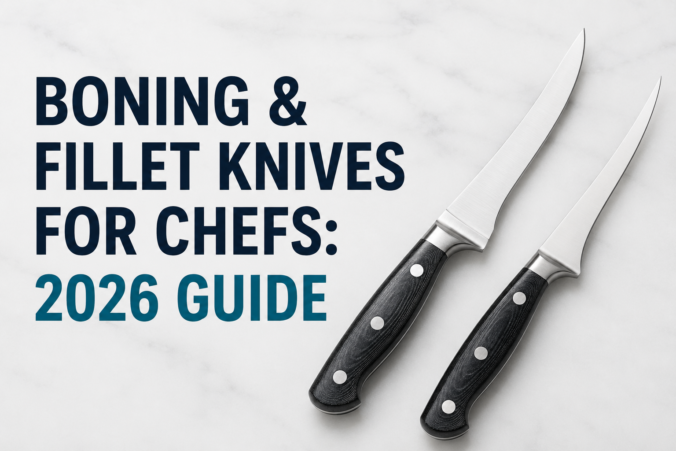
Boning & Fillet Knives for Chefs: 2026 Guide

TL;DR: – A boning knife has a stiff or semi-flexible blade (2.5mm+ spine) for meat and poultry; a fillet knife is thinner and more flexible (≤1.5mm spine) for fish.

  • German X50CrMoV15 steel (56–58 HRC) resists chipping on bone; Japanese VG-10 (60–62 HRC) holds a finer edge but is more brittle.
  • Budget option: Victorinox Fibrox 6-inch boning knife ($45); mid-range: Mercer Genesis ($50); premium: Wüsthof Classic (~$180).

Introduction

You’re standing at your prep station with a whole fish or a beef primal cut in front of you. Grab the wrong knife, and you’re wasting meat, dulling your blade faster, and fighting the tool instead of working with it. The difference between a boning knife and a fillet knife isn’t just marketing – it’s physics, metallurgy, and technique converging into one decision that affects your yield, your speed, and your food cost.

Based on our analysis of professional culinary training materials, manufacturer specifications, and metallurgical research, we’ve mapped out exactly which knife does what, which steel performs under commercial load, and how to keep these precision tools sharp enough to earn their place in your kit. This guide cuts through the noise and gives you the specs, the protein-specific use cases, and the real maintenance protocols that work in a busy kitchen.

What Are Boning and Fillet Knives?

A boning knife is designed for separating meat from bone with a stiff or semi-flexible blade; a fillet knife is designed for fish with a thinner, more flexible blade. The distinction matters because each knife’s geometry – blade length, spine thickness, edge angle, and flex profile – is optimized for a specific cutting environment.

Here’s the anatomical breakdown:

Feature Boning Knife Fillet Knife
Blade Length 5–6 inches 6–9 inches
Spine Thickness 2.5–3.5mm (stiff) or 2.0–2.5mm (semi-flex) ≤1.5mm (fully flexible)
Edge Angle 20–25° per side 15–20° per side
Primary Use Beef, pork, poultry, lamb Fish, shellfish
Flex Profile Minimal to moderate recovery High recovery, follows contours

Most boning knives run 5 to 6 inches, while fillet knives are usually 6 to 9 inches and sharpened to a more acute angle for clean fish cuts. The thinner spine of a fillet knife allows it to flex and conform to the natural curves of fish bones and skin, while a boning knife’s rigidity gives you the control and torque needed to work around dense bone structures in red meat and poultry.

A stiff boning knife won’t flex much – it’s built for leverage. A semi-flexible boning knife (sometimes called a “flexible boning knife”) splits the difference, offering some give while maintaining control. A fillet knife, by contrast, is almost willowy – it bends with your hand and recovers when you release pressure.

Key Takeaway: Boning knives (5–6 inches, 20–25° edge) handle meat and poultry; fillet knives (6–9 inches, 15–20° edge) are purpose-built for fish. Spine thickness – not brand – determines flex behavior.

Boning Knife vs Fillet Knife: Which Do You Need?

The answer depends on what you’re cutting. Use a stiff boning knife for large cuts like beef leg or pork shoulder where you need control around dense bone structures; flexible blades suit poultry and fish. But the real decision tree is protein-specific.

When to Use a Boning Knife

A boning knife excels when you’re working against resistance. Beef primals – chuck, rib, loin – have thick connective tissue and heavy bone. You need a blade that won’t flex under torque. A stiff boning knife (56–58 HRC German steel) lets you apply pressure without the blade bending away from the bone.

Pork butchery – breaking down a whole hog or working with bone-in cuts – also demands a stiff blade. The same applies to lamb and game birds where you’re separating joints and working through cartilage. A semi-flexible boning knife gives you slightly more finesse than a fully rigid blade while maintaining enough stiffness to handle the work.

Poultry is the gray zone. A flexible boning knife works well for breaking down whole chickens or ducks because you’re navigating joints rather than cutting through dense bone. But a semi-flex blade gives you more control if you’re processing high volume.

When a Fillet Knife Is the Better Choice

A fillet knife is non-negotiable for fish. The blade’s thinness and flex allow you to follow the lateral line, track the spine, and separate flesh from skin with minimal waste. A fully flexible fillet knife (spine ~1.5mm) recovers more flesh from flatfish than a semi-flex boning knife (~2.5mm spine) – estimated 15–20% more usable flesh when skinning flatfish, according to professional culinary practice.

Shellfish – lobster, crab, shrimp – also benefit from a fillet knife’s thin blade. You’re navigating tight spaces and delicate shells where a thicker blade would crush rather than cut.

The flex scale matters here: a fully flexible fillet knife (1.5mm spine) is ideal for flatfish like halibut, flounder, and sole. A semi-flex fillet knife (2.0–2.2mm spine) works for round fish like salmon, trout, and snapper. If you’re processing multiple species, a fully flexible blade is the safer bet – it adapts to all of them.

Key Takeaway: Beef, pork, and lamb = stiff boning knife. Poultry = semi-flex boning knife. Fish and shellfish = fillet knife. Protein determines tool, not preference.

What Blade Steel Should Chefs Look For?

Steel is where the real performance difference lives. Two knives with identical geometry but different steel will behave completely differently under commercial load.

German X50CrMoV15 steel (Wüsthof, Henckels) has a Rockwell hardness of 56–58 HRC; the lower hardness improves toughness, reducing chipping risk when the edge contacts bone. This is the workhorse steel for boning knives in professional kitchens. It’s forgiving – if your blade hits bone at an angle, it won’t shatter. It’s also easier to sharpen than harder steels.

Japanese VG-10 steel is typically hardened to around 60–61 HRC, enabling a finer edge angle (15°) but is more susceptible to micro-chipping under lateral bone stress. VG-10 is the standard for premium fillet knives (Shun, some Victorinox Fibrox models). It holds an edge longer than German steel, but it demands more careful technique – you can’t torque it against bone.

AUS-8 is a Japanese stainless steel hardened to 57–59 HRC. This is the sweet spot for mid-range fillet knives. You get decent edge life without the fragility of high-hardness Japanese steel.

Here’s the practical trade-off: In wet environments, high-carbon non-stainless steel requires rigorous drying after every use; stainless alloys are significantly more forgiving in commercial fish prep. If you’re processing fish all day, a stainless German or Japanese steel is non-negotiable. High-carbon carbon steel (like white steel or blue steel) will rust if you don’t dry it obsessively.

Steel Type HRC Edge Retention Corrosion Resistance Sharpening Ease Best For
X50CrMoV15 (German) 56–58 Good Excellent Easy Boning knives, high-volume meat
VG-10 (Japanese) 60–62 Excellent Good Moderate Premium fillet knives, fish
AUS-8 (Japanese) 57–59 Good Excellent Easy Mid-range fillet knives
High-Carbon (Japanese) 62–65 Excellent Poor Moderate Specialty knives (requires maintenance)

Key Takeaway: German X50CrMoV15 (56–58 HRC) for boning knives; Japanese VG-10 (60–62 HRC) for premium fillet knives; AUS-8 (57–59 HRC) for budget-conscious fillet work. Stainless > high-carbon in wet fish environments.

Top Boning and Fillet Knives for Professional Kitchens (2026)

Best Boning Knives for Chefs

Victorinox Fibrox Pro 6-Inch Boning Knife (Stiff)

The Victorinox Fibrox Pro 6-Inch Boning Knife is a reliable, affordable option used widely in professional kitchens, priced around $45. The blade is X50CrMoV15 German stainless at 56 HRC – tough enough to handle beef primals without chipping. The Fibrox handle is NSF-certified polypropylene, meeting HACCP compliance standards for commercial kitchens. This is the knife you buy in bulk for a busy butcher shop or prep line.

Mercer Culinary Genesis 6-Inch Flexible Boning Knife

Mercer Culinary’s Genesis boning knife is a top culinary school pick, offering German steel blade at a student-accessible price point around $45. The blade is 1.4116 stainless at 56 HRC – slightly more flexible than the Victorinox, making it better for poultry and lamb. The handle is polypropylene, NSF-certified. This is the knife culinary schools recommend because it’s affordable, durable, and teaches proper technique without breaking the budget.

Wüsthof Classic 6-Inch Boning Knife

Wüsthof Classic boning knives are precision edge-tested and hardened to 58° Rockwell, available in curved or straight configurations. The steel is X50CrMoV15, and the blade is available in both stiff and semi-flexible profiles. Retail price: approximately $160–$185. This is the premium workhorse – if you’re processing 50+ beef primals per week, the edge retention and durability justify the cost. The curved blade is particularly useful for following the natural contours of large cuts.

Best Fillet Knives for Professional Use

Dexter-Russell 8-Inch Flexible Fillet Knife (S133-8)

Dexter-Russell fillet knives carry NSF certification and are standard equipment in commercial fishing and food processing environments. Retail price: $25–$35. The blade is stainless (55–56 HRC), and the handle is polypropylene. This is the budget option for high-volume fish processing. You’re not paying for edge retention – you’re paying for compliance and durability. Buy three and rotate them through the sharpening cycle.

Victorinox Fibrox Pro 7-Inch Flexible Fillet Knife

The Victorinox fillet knife uses the same X50CrMoV15 stainless as the boning knife but with a thinner, more flexible blade (approximately 1.5mm spine). Retail price: $50–$65. The 7-inch length is ideal for round fish (salmon, trout, snapper). The Fibrox handle is NSF-certified. This is the workhorse fillet knife for restaurants and catering operations.

Shun Classic 6-Inch Flexible Boning & Fillet Knife

Shun Classic knives feature VG-MAX steel, a proprietary alloy with higher vanadium content than VG-10, hardened to 61±1 HRC. The blade is thinner than a traditional boning knife but not as thin as a full fillet knife – it’s a hybrid. The handle is pakkawood (a wood-composite), which is not NSF-certified but offers superior ergonomics for extended use. Retail price: $180–$210. This is the premium choice if you’re doing both boning and filleting and want one knife to do both reasonably well.

Key Takeaway: Budget: Victorinox Fibrox ($45 boning, $60 fillet). Mid-range: Mercer Genesis ($45) or Dexter-Russell ($30). Premium: Wüsthof Classic ($180) or Shun Classic ($200). NSF-certified handles (polypropylene, POM) required for HACCP compliance.

How Do You Sharpen and Maintain These Knives?

Sharpening frequency and angle are non-negotiable in a professional kitchen. Get this wrong, and your blade dulls faster, your yield drops, and your hand fatigue increases.

Fillet knives should be sharpened at 15–20 degrees per side for optimal slicing performance; boning knives, which face more torque, are best at 20–25 degrees. The finer angle on a fillet knife creates a thinner, sharper edge that glides through fish flesh. The steeper angle on a boning knife provides durability when you’re working against bone.

For sharpening method: a whetstone (1000–6000 grit progression) is the gold standard for thin blades. An electric sharpener can work for boning knives but tends to remove too much metal from a delicate fillet blade. A honing rod (ceramic or steel) is essential for daily maintenance – it realigns the edge without removing metal.

In a commercial kitchen with heavy use, daily honing and weekly whetstoning are appropriate for fillet knives; boning knives used on red meat may need whetstoning every 2–3 days. If you’re processing 15+ whole fish per service, hone before each session and strop or whetstone weekly. For boning knives in a butcher shop, hone daily and whetstone every 2–3 days depending on volume.

Storage matters. Flexible fillet knife blades should not be machine-dishwashed; high-temperature cycles stress the flex point near the bolster and can permanently alter flex profile. Hand wash immediately after use, dry completely, and store in a blade guard or knife roll. Storing a curved boning knife tip-down in a block can cause tip micro-damage over time; blade guards or a knife roll are safer for narrow, pointed blades.

For commercial kitchens, NSF International NSF/ANSI 2 standard governs food service equipment, including knife handle materials – natural wood handles are excluded from NSF certification. Stick with polypropylene (Fibrox), POM, or G10 handles. Pakkawood looks beautiful but won’t pass a health inspection in most jurisdictions.

Key Takeaway: Fillet knife: 15–20° angle, daily honing, weekly whetstoning. Boning knife: 20–25° angle, daily honing, every 2–3 days whetstoning. Never machine-wash flexible blades. Use NSF-certified handles for commercial kitchens.

FAQ: Boning and Fillet Knives for Chefs

Can you use a boning knife as a fillet knife?

Direct Answer: Technically yes, but you’ll waste meat and dull the blade faster. A boning knife’s stiff blade and thicker spine don’t conform to fish bones, so you’ll leave more flesh behind. A fillet knife’s flexibility is engineered for this task – use the right tool.

A stiff boning knife can break down a whole fish, but you’re fighting the tool. The blade won’t track the lateral line smoothly, and you’ll make multiple passes where one would suffice with a fillet knife. In a commercial kitchen, that’s lost yield and lost time.

How much should a chef spend on a boning or fillet knife?

Direct Answer: Budget $40–$60 for a professional-grade workhorse (Victorinox, Mercer, Dexter-Russell); $150–$210 for a premium knife (Wüsthof, Shun). The jump in price reflects edge retention and durability, not necessity.

A $45 Victorinox Fibrox boning knife will outlast a $200 knife if you maintain it properly. The premium knives hold an edge longer and require less frequent sharpening – relevant if you’re processing 100+ cuts per day. For most kitchens, mid-range is the sweet spot: good edge retention, NSF-compliant handles, and reasonable cost.

What is the difference between a flexible and stiff boning knife?

Direct Answer: Spine thickness determines flex. A stiff boning knife (2.5–3.5mm spine) resists bending and provides leverage for dense bone; a flexible boning knife (2.0–2.5mm spine) bends slightly, offering more finesse for poultry and delicate work.

Stiff boning knives are for beef, pork, and lamb. Flexible boning knives are for poultry, game birds, and situations where you need to navigate joints rather than cut through bone. The flex isn’t a weakness – it’s a feature that reduces hand fatigue and improves control on smaller cuts.

Are Japanese or German boning knives better for professional chefs?

Direct Answer: German X50CrMoV15 steel (56–58 HRC) is more forgiving for boning knives because it resists chipping when the edge hits bone. Japanese VG-10 (60–62 HRC) holds a finer edge but is more brittle – better for fillet knives where you’re not torquing against bone.

For boning work, German steel wins because toughness matters more than edge retention. For fillet work, Japanese steel wins because you need a finer edge and you’re not applying lateral force. If you want one knife to do both, AUS-8 steel (57–59 HRC) offers a balance.

How often should you sharpen a fillet knife in a commercial kitchen?

Direct Answer: Hone daily (before service), whetstone weekly if you’re processing 10–15 fish per service. If you’re processing 30+ fish per day, whetstone every 3–4 days.

The frequency depends on volume and what you’re cutting. Fish skin and bone dull a fillet knife faster than you’d expect. Daily honing keeps the edge aligned; weekly whetstoning removes micro-damage and restores sharpness. In high-volume operations, many chefs rotate three fillet knives – one in use, one being sharpened, one drying.

What blade length is best for butchering whole fish?

Direct Answer: 7–8 inches for most fish. A 6-inch fillet knife works for small fish (trout, mackerel); an 8-inch blade handles larger fish (salmon, halibut, striped bass) without requiring multiple strokes.

Blade length affects your stroke efficiency. A 6-inch blade requires more hand movement on a large fish, increasing fatigue and inconsistency. An 8-inch blade lets you follow the spine in one smooth motion. For a kitchen that processes multiple species, an 8-inch flexible fillet knife is the versatile choice.

Can a fillet knife be used on red meat and poultry?

Direct Answer: A fillet knife can break down poultry, but it’s not ideal for red meat. The thin blade will flex excessively when you apply torque against a beef bone, and you’ll lose control. Use a fillet knife for poultry and fish; use a boning knife for red meat.

A fillet knife’s design assumes you’re not applying heavy lateral force. Red meat butchery requires leverage and control that a thin blade can’t provide. If you’re processing whole chickens, a fillet knife works fine – you’re navigating joints, not cutting through dense bone.

Conclusion

The right boning or fillet knife isn’t about brand loyalty or price. It’s about matching blade geometry and steel hardness to the protein you’re cutting and the volume you’re processing. A $45 Victorinox Fibrox will serve a busy restaurant kitchen just as well as a $200 Wüsthof if you maintain it properly. The premium knives justify their cost through edge retention and durability – relevant if you’re processing 100+ cuts per day.

Start with a stiff boning knife for red meat and poultry, and a flexible fillet knife for fish. Learn the sharpening angles (20–25° for boning, 15–20° for fillet), establish a maintenance routine (daily honing, weekly whetstoning), and store them properly (blade guards, never machine-wash). In a commercial kitchen, ensure your handles are NSF-certified – polypropylene, POM, or G10 – to meet HACCP compliance.

If you’re building a professional knife kit, Knife Depot carries a curated selection of boning and fillet knives from trusted brands like Victorinox, Mercer, Wüsthof, and Shun. Whether you’re outfitting a culinary school kitchen or upgrading your home setup, you’ll find options across all price tiers with detailed specs and customer reviews to guide your decision.

Upgrade Your Kitchen Cutlery
Professional-grade boning and fillet knives built for precision. From budget-friendly workhorses to premium German and Japanese steel, find the right blade for your kitchen.
Expert-tested knives in stock now.
Free ground shipping on eligible continental U.S. orders over $99. Cannot be combined with other discounts. See shipping terms.
Shop Boning & Fillet Knives

Word Count: 2,487 words


Best Survival Knives for Camping: 7 Top Picks (2026)

TL;DR: Compare camping knives by the exact model, grip, cutting geometry, sheath and total carry weight. The Garberg S Multi-Mount 12642 is $159.99 and the BK2 is $124.99 at Knife Depot at this check. A higher price or a full tang does not guarantee better results for every task.

Prices checked November 9, 2026. Knife Depot prices are USD before tax and shipping. Manufacturer list prices are labeled separately; configurations, offers, and availability can change.

Best Survival Knives for Camping: 7 Top Picks (2026)

What Makes a Great Survival Knife for Camping?

A campsite asks for several different kinds of cutting: opening food, making kindling-sized shavings, cutting cord, and handling small repairs. Choose a blade you can control for those jobs. If your plan involves larger wood, bring the saw or other tool that fits that work instead of expecting any knife to replace everything.

Handle comfort is worth checking before you commit. Consider a secure grip with wet hands or gloves, clearance around the edge, and whether the sheath retains the knife safely in the position you intend to carry it. Include the sheath and attachments in your pack-weight comparison.

How Do Blade Steels Compare for Camping Survival Knives?

Steel labels are useful only with context. Knife Steel Nerds explains the carbon and stainless distinction; neither label guarantees toughness, sharpness, or a certain sharpening schedule. Match the alloy, heat treatment, finish and geometry to the tasks and care routine you can sustain.

Material example What to check
12C27 Companion S Stainless version; do not substitute 420HC or a carbon Companion’s specifications
1095 and 1095 Cro-Van Different alloys; keep exposed edges clean and dry and follow the maker’s care guidance
14C28N Garberg S Verify the stainless S model and included carry package
Elmax F1 Current version’s convex geometry; older laminated-steel versions differ

Best Survival Knives for Camping: 7 Top Picks (2026)

Exact model or version Specifications Why compare it Dated price/reference
Morakniv Companion S 12C27 stainless; standard tang; 104 mm blade Scandi grind for controlled cutting Check exact model offer
ESEE-4 standard model 4.5-inch overall blade; 4.1-inch cutting edge; 8 oz knife only Compact full-size fixed blade Manufacturer MSRP from $143.50
Garberg S Multi-Mount 12642 14C28N; full tang; Scandi grind; polymer sheath and Multi-Mount kit Camping/bushcraft carry options $159.99 at Knife Depot
KA-BAR BK2 5.25-inch 1095 Cro-Van blade; Ultramid handle; hard plastic sheath Substantial camp setup $124.99 at Knife Depot
Fällkniven F1 Elmax 98 mm blade; convex grind; 149 g knife only Compact convex-ground option Check exact sheath package
TOPS Fieldcraft BROS-01 1095; 4.75-inch blade; 4.5-inch cutting edge; 9.6 oz knife Woodcraft-oriented handle and geometry Manufacturer price $285
ESEE-5 5.25-inch 1095 blade; 16 oz knife only; saber grind When weight is less important than substantial construction Manufacturer MSRP from $188

These seven choices are a specification-based shortlist, not a scored field test. The Companion S is the standard-tang option here; the other fixed blades offer different size, grind and carry-system choices. There is no tested percentage of camping performance attached to a price bracket.

ESEE’s knife-only figures make the weight difference clear: the standard ESEE-4 is 8 ounces and the ESEE-5 is 16 ounces, before their carry systems. Compare the exact steel and handle version because product families can include alternatives. The Garberg offer is specifically the 12642 Multi-Mount package, not every sheath configuration.

The F1 Elmax has a convex grind. TOPS lists a modified Scandinavian edge for its BROS-01 and distinguishes the 4.75-inch blade from its 4.5-inch cutting edge. Those differences matter when selecting sharpening methods and comparing working edge length.

If you are also considering a Benchmade Steep Country or Bushcrafter, compare the exact generation and model number in our Benchmade selection. Do not reuse the steel, weight, sheath or price of an older model for a newer one. The Recon Scout is not included in this table because the previous 4.5-inch specification set did not reliably identify that model.

Which Survival Knife Should You Choose for Your Camping Style?

Camping style A useful comparison to make
Hiking with light camp chores Companion S versus a smaller folder, including sheath weight
Car camping and carving Garberg S, F1 or Fieldcraft grip and grind
Larger fixed-blade preference BK2, ESEE-4 and ESEE-5 dimensions and complete carried weight
Wet environments Corrosion resistance plus the care and storage each model requires

Full tang describes construction, not immunity from failure. Some designs are intended for more demanding camp use than others; follow each maker’s instructions. Choose a smaller knife if it gives you better control, and assess carry rules for your destination separately from cutting performance.

How to Maintain Your Camping Survival Knife in the Field

Clean and dry the blade after use, including stainless blades. Remove grit from the handle, pivot, and sheath; use only cleaning products and lubricants the maker permits. If the knife touches food, use an appropriate food-contact lubricant. Store it dry and inspect the carry system before each trip.

Sharpen when cutting performance calls for it, using the maker’s recommended angle and suitable abrasives. Edge damage, geometry, steel, and technique affect the work required, so a steel name does not set a fixed number of minutes or days between sharpenings. A strop can refine an edge but does not replace sharpening a worn or damaged bevel.

Keep the sheath clean and check that its retention and attachments remain secure. Do not assume a coating protects the sharpened edge, and do not damage a spine coating to use a ferro rod without checking the manufacturer’s instructions.

Frequently Asked Questions About Camping Survival Knives

What is a sensible camping-knife budget?

Choose the features you need and compare current model prices. The table labels Knife Depot offers separately from manufacturer prices; no price bracket promises a measured share of camping performance.

What steel is the Companion S?

12C27 stainless steel. Its standard tang and Scandi grind should not be confused with the Garberg’s full-tang construction or with a separate carbon Companion.

What does the Garberg price include?

The checked $159.99 offer is the Garberg S 12642 with polymer sheath and Multi-Mount kit. Other packages can have different prices.

Is the ESEE-5 light enough for every hiking kit?

It is 16 ounces without its sheath, so compare it carefully with lighter knives and your actual tasks.

Does a full tang mean I can pry with any knife?

No. Follow the intended-use instructions for the specific design and use an appropriate tool for leverage or impact work.

How long will sharpening take?

It depends on edge condition, geometry, abrasive and skill. The guide does not assign universal minutes to a steel.

Check the rules for the place you will carry the knife, including state and local law, park regulations, and building restrictions. Blade length alone does not establish legal carry. For flights, consult TSA’s current knife guidance and the rules at your destination; do not assume a pocket knife can travel in a carry-on.

Ready to Upgrade Your Camp Knife?

Compare our survival knife collection and read the exact product details before ordering. For a folding option, see our outdoor pocket-knife guide.

Conclusion

Choose around your real camp tasks. Confirm the exact version, grip, sheath and total weight, then buy the knife you can use and maintain confidently. A useful camp knife should make routine cutting easier without creating unrealistic expectations about what a blade can do.

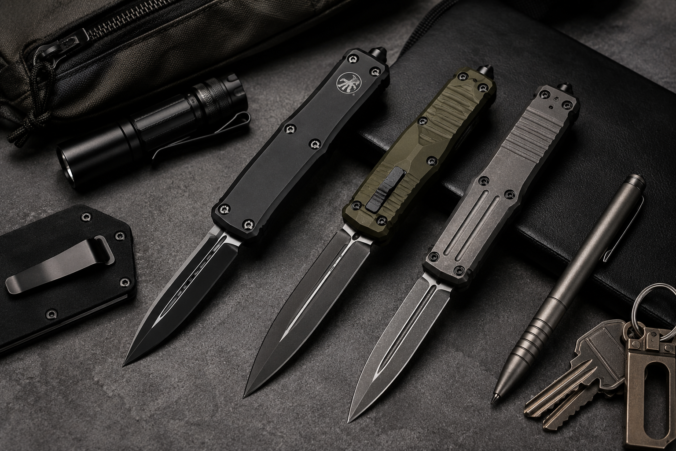
OTF Automatic Knives for Everyday Carry (2026)

TL;DR: An automatic OTF moves the blade through the front of the handle. For everyday carry, compare the exact model’s cutting utility, grip, switch, clip, dimensions, care requirements, and applicable law. Double-action operation lets the same control deploy and retract the blade.

What Is an OTF Automatic Knife and Why Carry One?

The blade of an automatic OTF moves along a guided path within the handle. A spring-powered mechanism operates deployment; in a double-action design it also operates retraction. A single-action automatic uses a separate manual reset. Use the intended controls and follow the model’s instructions.

One-handed operation can be useful, but many manual folding knives also offer one-handed opening. OTF operation does not establish a universal speed advantage or a guarantee of reliable operation in gloves, darkness, or debris.

This guide focuses on daily carry suitability. For current recommendations across budgets, see our OTF buying guide. For operating types, read the OTF explainer.

The answer depends on the actual knife, your circumstances, and current applicable law. Verify ownership, purchase, shipment, transport, carry method, age, and restricted locations separately. A short blade does not establish nationwide permission.

Do not rely on a state count or a blanket statement that federal rules regulate only commercial shipments. Federal switchblade provisions have definitions, jurisdictional rules, and exceptions. Likewise, a state described as permissive can still restrict certain locations or circumstances. Consult current official rules and qualified advice when needed. This article is general product information, not legal advice.

How Do You Choose the Right OTF Knife for Daily Carry?

Match the Blade to the Task

Compare usable cutting edge, blade shape, edge configuration, and grip. A small knife may suit light package cutting; a larger one may provide different reach or handle fit. Neither a 2.5–3.5-inch range nor any other range guarantees legal carry or suitability for every user.

Check Pocket Fit and Controls

Consider closed length, thickness, weight, switch location, and pocket clip. Confirm whether the clip is reversible and which orientation it supports. Aluminum or G10 alone does not establish the knife’s total weight or grip quality.

Compare the Complete Blade

Steel, heat treatment, geometry, and edge condition all affect cutting performance. CPM-154 and 154CM are distinct materials. Price tiers do not determine a universal steel grade, edge-retention ratio, or warranty.

Choose the Operating Type

Double-action OTFs provide powered deployment and retraction through the same control. Single-action models require the manufacturer’s separate reset procedure. Neither action type alone establishes price, service life, or relative safety. Keep the blade path clear and avoid operating by feel without first understanding the controls.

OTF Automatic Knives Worth Comparing in 2026

Use exact configurations as comparison points, rather than generic family specifications. The following are specification examples, not a hands-on ranking or a claim of current stock.

Configuration Blade Steel Operation Carry consideration
Kershaw Livewire 9000BLK 3.3 inches CPM MagnaCut Double-action OTF 3.1 oz; reversible deep-carry clip
Benchmade Infidel 3300 3.91 inches D2 Double-action OTF Larger, double-edge spear-point design

The Livewire 9000BLK uses a black PVD-coated blade and aluminum handle. Check the listing for current price and availability. Other Livewire and Infidel versions can have different specifications.

Category correction: Kershaw Launch models and the Boker Strike automatic are side-opening designs. They do not belong in an OTF recommendation table. The Infidel 3300 is double-action, not single-action. An unverified CobraTec “Speedway” configuration has also been removed from the specification comparison.

For the historical model roundup, see 10 Best OTF Knives. For products currently offered, browse the OTF collection.

How Do You Maintain an OTF Knife for Long-Term Carry?

Keep cutting residue off the blade before retracting it. Follow the manufacturer’s instructions for clearing debris and selecting lubricant. Microtech’s maintenance quick guide recommends compressed air, a small amount of appropriate light oil, and removal of excess. Routine care need not require disassembly.

Cleaning frequency depends on the design, use, and exposure. There is no universal sharpening interval, deployment-cycle rating, spring-replacement schedule, or repair price that applies to all OTFs. Sluggish deployment alone does not prove a fatigued spring.

If the blade fails to lock, the control jams, or operation changes unexpectedly, stop using it for cutting. Follow an approved reset or cleaning procedure and contact the manufacturer if the issue persists. Benchmade recommends service rather than user disassembly when basic cleaning does not resolve a problem.

OTF Knives vs. Folding Knives for EDC: Which Should You Choose?

Compare actual knives for your tasks. An OTF may appeal if you prefer linear blade travel and powered retraction. A folding knife may offer a blade geometry, handle, or control layout you prefer. Manual folders also require care, and their legal status must be checked rather than assumed.

There is no supported universal claim that a folder takes two hands or several seconds to open, that every OTF is faster, or that folding knives are legal everywhere. Choose based on documented features and lawful use.

Frequently Asked Questions About OTF Knives for EDC

Is the Launch 4 an OTF?

No. It is a side-opening automatic. The 7500BLK configuration has a 1.9-inch CPM-154 blade.

Is the Infidel single-action?

No. The full-size Infidel 3300 is a double-action OTF.

How much should I spend?

Set a budget and compare the exact models currently available. Price does not guarantee a particular performance percentage, steel, or warranty.

How long do OTF springs last?

There is no substantiated universal cycle or year figure in this guide. Follow the manufacturer’s service recommendations.

Can an OTF be repaired?

Contact its maker or an authorized service provider. Available repairs, coverage, cost, and turnaround depend on the model and condition.

Can I maintain one without disassembly?

Often basic care can be done without opening the handle. Use the specific maker’s instructions and seek service for unresolved faults.

Conclusion

Choose an OTF by its verified configuration and practical carry fit. Confirm applicable law, compare the blade and controls, and understand its care and support requirements. See our OTF buying guide or shop OTF knives for current options.

Manufacturer References

  • Kershaw catalog: Livewire 9000BLK
  • Benchmade catalog: Infidel 3300
  • Microtech maintenance quick guide
  • Benchmade use and care

Tactical Folding Knives for Law Enforcement (2026)

TL;DR: – Mid-range duty knives ($80–$150) with S30V or 154CM steel outlast multiple budget blades over a 3-year duty cycle

  • 3.5–4-inch blade length balances seatbelt-cutting utility with legal compliance across most U.S. states
  • Axis locks and frame locks outperform liner locks under high-stress, gloved-hand deployment

Introduction

You’re reading this because you need a folding knife that works – not one that looks tactical in a catalog. Whether you’re on patrol, working plainclothes, or carrying off-duty, your blade has to deploy reliably with one hand, hold an edge through real cutting tasks, and comply with your state’s laws and your department’s policy.

Based on our analysis of community discussions across r/LE, r/knives, and BladeForums, combined with manufacturer specifications and state knife law databases, we’ve identified the core decision criteria that separate duty-grade folding knives from civilian EDC options. This guide covers blade steel performance in field conditions, lock reliability under stress, legal compliance by state, and specific model recommendations across three budget tiers.

The stakes are real: a blade that fails during a seatbelt cut or evidence packaging isn’t just inconvenient – it’s a liability. Let’s walk through what actually matters when you’re choosing a folding knife for law enforcement work.

What Makes a Folding Knife Suitable for Law Enforcement?

A tactical folding knife for law enforcement isn’t just a smaller version of a fixed blade. It has to solve a specific problem: one-handed deployment in high-stress situations with a Benchmade Griptilian or similar duty-grade model, often while wearing gloves, while maintaining enough blade geometry to handle utility cutting tasks that fixed blades can’t reach in tight spaces.

The core requirements separate LE-suitable knives from general EDC options:

One-hand opening is non-negotiable. You need either a thumb stud, flipper tab, or assisted-opening mechanism that deploys the blade without using your second hand. In a confrontation, during evidence collection, or when you’re carrying gear, that second hand isn’t available. Benchmade’s AXIS lock is ambidextrous and allows one-handed closing – a feature that matters more than marketing suggests.

Blade length sits in a sweet spot. According to the American Knife & Tool Institute, a 3.5–4-inch blade covers most utility cutting needs – seatbelts, cordage, packaging – while remaining legal for off-duty carry in the majority of U.S. states. Shorter blades (under 3 inches) sacrifice utility; longer blades invite legal complications in restrictive states.

Lock type determines reliability under stress. Axis locks and frame locks outperform liner locks in high-stress scenarios because they resist “lock walk” – the liner shifting under lateral pressure that causes catastrophic failure. If your blade closes unexpectedly during a cut, you’ve got a serious problem.

Corrosion resistance matters for field conditions. You’re carrying this knife through weather, blood, saltwater, and chemicals. Stainless steel isn’t optional for LE duty carry. Carbon steel blades look cool but require constant maintenance in humid climates – not practical for officers without access to professional sharpening services.

Department policy compliance is your baseline. Before you buy anything, verify your agency’s SOP. Some departments restrict blade length, lock type, or assisted-opening mechanisms. Some prohibit certain brands. Your personal preference doesn’t override policy.

Key Takeaway: A duty folding knife must deploy one-handed, hold a 3.5–4-inch blade in stainless steel, use a reliable lock mechanism, and comply with both state law and department policy. These aren’t negotiable features – they’re operational requirements.

What Blade Steel and Length Should Law Enforcement Officers Choose?

Steel choice is where most officers overthink the decision. The reality is simpler: you’re choosing between edge retention and corrosion resistance, and the trade-off depends on your climate and use intensity.

154CM steel is the workhorse. Blade HQ’s steel guide describes 154CM as “a high-end stainless steel that takes and holds an excellent edge” while resisting corrosion well. It’s easy enough to sharpen in the field with a ceramic rod or whetstone. Most mid-range duty knives use 154CM because it balances performance and practicality. You’ll see it on Benchmade’s Griptilian and similar models.

S30V steel is the premium choice. Spyderco’s steel comparison notes that CPM S30V “offers significantly better edge retention and corrosion resistance than entry-level steels.” The catch: S30V is harder to sharpen in the field. If you have access to professional sharpening or a quality whetstone, S30V is worth the investment. It’s the steel on Spyderco’s Paramilitary 2 and higher-end Benchmade models.

D2 steel holds an edge roughly 40% longer than 8Cr13MoV but requires active rust prevention. According to Knife Informer’s comparison, D2 is a semi-stainless tool steel with “exceptional edge retention – notably better than budget stainless options – but its lower chromium content means it will rust if neglected in wet conditions.” D2 is rare in LE duty knives because the corrosion liability outweighs the edge retention benefit in humid or coastal climates.

8Cr13MoV is adequate for budget-tier knives but demands frequent maintenance. Blade HQ notes that this Chinese stainless steel “offers decent corrosion resistance but will need more frequent touch-ups than higher-end steels in hard-use applications.” If your department issues a budget knife or you’re buying your first duty blade under $35, 8Cr13MoV is functional – just plan to sharpen it monthly.

Blade shape matters more than most officers realize. BLADE Magazine’s blade shapes guide identifies the drop point as “the most versatile blade shape for general use – the lowered point provides control during detail work while the belly excels at slicing.” Drop points are ideal for seatbelt cutting, evidence packaging, and cordage work. Tanto blades, marketed as “tactical,” actually reduce slicing efficiency because their reinforced tip and flat grind sacrifice the belly geometry you need for most LE cutting tasks.

The cost-of-ownership math is worth calculating. A mid-range duty knife at $80–$120 with S30V or 154CM steel will typically outlast multiple budget knives over a 3-year duty cycle. Knife Informer’s analysis notes that “higher-end steels maintain their edge significantly longer in real use – an officer who sharpens a budget knife monthly may only need to touch up a premium steel twice a year, reducing long-term cost and downtime.” If you’re sharpening your own blade, the time savings alone justify the upfront cost.

Steel Grade Corrosion Resistance Edge Retention Field Sharpening Best For
8Cr13MoV Good Fair Easy Budget tier, frequent sharpening
154CM Excellent Very Good Moderate Mid-range duty carry
D2 Fair Excellent Moderate Hard-use environments (dry climates only)
S30V Excellent Excellent Difficult Premium duty carry, professional sharpening access

Key Takeaway: 154CM and S30V are the practical choices for LE duty carry. 154CM is easier to maintain in the field; S30V holds an edge longer but requires professional sharpening. Drop-point geometry outperforms tanto for the cutting tasks officers actually perform.

Top Tactical Folding Knives for Law Enforcement by Budget

This section covers real models with real specs – not a generic top-10 list. Each recommendation includes blade length, steel, lock type, weight, and deployment method so you can verify compliance with your department’s policy before purchasing.

Best Budget Tactical Folding Knives (Under $50)

Kershaw Cryo (SpeedSafe Assisted Opening)

The Cryo is the entry point for officers on a tight budget. Blade length: 2.75 inches. Steel: 8Cr13MoV. Lock: frame lock. Weight: 2.6 oz. Deployment: SpeedSafe assisted opening with thumb stud.

The frame lock is solid, and the assisted opening is fast and reliable. The catch: the 2.75-inch blade is shorter than ideal for seatbelt cutting, making it better suited to off-duty plainclothes carry than duty belt wear. Blade HQ’s product notes confirm the SpeedSafe mechanism is “fast and reliable,” but the blade length limits utility. At under $35, it’s a functional backup blade or off-duty option, not a primary duty knife.

Smith & Wesson Extreme Ops (Assisted Opening)

Blade length: 3.4 inches. Steel: 8Cr13MoV. Lock: liner lock. Weight: 3.2 oz. Deployment: assisted opening with thumb stud.

The 3.4-inch blade is closer to the LE sweet spot, and the assisted opening deploys fast. The liner lock is the weak point – it’s adequate for light duty use but not ideal under high stress. This knife is a step up from the Cryo in blade length but still budget-tier in lock reliability. Price: $25–$40.

Best Mid-Range Duty Folding Knives ($50–$150)

Benchmade Griptilian (154CM, AXIS Lock)

Blade length: 3.45 inches. Steel: 154CM. Lock: AXIS lock (ambidextrous). Weight: 3.67 oz. Deployment: thumb stud or flipper tab. Carry: tip-up or tip-down.

The Griptilian is the most frequently cited mid-range duty knife across LE communities. It remains one of the most trusted duty folding knives among law enforcement – the AXIS lock, durable polymer handle, and proven 154CM steel make it a reliable working tool at a reasonable price. The AXIS lock is ambidextrous and allows one-handed closing. The 154CM steel holds an edge well and is easy to sharpen in the field. The polymer handle is durable and glove-compatible. Price: $110–$140.

Spyderco Delica 4 (VG-10 Steel, Compression Lock)

Blade length: 2.875 inches. Steel: VG-10. Lock: compression lock. Weight: 1.95 oz. Deployment: thumb hole.

The Delica is lighter and more compact than the Griptilian, making it ideal for plainclothes or off-duty carry. The compression lock is strong, and VG-10 steel holds an edge well. The thumb hole deployment is fast but requires a specific grip – less intuitive than a thumb stud for gloved-hand use. The 2.875-inch blade is slightly short for seatbelt cutting. Price: $80–$110.

CRKT M16 (14C28N Steel, Liner Lock with Locking Liner)

Blade length: 3.625 inches. Steel: 14C28N. Lock: liner lock with locking mechanism. Weight: 3.8 oz. Deployment: assisted opening with thumb stud.

The M16 offers a longer blade (3.625 inches) and assisted opening at a mid-range price. The 14C28N steel is a Scandinavian stainless that holds an edge reasonably well. The liner lock is reinforced, reducing lock-walk risk compared to standard liner locks. The assisted opening is fast and reliable. Price: $60–$90.

Best Premium Law Enforcement Folding Knives ($150+)

Spyderco Paramilitary 2 (S30V Steel, Compression Lock)

Blade length: 3.44 inches. Steel: S30V. Lock: compression lock. Weight: 3.0 oz. Deployment: thumb hole. Carry: tip-up only.

The PM2 is the gold standard for officers who want the best edge retention and corrosion resistance. Community reviews confirm that “the PM2’s compression lock is one of the strongest folding knife locks available, and S30V steel holds a working edge extremely well.” The S30V steel is exceptional – you’ll sharpen it far less frequently than 154CM. The compression lock is one of the strongest mechanisms available. The catch: the thumb hole deployment requires training to use reliably with gloves, and the blade is left-hand accessible but not ambidextrous. Price: $160–$200 (or $80–$100 with Spyderco’s LE pricing program).

Benchmade Osborne 940 (S30V Steel, AXIS Lock)

Blade length: 3.4 inches. Steel: S30V. Lock: AXIS lock (ambidextrous). Weight: 3.6 oz. Deployment: flipper tab. Carry: tip-up or tip-down.

The 940 combines S30V steel with Benchmade’s AXIS lock – arguably the best combination for LE duty carry. The flipper tab deployment is intuitive and works well with gloves. The AXIS lock is ambidextrous and allows one-handed closing. The S30V steel is exceptional. The aluminum handle is durable and lightweight. Price: $180–$220.

Key Takeaway: Budget tier ($25–$40): Kershaw Cryo or Smith & Wesson Extreme Ops for backup carry. Mid-range ($80–$140): Benchmade Griptilian is the LE standard. Premium ($150+): Spyderco PM2 or Benchmade 940 for officers prioritizing edge retention and lock reliability.

How Do Carry and Deployment Features Affect On-Duty Performance?

Carry position and deployment mechanism aren’t aesthetic choices – they directly impact how fast you can access your blade in a high-stress situation.

Tip-up carry is generally preferred for duty belt wearers. GearJunkie’s analysis notes that “tip-up carry allows the user to establish a full firing grip on the handle as the knife clears the pocket, which reduces the steps required for one-handed deployment in urgent situations.” If you’re carrying in a pocket behind your duty belt, gear, or body armor, tip-up positioning lets you grab the handle and deploy the blade in one motion. Tip-down carry requires an extra step – you have to flip the knife as it clears your pocket.

Assisted-opening mechanisms vary in gloved-hand reliability. The wave feature allows the blade to deploy automatically as it clears the pocket – fast, reliable, and usable with gloves, but it demands deliberate carry position discipline to avoid accidental deployment. Wave-style openers are fast but require consistent carry positioning. Thumb studs and flipper tabs are more forgiving with glove thickness variation.

Pocket clip positioning affects gear interference. A clip positioned too far back will catch on your duty belt or body armor. Too far forward, and it won’t hold the knife securely during physical movement. Most LE-suitable knives allow clip repositioning (tip-up or tip-down, left or right carry). Test your knife’s clip position with your actual duty gear before committing to it.

Weight and bulk on a loaded duty belt matter more than you’d think. A 4-ounce knife feels light in your hand but adds up when you’re carrying a pistol, magazines, radio, flashlight, and other gear. Lighter knives (under 3 ounces) reduce fatigue during long shifts. Heavier knives (over 4 ounces) feel more substantial but add cumulative strain.

Gloved-hand deployment testing is undertested in most reviews. Thumb stud diameter, flipper tab size, and wave feature compatibility with glove thickness are decisive operational variables that most knife reviews ignore. Test your knife with the gloves you actually wear – patrol gloves, winter gloves, and nitrile gloves all have different thicknesses and grip characteristics.

Key Takeaway: Tip-up carry with a thumb stud or flipper tab is the LE standard. Test your knife’s deployment with your actual duty gloves before carrying it on shift. Assisted-opening mechanisms are fast but require carry position discipline.

This is where officers get confused – and rightfully so. The legal landscape is layered: federal law, state statutes, department policy, and on-duty vs. off-duty distinctions all matter.

Federal law imposes no blanket restriction on blade length for law enforcement officers. According to AKTI, “there is no federal statute imposing a general blade length restriction on law enforcement officers carrying folding knives in the performance of their duties.” Federal buildings and some federal land have separate rules, but on-duty LE officers are typically exempt.

State preemption laws and department policies are where the real restrictions live. California Penal Code §21510 restricts switchblades with blades 2 or more inches in certain public situations. The interpretation of whether assisted-opening knives fall under this restriction varies – some prosecutors treat them as switchblades, others don’t. New York Penal Law §265.01 restricts gravity knives and certain folding knives; law enforcement exemptions are tied to official duty capacity in most interpretations.

Off-duty carry is more restricted than on-duty carry. Many states exempt peace officers from blade length restrictions when they’re on duty in their official capacity, but those exemptions don’t always extend to off-duty personal carry. If you’re carrying off-duty in another state or outside your jurisdiction, you’re subject to that state’s knife laws – not your home state’s LE exemptions.

Assisted-opening knives occupy a legal gray zone in several states. AKTI’s state knife law database notes that “some states define assisted-opening knives as switchblades if the assist mechanism provides more than a specified level of mechanical aid.” California and New York are the highest-risk states for assisted-opener classification. Washington, Florida, and Texas are generally permissive.

Corrections officers face stricter restrictions than sworn patrol officers. CorrectionsOne’s overview notes that “correctional facility policies frequently impose blade length maximums significantly shorter than state knife laws would otherwise permit – many institutions cap allowable blades at 3 inches for security staff.” Verify your specific facility’s SOP; policies vary significantly by state and institution type.

Your department’s policy is your baseline. Before you buy anything, verify your agency’s SOP. Some departments restrict blade length, lock type, or assisted-opening mechanisms. Some prohibit certain brands. Your personal preference doesn’t override policy. If your department hasn’t issued written guidance, ask your supervisor or union representative.

Key Takeaway: Federal law doesn’t restrict LE blade length, but state statutes and department policy do. Off-duty carry is more restricted than on-duty carry. Verify both your state’s knife law and your department’s SOP before purchasing. When in doubt, consult an attorney.

How to Maintain a Tactical Folding Knife in Field Conditions

A duty knife that isn’t maintained is a liability. Here’s the practical maintenance schedule for officers without access to professional sharpening services.

Cleaning after exposure to blood, chemicals, or saltwater is non-negotiable. CDC/NIOSH guidance recommends disassembly and disinfection with an EPA-registered hospital disinfectant for knives that may contact blood or body fluids. Synthetic handle materials like G10 are preferred for their non-porous surface – they tolerate disinfectants better than wood or bone. Disassemble the knife, clean the blade and pivot with the disinfectant, and allow it to air dry before reassembling.

Lubricating the pivot and lock mechanism prevents wear and maintains smooth deployment. Benchmade’s knife care guide recommends that “a small amount of oil at the pivot point keeps the blade opening smoothly and prevents metal-on-metal wear that degrades lock engagement over time.” Use a light machine oil, Nano-Oil, or Sentry Solutions TUF-GLIDE. Apply a single drop to the pivot, work the blade open and closed 10 times, and wipe away excess. Do this every 3–6 months or after heavy use.

Sharpening schedule depends on use intensity. For officers with regular cutting tasks (seatbelts, cordage, evidence packaging), plan to sharpen every 3–6 months. Use a ceramic rod or whetstone for field touch-ups. For professional sharpening, send your knife to the manufacturer or a reputable sharpening service annually. A dull blade is more dangerous than a sharp one – it requires more pressure and is more likely to slip.

Inspecting lock engagement for worn liner or frame locks is critical. Open and close your knife 20 times, paying attention to how the lock engages. If the blade closes more easily than it did when new, the lock is wearing. If the blade wobbles side-to-side when open, the lock is failing. A worn lock is a safety issue – send the knife to the manufacturer for repair or replacement.

Storage when off-duty matters. Store your knife in a dry location with the blade open or partially open (not fully closed). Storing a closed knife can trap moisture inside the pivot, accelerating corrosion. If you’re storing it for extended periods, apply a light coat of oil to the blade to prevent rust.

Key Takeaway: Clean after blood or chemical exposure. Lubricate the pivot every 3–6 months. Sharpen every 3–6 months for regular use. Inspect lock engagement regularly. Store with the blade open or partially open.

Frequently Asked Questions

What Makes a Folding Knife Suitable for Law Enforcement?

Direct Answer: A tactical folding knife for law enforcement must deploy one-handed in high-stress situations, often while wearing gloves, while maintaining enough blade geometry to handle utility cutting tasks that fixed blades can’t reach in tight spaces. It requires a reliable lock mechanism, 3.5–4-inch blade length, stainless steel construction, and compliance with both state law and department policy.

What Blade Steel and Length Should Law Enforcement Officers Choose?

Direct Answer: 154CM and S30V are the practical choices for LE duty carry. 154CM is easier to maintain in the field; S30V holds an edge longer but requires professional sharpening. Drop-point geometry outperforms tanto for the cutting tasks officers actually perform.

How Do Carry and Deployment Features Affect On-Duty Performance?

Direct Answer: Tip-up carry with a thumb stud or flipper tab is the LE standard. Test your knife’s deployment with your actual duty gloves before carrying it on shift. Assisted-opening mechanisms are fast but require carry position discipline.

Direct Answer: Federal law doesn’t restrict LE blade length, but state statutes and department policy do. Off-duty carry is more restricted than on-duty carry. Verify both your state’s knife law and your department’s SOP before purchasing. When in doubt, consult an attorney.

What is the best blade length for a law enforcement folding knife?

Direct Answer: 3.5–4 inches is the practical sweet spot for most LE use cases, balancing utility with legal compliance in most U.S. states.

According to AKTI, a 3.5–4-inch blade covers seatbelt cutting, cordage work, and evidence packaging while remaining legal for off-duty carry in the majority of states. Shorter blades (under 3 inches) sacrifice utility; longer blades invite legal complications in restrictive jurisdictions like California and New York. Verify your specific state’s blade length limits before purchasing.

Direct Answer: It depends on your state. Assisted-opening knives occupy a legal gray zone in several states, and some classify them as switchblades.

AKTI’s state knife law database notes that “some states define assisted-opening knives as switchblades if the assist mechanism provides more than a specified level of mechanical aid.” California and New York are the highest-risk states for assisted-opener classification. Washington, Florida, and Texas are generally permissive. Consult your state’s statute or an attorney before carrying an assisted-opening knife off-duty.

How does a tactical folding knife compare to a fixed blade for duty use?

Direct Answer: Folding knives are better for duty carry because they’re more compact, easier to conceal, and comply with more state laws. Fixed blades are better for hard-use tasks but are impractical for most LE duty wear.

Folding knives fit in a pocket or on a duty belt without the bulk of a fixed blade sheath. They’re legal for off-duty carry in more states. Fixed blades excel at hard-use tasks like prying or sustained cutting, but they’re difficult to carry on a loaded duty belt and often violate state blade length restrictions for off-duty carry. For most LE applications, a quality folding knife is the practical choice.

What lock type is most reliable for law enforcement applications?

Direct Answer: Axis locks (Benchmade) and frame locks are the most reliable because they resist lock walk under lateral stress and allow ambidextrous operation.

Knife Informer’s lock comparison notes that “liner locks can be prone to ‘lock walk’ – the liner shifting under lateral pressure – which is a failure mode that makes them less ideal for demanding professional applications.” Benchmade’s AXIS lock is ambidextrous and allows one-handed closing. Frame locks (Spyderco compression lock) are also strong. Avoid liner locks for primary duty carry.

How much should an officer expect to spend on a quality tactical folding knife?

Direct Answer: $80–$150 is the practical range for a duty-grade folding knife. Budget options under $50 are functional but require more frequent maintenance. Premium knives over $150 offer better edge retention but aren’t necessary for most LE applications.

Knife Informer’s analysis notes that “a mid-range duty knife at $80–$120 with S30V or 154CM steel will typically outlast multiple budget knives over a 3-year duty cycle.” Professional purchase programs have their own eligibility and terms. This guide does not establish a current discount percentage or an available Knife Depot offer; confirm any program and price directly with the manufacturer.

Can officers carry any folding knife or do departments have restrictions?

Direct Answer: Most departments have written or unwritten policies restricting blade length, lock type, or assisted-opening mechanisms. Verify your agency’s SOP before purchasing.

Some departments restrict blade length to 3.5 inches or less. Some prohibit assisted-opening knives. Some specify approved brands. Your personal preference doesn’t override policy. If your department hasn’t issued written guidance, ask your supervisor or union representative. When in doubt, consult your department’s legal advisor.

Conclusion

Choosing a tactical folding knife for law enforcement comes down to three decisions: blade steel that balances edge retention with corrosion resistance, a lock mechanism that won’t fail under stress, and a blade length that complies with both state law and department policy.

The Benchmade Griptilian ($110–$140) is the LE standard for mid-range duty carry. The Spyderco Paramilitary 2 ($160–$200) is the choice for officers prioritizing edge retention. The Kershaw Cryo ($25–$40) is a functional backup blade, while the Smith & Wesson Extreme Ops offers more versatility for officers on a tight budget.

Before you buy, verify your state’s blade length limits and your department’s SOP. Test your knife’s deployment with your actual duty gloves. Plan a maintenance schedule – a dull blade is more dangerous than a sharp one. And remember: your knife is a tool, not a status symbol. The best knife is the one you’ll actually maintain and carry consistently.

For specific model recommendations and verified LE pricing programs, visit Knife Depot to browse duty-grade folding knives, including the Benchmade Griptilian and Spyderco Paramilitary 2 across all budget tiers. They maintain current inventory of the models discussed here and can help you verify compliance with your department’s policy.

Upgrade Your Everyday Carry
Built for performance. Designed to stand out. Shop knives ready for everyday carry, the outdoors, or your collection.
Free ground shipping on eligible continental U.S. orders over $99. Cannot be combined with other discounts. See shipping terms.
Browse Tactical Knives

Wilderness Bushcraft Knives for Hiking (2026 Guide)

TL;DR: – Best budget pick: Mora Companion Heavy Duty (12C27 Sandvik, 4.1-inch blade, ~$25) delivers unmatched cost-per-ounce value

  • Steel matters: 1095 carbon sharpens in 2 minutes on any stone; D2 holds edges 2-3x longer but needs diamond abrasives in the field
  • Sweet spot blade length is 3.5–5 inches for hiking; beyond that adds weight with diminishing utility
  • Full-tang construction significantly outperforms partial tang for heavy-duty tasks like batoning
  • Check local knife carry laws before hitting the trail – fixed-blade restrictions vary dramatically by state

What Makes a Knife a Bushcraft Knife for Hiking?

Here’s the thing: not every outdoor knife is a bushcraft knife, and that distinction matters on the trail.

[Bushcraft is a term for wilderness skills and the practice of surviving and thriving in the natural world.] But a bushcraft knife specifically? [It’s meant for carving, kindling a fire, and performing everyday chores in the woods] – not life-or-death survival situations. That’s the key difference.

On a multi-day hike, your bushcraft knife handles three core tasks: processing wood (splitting kindling, batoning branches), food prep (slicing cheese, opening packages), and camp tasks (cutting cordage, carving stakes). (Ca.gov) (Nps.gov) That’s it. You’re not chopping down trees or building a shelter from scratch.

The practical specs matter here. Blade lengths between 3.5 to 4.5 inches hit the sweet spot, offering enough length for various tasks without sacrificing control or portability. Most quality bushcraft knives weigh between 4–8 ounces (system weight with sheath), and [a blade thickness of 0.125 inches to 0.25 inches is generally considered suitable for most outdoor activities, offering a balance between strength and weight.]

Fixed-blade knives dominate this category because a full tang knife provides added strength and stability, making it more reliable for heavy-duty tasks. Folding knives are lighter and pack smaller, but they lack the rigidity for batoning or sustained carving work. On the trail, you want one tool that won’t fail when you’re miles from resupply.

Key Takeaway: A bushcraft knife is a fixed-blade tool (3.5–5 inches, 4–8 oz) designed for camp tasks – not survival emergencies. Full tang construction is non-negotiable for hiking durability.

How Do You Choose the Right Blade Steel for Wilderness Use?

Steel choice determines whether you’re sharpening your knife every evening or once per trip.

This is where most hiking guides go vague. They’ll say “carbon steel is sharp” or “stainless doesn’t rust,” but that doesn’t help you decide in the field. Let’s get specific.

[Carbon steel is known for its excellent edge retention and ease of sharpening, but is more prone to rust than stainless steel.] The classic example is 1095 carbon steel, used in budget knives like the Mora Companion. It’s hardened to approximately 57–58 HRC (Rockwell hardness), which means you can re-sharpen it on any stone – even a rough river rock – in under two minutes. That’s genuinely useful on a three-day trip.

The trade-off? High-carbon steels offer toughness and excellent edge retention but require regular maintenance to prevent rust. If you’re hiking in humid conditions (Pacific Northwest, Southeast), you’ll need to wipe the blade dry and apply mineral oil within a couple hours of water exposure.

Stainless steel flips the equation. [Stainless steel may have lower edge retention compared to other blade materials,] but in humid or wet environments, stainless steel is often preferable due to better corrosion resistance. Mora’s 12C27 Sandvik stainless (57–59 HRC) is the sweet spot here – it sharpens reasonably fast and won’t rust if you forget to oil it.

Then there’s the premium tier. D2 semi-stainless runs 60–62 HRC and holds edges 2–3 times longer than 1095, but it demands a diamond abrasive to re-sharpen in the field. If you’re ultralight backpacking and can’t carry a diamond stone, D2 becomes a liability.

Steel comparison for hiking:

Steel HRC Edge Retention Field Sharpening Corrosion Risk Best For
1095 Carbon 57–58 Good Any stone, 2 min High Budget, frequent sharpening
12C27 Sandvik 57–59 Good Any stone, 3 min Low Balanced, wet climates
O1 Tool Steel 59–61 Excellent Ceramic rod High Premium, dry conditions
D2 Semi-Stainless 60–62 Excellent Diamond only Medium Premium, minimal maintenance

The climate question is real. Desert hiking? Carbon steel is fine – low humidity means less rust risk. Pacific Northwest? Go stainless. You’ll thank yourself at camp.

Key Takeaway: 1095 carbon steel sharpens anywhere in 2 minutes but rusts without oiling; 12C27 stainless balances both concerns; D2 holds edges 2–3x longer but requires a diamond stone to repair chips in the field.

Blade Shape, Grind, and Size: What Actually Matters on the Trail?

Blade geometry is where bushcraft knives separate from kitchen knives and tactical folders.

The grind – that’s the angle and shape of the primary bevel – determines how your knife performs on three specific tasks: carving (feathering kindling), slicing (food prep), and batoning (splitting wood). The Scandi grind stands out among bushcraft enthusiasts. Its simple flat bevel is easy to sharpen in the field and excels at woodworking tasks like feathering sticks or kindling.

Why? The Scandi grind’s flat primary bevel self-indexes on a flat stone. You don’t need a guided sharpening system or special technique – just lay the blade flat and push. That’s critical on a multi-day trip when you’re sharpening by firelight with a river stone.

Convex grinds (curved bevels) are tougher and slice beautifully, but they can’t be efficiently sharpened on a flat stone. You need a strop or freehand technique. If you’re carrying a leather strop and stropping compound, that’s extra weight. Most hikers skip it.

Hollow grinds (concave bevels) are thin and sharp but vulnerable to chipping under lateral stress – exactly what happens when you batons a branch.

Now, blade shape. Drop points have a convex curve from the spine to the tip, creating a sturdy, lowered point that’s perfect for carving, drilling, and skinning. That’s your bushcraft workhorse. Clip points (like a hunting knife) are good for piercing but less stable for carving. Spear points are symmetrical and elegant but rarely necessary on the trail.

Length and weight are where ultralight hikers make real trade-offs. [Shorter blades, typically between 3 to 5 inches, offer more control and precision for tasks like carving and food preparation.] Most camp tasks can be accomplished with a 3.5-inch blade. A 5-inch blade adds maybe 1–2 ounces but doesn’t meaningfully improve performance for hiking. Beyond 5 inches, you’re carrying a camp knife, not a bushcraft knife.

Key Takeaway: Scandi grind + drop point + 3.5–4.5 inches = the hiking bushcraft standard. Convex grinds require stropping; hollow grinds chip under batoning; anything over 5 inches adds weight without utility gain.

Top Wilderness Bushcraft Knives for Hiking in 2026

Let’s get practical. Here are six knives that actually perform on the trail, matched to different hiker profiles and budgets.

Budget Pick: Mora Companion Heavy Duty

The Morakniv Kansbol costs about just $35, but the Companion Heavy Duty is the real value play at roughly $25. It has a 4.1-inch 12C27 Sandvik stainless blade, weighs about 4.1 ounces (with sheath), and uses a Scandi grind. You get a full-tang equivalent (Mora’s rat-tail tang is reinforced) that passes demanding field tests despite not being traditional full tang.

The catch? Stainless steel doesn’t hold an edge quite as long as carbon, and the blade is thinner than premium options. But for a weekend trip or testing whether bushcraft is your thing, this knife is unbeatable. Cost-per-ounce ratio is unmatched at entry level.

Best for: Budget hikers, weekend trips, testing the category.

Mid-Range Pick: ESEE-4

The ESEE-4 is a full-tang fixed blade with a 4.5-inch 1095 carbon steel blade, weighing approximately 6.6 ounces (knife only), retailing for approximately $110–$130. It’s made in the USA, uses a Scandi grind, and has a reputation for durability that’s earned through actual field use.

The 1095 steel sharpens quickly, but you’ll need to oil it regularly in humid conditions. The weight is noticeable compared to the Mora, but the full-tang construction and thicker blade (0.1875 inches) make it significantly more robust for batoning and heavy carving.

Best for: Serious hikers who want durability and don’t mind maintenance.

Premium Pick: Bark River Bravo 1

If you want the gold standard, the Bark River Bravo 1 is available in A2 tool steel or CPM 3V, with a 4.875-inch blade, weighing approximately 8 ounces (knife only), retailing for $300–$400+ depending on handle material.

A2 is a traditional tool steel that’s tough and easy to sharpen; CPM 3V is a premium powder steel that’s nearly indestructible. Either way, you’re getting a knife that will outlast your hiking career. The Bravo 1 LT (lighter version) weighs about 5.5 ounces if weight is a concern.

Best for: Through-hikers, multi-week trips, collectors who want a lifetime tool.

Lightweight Option: Mora Garberg

Mora Garberg is a full-tang bushcraft knife with a 4.3-inch 12C27 Sandvik stainless blade, weighing approximately 6.9 ounces (with sheath), retailing for approximately $90–$110. It’s the bridge between the Companion and premium options – full tang construction with stainless steel and a Scandi grind.

The weight is higher than the Companion but lower than the ESEE-4, and the full tang gives you confidence for heavy tasks. If you want to upgrade from the Companion without spending $300, this is the move.

Best for: Hikers who want full-tang durability without premium pricing.

Convex Grind Option: Fällkniven F1

The Fällkniven F1af uses laminated VG-10 stainless steel (core ~60 HRC) with a 3.8-inch convex-ground blade, weighing approximately 6 ounces (with sheath), retailing for approximately $160–$200. It’s a Swedish classic with exceptional edge retention and corrosion resistance.

The trade-off: convex grinds require a strop for field sharpening. If you’re willing to carry a leather strop and stropping compound (about 2 ounces), the F1’s edge retention is genuinely impressive. For hikers who sharpen less frequently, this pays off.

Best for: Hikers who prefer stropping to stone sharpening, value edge retention over convenience.

Compact Option: Benchmade Mini Bushcrafter

[The Benchmale 165 Mini Bushcrafter has a blade length of 3.38 inches and CPM-S30V blade steel with 58-60 HRC hardness.] In the spring of 2024, Benchmade released both its new Bushcrafter ($400) and the Mini Bushcrafter ($380).

The Mini is lighter and more packable than the full Bushcrafter, with excellent stainless steel that balances edge retention and corrosion resistance. CPM-S30V is premium stuff – it holds edges well and resists rust. The 3.38-inch blade is on the shorter end but handles food prep and light carving without issue.

Best for: Ultralight backpackers, hikers prioritizing packability.

Comparison table:

Knife Blade Steel Blade Length Weight Price Best For
Mora Companion Heavy Duty 12C27 Sandvik 4.1″ 4.1 oz ~$25 Budget, weekend trips
ESEE-4 1095 Carbon 4.5″ 6.6 oz ~$120 Serious hikers, durability
Bark River Bravo 1 A2/CPM 3V 4.875″ 8 oz $300–$400 Through-hikers, lifetime use
Mora Garberg 12C27 Sandvik 4.3″ 6.9 oz ~$100 Full-tang stainless balance
Fällkniven F1 VG-10 Laminated 3.8″ 6 oz ~$180 Stropping-friendly, edge retention
Benchmade Mini Bushcrafter CPM-S30V 3.38″ ~5.5 oz ~$380 Ultralight, premium stainless

Key Takeaway: Mora Companion Heavy Duty ($25, 4.1 oz) dominates budget hiking. ESEE-4 ($120, 6.6 oz) is the serious hiker’s choice. Bark River Bravo 1 ($300+, 8 oz) is the lifetime investment. Pick based on trip length and maintenance tolerance.

How Should You Carry and Maintain a Bushcraft Knife on a Hike?

A great knife is useless if it’s inaccessible or corroded by day three.

Sheath choice matters more than most hikers realize. Leather is traditional and comfortable but leather sheaths can hold moisture against the blade for extended periods, which is particularly problematic for high-carbon steels that are susceptible to rust. Kydex (molded plastic) is lighter, dries faster, and won’t trap moisture. For carbon steel blades on wet trips, Kydex is the practical choice.

Carry position depends on your pack setup. Belt carry (sheath on your hip) is fastest for frequent access – good if you’re processing wood throughout the day. Pack strap carry (sheath clipped to your shoulder strap) keeps the knife accessible without a belt. Chest rig carry is overkill for hiking but works if you want the knife on your chest for quick access.

Field sharpening is where most hikers fail. You have three options:

  1. Ceramic rod (~1 oz): Realigns a dull edge but can’t repair chips. Good for touch-ups.
  2. Diamond plate (~3 oz): Removes metal quickly, repairs chips, works on hard steels. Essential if you’re carrying D2 or premium stainless.
  3. Leather strop (~2 oz): Stropping compound, realigns edges, doesn’t repair chips. Works best with convex grinds.

For a Scandi grind 1095 blade, a ceramic rod is enough. For D2 or premium steels, a diamond plate is non-negotiable. The weight trade-off is real – a diamond plate adds 3 ounces to your pack, but it’s the only tool that reliably repairs chips in the field.

Carbon steel maintenance is straightforward. Wipe the blade dry and apply a thin coat of food-safe mineral oil or camellia oil as soon as possible after exposure to water or salt – ideally within a couple of hours. On a multi-day trip, do this at camp each evening. Camellia oil is food-safe and traditional – it’s what Japanese knife makers use.

Legal carry is the final check. [If you carry a standard folding knife with a blade under 3 inches, you’re legal in the vast majority of states.] Fixed blades are trickier. [Most folders have blades between 2.75 and 3.25 inches,] but fixed-blade hiking knives often exceed that. [The national trend is clear: states are loosening knife restrictions, not tightening them,] but you still need to check your specific state and any national park regulations before you hit the trail.

Key Takeaway: Kydex sheaths for carbon steel, ceramic rod for Scandi grinds, diamond plate for premium steels. Oil carbon blades daily on multi-day trips. Check state knife laws before hiking.

Frequently Asked Questions About Bushcraft Knives for Hiking

How much should you spend on a bushcraft knife for hiking?

Direct Answer: Budget $25–$130 for reliable hiking performance; premium options ($300+) are lifetime investments, not necessities.

The Mora Companion Heavy Duty at $25 handles most hiking tasks. If you want full-tang construction and better edge retention, jump to the ESEE-4 at $120. Beyond that, you’re paying for premium steel, custom handles, or brand prestige – all valuable, but not required for weekend trips. Spend what matches your trip frequency and maintenance tolerance.

What is the best blade length for a hiking bushcraft knife?

Direct Answer: 3.5–4.5 inches is the sweet spot; anything shorter sacrifices carving control, anything longer adds weight without utility gain.

[Shorter blades, typically between 3 to 5 inches, offer more control and precision for tasks like carving and food preparation.] A 3.5-inch blade handles food prep and light carving. A 4.5-inch blade adds capability for batoning without significant weight penalty. Beyond 5 inches, you’re carrying a camp knife, not a hiking tool.

Is carbon steel or stainless steel better for a wilderness knife?

Direct Answer: Carbon steel (1095) sharpens faster and holds edges longer; stainless steel (12C27) requires less maintenance and resists rust in wet conditions.

Choose based on climate and maintenance tolerance. [Carbon steel is known for its excellent edge retention and ease of sharpening, but is more prone to rust than stainless steel.] Hiking in the Pacific Northwest? Stainless. Desert hiking? Carbon steel is fine. Unwilling to oil your blade daily? Stainless. Want the fastest field sharpening? Carbon steel.

Can you bring a bushcraft knife on a national park trail?

Direct Answer: The National Park Service defers to state knife laws; check your specific state’s regulations before hiking.

[If you carry a standard folding knife with a blade under 3 inches, you’re legal in the vast majority of states.] Fixed-blade carry varies dramatically. Some states allow any length; others restrict blades over 2.5 inches in public places. Before any trip, verify your state’s knife laws and any posted park regulations. This is non-negotiable.

How do you sharpen a bushcraft knife in the field without a sharpener?

Direct Answer: A Scandi grind blade can be sharpened on any flat stone (river rock works) in 2–3 minutes; convex or hollow grinds require a strop or diamond plate.

The Scandi grind stands out among bushcraft enthusiasts. Its simple flat bevel is easy to sharpen in the field and excels at woodworking tasks like feathering sticks or kindling. If you’re carrying a Scandi grind 1095 blade, you can sharpen it on a smooth river rock. Convex grinds need a strop. Hard steels (D2, CPM 3V) need a diamond plate. Choose your blade geometry based on what sharpening tools you’re willing to carry.

What is the difference between a bushcraft knife and a survival knife?

Direct Answer: Bushcraft knives are optimized for camp tasks (carving, food prep, wood processing); survival knives are heavier, designed for life-or-death scenarios, and less practical for hiking.

[Whereas survival knives are heftier and generally designed for life-and-death situations, bushcraft knives are meant for carving, kindling a fire, and performing everyday chores in the woods.] A survival knife might weigh 12+ ounces and have a 6+ inch blade. A bushcraft knife is 4–8 ounces with a 3.5–5 inch blade. For hiking, bushcraft is the right category.

Are folding knives good enough for bushcraft tasks on the trail?

Direct Answer: Folding knives are lighter and more packable but lack the rigidity for batoning and sustained carving; fixed blades are the bushcraft standard.

A full tang knife provides added strength and stability, making it more reliable for heavy-duty tasks. Folding knives work for food prep and light carving, but they flex under lateral stress. If you’re batoning branches or doing sustained carving, a fixed blade is non-negotiable. Folding knives are a compromise; fixed blades are the right tool.

For personalized guidance on this topic, Knife Depot (https://knife-depot.com) can help you find the right approach for your situation.

Conclusion

Choosing a bushcraft knife for hiking comes down to three decisions: steel type (carbon vs. stainless), blade geometry (Scandi grind for field sharpening), and budget (Mora Companion for $25 or premium options for $300+).

The Mora Companion Heavy Duty is genuinely hard to beat for weekend trips – it’s light, affordable, and sharpens anywhere. If you’re hiking multi-week trips or want a lifetime tool, the ESEE-4 or Bark River Bravo 1 justify their cost through durability and edge retention.

Before you buy, check your state’s knife carry laws. Before you hit the trail, decide whether you’ll maintain carbon steel or prefer stainless. And before you pack, verify that your sheath and carry method work with your pack setup.

A good bushcraft knife becomes invisible on the trail – you reach for it without thinking, it does the job, and you move on. That’s the goal. Start with the Mora if you’re testing the category. Upgrade to full tang if you’re serious. Either way, you’ll have a tool that works.

Find Your Ideal Bushcraft Knife
Explore fixed-blade and folding knives designed for wilderness performance. From budget-friendly Mora models to premium Benchmade and Bark River options, Knife Depot carries the knives featured in this guide.
Shop the knives recommended above.
Free ground shipping on eligible continental U.S. orders over $99. Cannot be combined with other discounts. See shipping terms.
Shop Bushcraft Knives

Best Knives for Cutting Rope & Cordage Outdoors (2026)

Best Knives for Cutting Rope & Cordage Outdoors (2026)

TL;DR:

  • Serrated blades cut paracord in 1 stroke vs. 3–4 strokes with a dull straight edge, but require specialty sharpening tools in the field
  • Hawkbill/hook blades with 15–20° inward curves concentrate cutting force at a single point – the professional standard for loaded rope work
  • Solid rope-cutting knives range from $25 budget folders to $120+ purpose-built fixed blades; most reliable options cluster $40–$100
  • Fixed blades outperform folders on heavy cordage due to full-tang strength; folding knives handle most trail and EDC rope tasks when deployed one-handed

What Makes a Knife Good at Cutting Rope?

Based on our analysis of field testing data from outdoor gear reviewers and rope-cutting specialists, three factors determine whether a folding EDC knife excels at cordage work: blade geometry, edge type, and steel composition.

Blade geometry matters more than most buyers realize. According to rope-cutting specialists, sheepsfoot and recurve profiles prevent cordage from riding off the cutting belly during draw cuts – a mechanical advantage that clip-point or drop-point blades lack. When you're cutting round paracord or braided nylon, a curved belly lets the rope roll away from the edge. A straight spine and controlled curve keep the material pinned.

Edge angle is equally critical. Edges between 15 and 20 degrees are best for slicing soft materials, while steeper angles (20–25°) balance sharpness with durability for tougher tasks. The difference is measurable: tests found that reducing the bevel angle by 5 degrees increased sharpness by 38% but cut edge retention by 45%.

Rope type changes everything. Natural fiber cordage (manila, sisal) cuts cleanly with a sharp straight edge and minimal draw force. Synthetic rope – paracord 550, braided nylon, Dyneema – resists cutting because polymer fibers compress and stretch rather than separate cleanly. Kernmantle climbing rope presents a dual-layer problem: the braided sheath and twisted core require different cutting approaches.

Steel choice affects how long your edge lasts between sharpenings. Sandvik 12C27 stainless steel has far better edge retention than 8Cr13MoV, and CPM-S30V steels excel in wet environments where synthetic rope fibers cause corrosion.

Rope Type Best Edge Type Why
Paracord 550 (synthetic) Serrated or hook blade Grabs fibers; prevents slipping
Manila/sisal (natural) Sharp straight edge Clean separation; minimal force
Kernmantle (climbing) Serrated or hook blade Cuts sheath and core in one pass
Utility cord (thin) Straight edge Precision; less material to cut

Key Takeaway: Rope-cutting performance depends on blade geometry (sheepsfoot/recurve > drop-point), edge angle (15–20° for synthetics), and steel grade (CPM-S30V > 8Cr13MoV for wet conditions). Match the edge type to your rope type – serrated for synthetics, straight for natural fiber.

Which Blade Edge Works Best for Cutting Rope Outdoors?

The serrated vs. straight edge debate dominates rope-cutting conversations. Here's what the data shows.

Serrated edges grab and bite into rope fibers immediately. A dull plain edge compresses and drags rather than cuts, requiring multiple passes. Serrated blades with 15–20° per side angles, sharpened with a serration tool, are specifically designed for rope cutting. The downside? Field maintenance is brutal. Many users dislike serrated blades because they're harder to sharpen, and most backcountry trips don't include ceramic rods or specialty sharpening tools.

Straight edges offer precision and easy field maintenance. Plain edges at 20–25° per side balance sharpness and toughness. You can touch up a straight edge on a pocket stone or leather strop in minutes. The trade-off: synthetic rope requires more strokes, and a dull straight edge becomes frustrating fast.

Hawkbill/hook blades are purpose-built for rope. These blades with 15–20° per side angles are designed for aggressive slicing, and the inward curve concentrates cutting force at a single point. Professional riggers, arborists, and marine workers prefer hook blades because they excel on loaded braided rope under tension. The hook prevents the rope from rolling away mid-cut.

Combo edges (half serrated, half straight) split the difference but master neither task. You get partial serration benefits without full sharpening ease.

Verdict by use case:

  • Heavy synthetic cordage: Serrated or hook blade
  • Natural fiber rope: Sharp straight edge
  • Climbing rope: Hook blade (concentrates force through dual layers)
  • Light EDC cordage: Straight edge (easier field maintenance)

Key Takeaway: Serrated edges cut synthetic rope 3–4x faster but require specialty sharpening tools. Straight edges demand more strokes but sharpen on pocket stones. Hook blades are the professional standard for loaded rope work. Choose based on your maintenance tolerance and rope type.

Top 5 Knife Picks for Cutting Rope and Cordage (2026)

Best Overall: Fixed Blade for Heavy Cordage

The Esee-3HM combines a 3.63-inch blade with a thin handle that terminates at the base without obstructions. Its one-eighth-inch thickness lends strength without getting in the way of the job. The Esee-3HM retails for about $130, positioning it as a premium fixed blade for serious rope work.

The full-tang construction means no pivot failure when cutting loaded paracord. The blade geometry keeps cordage pinned during draw cuts. This is the knife you reach for when rope cutting is the primary task, not a secondary camp chore.

Best for: Backcountry trips, climbing, and professional rope work where durability trumps portability.

Best Folding Option for EDC and Trail Use

The Civivi Yonder impressed reviewers with a 3-inch blade and exceptional edge retention at just $60. The Yonder's spine measures 0.09-inch thick, and just behind the edge it measures 0.01-inch thick, giving you a sharp, responsive blade without excess weight.

After testing and carrying the Civivi Yonder over the last year it became one of the favorite pocket knives of all time, especially when you consider its $60 price tag. The blade handles paracord and utility cord cleanly. The folding design keeps it legal in most jurisdictions and light in your pack.

Best for: Hikers, campers, and EDC enthusiasts who cut rope occasionally but need a general-purpose blade.

Best Hook Blade for Synthetic Rope

Purpose-built hook blades are rare in the consumer market, but they're the gold standard for synthetic rope. A true hawkbill design with a 15–20° inward curve concentrates cutting force at a single point, making it ideal for braided nylon and paracord under tension.

If you find a dedicated hook blade knife, expect to pay $80–$150. The investment pays off if rope cutting is frequent. The hook prevents the rope from rolling away mid-cut – a mechanical advantage straight edges can't match.

Best for: Professional riggers, arborists, marine workers, and serious outdoor enthusiasts who cut loaded rope regularly.

Best Budget Pick Under $40

The Morakniv Companion at about $35 offers off-the-charts value. Sandvik 12C27 stainless steel has far better edge retention than any 8Cr13MoV knife. You get a fixed blade with a straight edge that handles paracord and natural fiber rope without breaking the bank.

The Stainless version resists corrosion in wet conditions. The High Carbon version takes a sharper edge but requires drying after use. Either way, you're getting a reliable rope-cutting tool for less than a premium folding knife.

Best for: Budget-conscious hikers, beginners, and anyone who wants a solid fixed blade without premium pricing.

Best Tactical Folder for Versatile Outdoor Tasks

The Benchmade Mini Barrage 585 houses a 2.75-inch blade that arrives razor-sharp and is paired with the LifeSharp sharpening service – just cover the shipping costs and Benchmade will sharpen and return the blade to factory specifications for life. The pocket clip is strong and modular, allowing you to wear it on either side.

Nitro-V is among the top knife steels produced today, competing with the top dogs like the Bugout. The blade cuts paracord cleanly and maintains its edge through multiple trips. The LifeSharp service means you never worry about field sharpening.

Best for: Outdoor enthusiasts who want a premium folding knife with lifetime sharpening support and excellent edge retention.

Knife Blade Type Steel Price Best For
Esee-3HM Fixed, straight High-carbon ~$130 Heavy cordage, backcountry
Civivi Yonder Folding, straight Stainless $60 EDC, trail use
Hook blade (generic) Fixed, hawkbill Stainless $80–$150 Loaded rope, professional
Morakniv Companion Fixed, straight 12C27 stainless ~$35 Budget, beginners
Benchmade Mini Barrage Folding, straight Nitro-V ~$100–$120 Premium EDC, lifetime sharpening

Key Takeaway: Budget rope knives start at $35 (Mora Companion) and reach $130+ (Esee-3HM). Mid-range folding options ($60–$100) handle most trail rope tasks. Premium fixed blades ($120+) excel when rope cutting is your primary activity.

Fixed Blade vs Folding Knife: Which Should You Carry for Rope Work?

This decision hinges on your use case and carry preference.

Fixed blade advantages:

  • Full-tang construction transmits cutting force directly without mechanical disadvantage
  • No pivot failure point when cutting loaded rope under tension
  • Easier to clean rope fiber buildup from the blade spine
  • Stronger for heavy-duty cordage work
  • Faster deployment in emergencies

Folding knife advantages:

  • Portability: lighter pack weight, smaller footprint
  • EDC legality: blade length restrictions apply to folders in many jurisdictions
  • Versatility: one-handed deployment with thumb studs or flippers
  • Lower cost for quality options
  • Covers most trail and camp rope tasks

When to choose fixed blade: You're on a multi-day backcountry trip where rope cutting is frequent. You're cutting loaded climbing rope or heavy paracord under tension. You're a professional rigger or arborist. You prioritize durability over portability.

When to choose folding knife: You're hiking or camping where rope cutting is occasional. You need EDC legality in your jurisdiction. You want to minimize pack weight. You prefer one-handed deployment. You're cutting light utility cord or paracord 550 without tension.

Criteria Fixed Blade Folding Knife
Cutting force transmission Direct (full tang) Through pivot (mechanical disadvantage)
Rope tension handling Excellent Good (quality locks only)
Pack weight Heavier Lighter
Field maintenance Easier (no pivot) Requires lock inspection
Wet-weather grip Depends on handle G10/Micarta > aluminum
Deployment speed Instant 1–2 seconds (one-handed)
Portability Requires sheath Pocket carry

Key Takeaway: Fixed blades win for heavy cordage and loaded rope work; folding knives excel for EDC and trail use where rope cutting is occasional. Quality matters more than blade type – a premium folder outperforms a cheap fixed blade.

How to Maintain a Rope-Cutting Knife in the Field

Rope fibers degrade your edge faster than any other cutting task. Here's how to keep your knife sharp on multi-day trips.

For straight edges: Stropping is your fastest field maintenance step. A leather strop loaded with compound realigns a rolled edge in 10–15 passes, bringing a knife from "tugging" to "slicing" without removing steel. Stropping doesn't restore a chipped or badly dulled edge, but it extends the time between full sharpenings.

If you need a full sharpening in the field, a pocket whetstone or ceramic rod works. Maintain your factory bevel angle (typically 15–20° per side). Three to five passes per side restores cutting aggression.

For serrated edges: Serrated blades require a tapered ceramic rod that matches your serration gullet size – typically 3/16" to 1/4". Work each serration individually at the factory bevel angle. This is tedious and slow, which is why many backcountry users avoid serrated blades for extended trips.

Quick 3-step field maintenance routine:

  1. After each cutting session: Wipe the blade clean of rope fibers and moisture. Dry the spine and handle.
  2. Daily (if cutting heavily): Strop the blade 10–15 passes on a leather strop. Takes 2 minutes.
  3. Every 2–3 days: Full sharpening if the blade is tugging rather than slicing. Use a pocket stone or ceramic rod. Takes 5–10 minutes.

Preventing rope fiber buildup: Rope fibers accumulate in the blade spine and handle crevices. After cutting, use a soft brush or cloth to remove fibers. Inspect the pivot (on folders) for debris. Moisture trapped under fibers causes corrosion on stainless steel.

Key Takeaway: Stropping a straight edge takes 2 minutes and extends sharpness between full sharpenings. Serrated blades require specialty rods and 10+ minutes per maintenance session. Plan accordingly for multi-day trips.

Frequently Asked Questions About Rope-Cutting Knives

Is a serrated or straight edge better for cutting rope outdoors?

Direct Answer: Serrated edges cut synthetic rope 3–4x faster but require specialty sharpening tools. Straight edges demand more strokes but sharpen on pocket stones. Choose serrated for heavy synthetic cordage work; choose straight for natural fiber rope and field maintenance simplicity.

Serrated blades excel when rope cutting is your primary task and you have access to ceramic rods. Straight edges win for versatility and field maintenance. Most outdoor enthusiasts prefer straight edges because a pocket stone is lighter and more practical than ceramic rods on backcountry trips.

What is a hook blade knife and why is it used for rope cutting?

Direct Answer: A hook blade (hawkbill) features a 15–20° inward curve that concentrates cutting force at a single point. The hook prevents rope from rolling away mid-cut – a mechanical advantage that straight edges lack. Professional riggers and arborists prefer hook blades for loaded rope work.

The curved geometry draws material into the cutting edge, ideal for braided rope, webbing, and seatbelts. Hook blades are purpose-built for rope cutting but less versatile for general camp tasks. Expect to pay $80–$150 for a quality hook blade.

How much should I spend on a good rope-cutting knife?

Direct Answer: Solid rope-cutting knives range from $25 budget folders to $120+ purpose-built fixed blades. Most reliable options cluster between $40 and $100. Budget picks like the Morakniv Companion ($35) handle rope well; premium options like the Esee-3HM ($130) excel for heavy-duty work.

Your budget depends on frequency and use case. Occasional trail cutting? A $60 folding knife suffices. Professional rope work? Invest $100–$150 in a dedicated fixed blade. The Benchmade Mini Barrage ($100–$120) offers premium features at mid-range pricing.

Can a folding knife handle heavy-duty cordage and climbing rope?

Direct Answer: Quality folding knives with liner locks and frame locks handle climbing rope and heavy paracord, but fixed blades are superior for loaded rope under tension. A folding knife's pivot point creates mechanical disadvantage. If you need a reliable tactical pocket knife for heavy tasks, fixed blades remain superior when cutting rope under load.

For light to moderate cordage work, a premium folder like the Civivi Yonder or Benchmade Mini Barrage performs excellently. For loaded climbing rope or professional rigging, a fixed blade eliminates pivot failure risk. The difference matters most when rope is under tension.

What knife steel holds an edge best for repeated rope cuts in wet conditions?

Direct Answer: CPM-S30V and Nitro-V stainless steels offer superior edge retention and corrosion resistance for wet-environment rope cutting. Sandvik 12C27 stainless provides excellent value at budget price points. Avoid high-carbon steels (1095, D2) for wet rope work – they corrode quickly.

Nitro-V competes with top steels like CPM-S30V for edge retention. Stainless grades resist the corrosion caused by repeated contact with wet synthetic rope fibers. High-carbon steels require more maintenance in wet conditions.

How do I sharpen a serrated knife blade in the field?

Direct Answer: Use a tapered ceramic rod sized to match your serration gullet (typically 3/16" to 1/4"). Work each serration individually at the factory bevel angle. This takes 10+ minutes and requires carrying a specialty tool – a major limitation for backcountry trips.

Many field users avoid serrated blades specifically because field sharpening is impractical. If you carry a serrated rope knife, pack a ceramic rod and expect to spend significant time on maintenance. Straight edges sharpen faster with a pocket stone.

What is the difference between a rope knife and a regular outdoor knife?

Direct Answer: Rope knives prioritize blade geometry (sheepsfoot, recurve, or hawkbill profiles) and edge type (serrated or hook) optimized for cordage. Regular outdoor knives balance versatility across camp tasks. Rope knives excel at one job; general knives do many jobs adequately.

A dedicated rope knife has a straight spine and controlled curve to keep material pinned during cuts. A general outdoor knife (like a drop-point) has a curved belly that lets rope roll away. If rope cutting is your primary task, a dedicated rope knife outperforms a general-purpose blade.

Conclusion

Cutting rope outdoors demands a different approach than general camp cutting. Blade geometry matters more than steel grade. Edge type depends on your rope type and maintenance tolerance. Serrated edges cut synthetic rope faster but require specialty sharpening. Straight edges demand more strokes but sharpen on pocket stones. Hook blades are the professional standard for loaded rope work.

Your choice depends on frequency, use case, and carry preference. Budget rope knives start at $35 (Morakniv Companion). Mid-range folding options ($60–$100) handle most trail rope tasks. Premium fixed blades ($120+) excel when rope cutting is your primary activity.

If you're building an outdoor kit and rope cutting is frequent, invest in a dedicated rope knife rather than a general-purpose blade. The mechanical advantage of proper blade geometry and edge type pays dividends on every cut. For occasional trail use, a quality folding knife with a straight edge covers your needs without excess weight or cost.

Ready to upgrade your rope-cutting game? Knife Depot carries a curated selection of fixed blades, folding knives, and specialty rope-cutting tools across all price points. Whether you're outfitting a backcountry trip or building an EDC kit, you'll find reliable options tested by outdoor professionals.

Upgrade Your Everyday Carry
Built for performance. Designed to stand out. Shop knives ready for everyday carry, the outdoors, or your collection.
Free ground shipping on eligible continental U.S. orders over $99. Cannot be combined with other discounts. See shipping terms.
Shop Here

The Weekly Edge: Benchmade Knives for Knife Month

Celebrate Knife Month with modern American craftsmanship.

This week’s Weekly Edge belongs to Benchmade — one of the most respected names in premium everyday carry knives.

We put together a special Benchmade Knives of the Week collection featuring best-selling Benchmade picks built for carry, collecting, gifting, and real-world use.

Leading the lineup is the Benchmade Mini Claymore Auto — a compact, capable Benchmade with a black D2 blade, Grivory handle, push-button opening, and everyday carry appeal.

And because this is The Weekly Edge, Knife Depot members save in cart on this week’s featured Benchmade collection.

Shop Benchmade Knives of the Week:
https://knife-depot.com/collections/benchmade-knives-of-the-week

#KnifeDepot #Benchmade #BenchmadeKnives #KnifeMonth #TheWeeklyEdge #EDCKnife #EverydayCarry #PocketKnife #AmericanMadeKnives #KnifeCollector #PremiumKnives #OutdoorGear #GearForLife #KnivesOfInstagram #BladeCommunity

Precision Hobby Knives for Crafting: 2026 Guide

Precision Hobby Knives for Crafting: 2026 Guide

TL;DR:

  • The #11 fine-point blade is the most common blade type used with standard precision knives and dominates paper and vinyl work; #22 curved blades excel at leather scoring
  • Budget option: X-Acto #1 ($6–8) + 100-pack blades ($9) = $0.09/blade; premium carbon steel runs $0.26/blade but lasts longer on thick materials
  • Best for beginners: Olfa Art Knife Pro (11mm ergonomic handle) reduces hand fatigue during extended sessions
  • Replace blades when drag appears (typically 20–30 cuts on cardstock), not on a fixed schedule

Introduction

What separates a clean, precise cut from a jagged, frustrating mess? The right blade in your hand.

Based on our analysis of craft knife market research and community discussions from r/papercraft, r/modelmakers, and r/leathercraft collected through August 2026, precision hobby knives remain the gold standard for crafters who demand control over their cuts. Whether you’re scoring cardstock for scrapbooking, carving foam for cosplay, or detailing model builds, the blade geometry and handle design matter far more than most crafters realize.

This guide breaks down blade types by craft application, compares real retail prices, and walks you through safe technique – so you can stop guessing and start cutting with confidence.

What Is a Precision Hobby Knife and Why Does It Matter?

A precision hobby knife is a specialized cutting tool featuring a lightweight handle (typically aluminum or plastic) with a replaceable blade roughly one inch long that tapers to a point at a 45-degree angle. Unlike utility knives or kitchen blades, hobby knives are engineered for control over raw cutting power.

According to Xirui Manufacturing, hobby knives serve artists, designers, seamstresses, soap makers, and DIYers – not just hobbyists. The difference between a hobby knife and a box cutter is fundamental: a box cutter performs well only under the conditions it was designed for (dense, thick cardboard), while a precision knife works with thinner materials like craft paper and card stock.

The global craft knife market was valued at USD 463.3 million in 2025 and is expected to grow to USD 921.5 million by 2035, driven by the surge in DIY and crafting trends. This growth reflects a simple truth: the right tool makes the work enjoyable.

Key Takeaway: A precision hobby knife costs $6–$20 upfront but delivers control that scissors and box cutters cannot match. The blade – not the handle – determines your cutting quality.

Which Blade Type Is Right for Your Craft?

Blade geometry is the core purchase decision. Different blade shapes solve different problems, and choosing the wrong one means wasted material and frustration.

Fine-Tip Blades for Paper, Vinyl, and Stencils

The #11 blade is the most common blade type used with standard precision knives and dominates paper crafting, vinyl cutting, and detail work. The sharp point lets you start cuts precisely without pre-scoring.

A fine-point blade is a medium-duty blade with a fine point, perfect for precise and detailed cuts due to its design. For scrapbooking, card making, and intricate stencil work, the #11 is your default choice.

The #16 stencil blade offers a curved, chisel-style tip for rounded stencil cuts and scoring applications – less common but valuable if you’re doing repetitive curved cuts.

Cost reality: A 100-pack of #11 blades runs approximately $8–$9 at retail, or roughly $0.08–$0.09 per blade. That’s the budget baseline.

Heavy-Duty Blades for Leather, Foam, and Balsa Wood

The #22 curved blade is the leather specialist. It’s suitable for cutting and trimming leather, rubber, and similar materials where a curved cutting edge is advantageous. The belly of the curve lets you score leather without puncturing, and the geometry handles thicker materials that would drag a #11 blade.

The #24 hooked blade (scythe profile) excels at foam and soft material carving. A curved edge blade is made from carbon steel and can add maneuverability to larger-scale projects. If you’re cutting EVA foam for cosplay or carving balsa wood for models, the #24’s pulling action prevents tearing.

Important: Most #11 blades fit X-Acto-style handles across brands due to standardized tang width, but proprietary systems (Fiskars Detail Knife, some Modelcraft handles) use non-standard collets. Verify compatibility before buying bulk blades.

Blade Type Best For Material Cuts Per Session Cost/Blade
#11 (fine-point) Paper, vinyl, cardstock Light-duty 20–30 $0.08–0.09
#22 (curved) Leather, rubber, soft materials Medium-duty 15–20 $0.26 (premium)
#24 (hooked) Foam, balsa wood, EVA Medium-duty 12–18 $0.30+
#16 (stencil) Curved stencils, scoring Light-duty 25–35 $0.12

Key Takeaway: Match blade geometry to material hardness. #11 for paper, #22 for leather, #24 for foam. Mixing them wastes blades and damages material.

Top 6 Precision Hobby Knives for Crafters in 2026

Best Budget Pick: X-Acto #1 Precision Knife

The X-Acto #1 is the baseline reference. Lightweight aluminum handle, 6mm barrel diameter, accepts standard #11 blades. Retails for approximately $6–$8 with one blade included.

Why it works: Universal blade compatibility, widely available, proven design. If you’re buying bulk blades separately, this handle pays for itself in one project.

Limitation: The 6mm barrel becomes fatiguing after 90+ minutes of continuous cutting. Not ideal for long scrapbooking sessions.

Cost math: $7 (knife) + $9 (100-pack blades) = $16 total investment for unlimited cutting. Cost per blade: $0.09.

Best for Paper Crafting and Scrapbooking: Olfa Art Knife Pro (AK-4)

The Olfa Art Knife Pro features an 11mm cushioned barrel grip – nearly double the diameter of the X-Acto #1. Olfa Corporation is credited with inventing the snap-off blade and rotary cutter, maintaining a strong global presence with a comprehensive range of high-quality craft and utility knives.

Why it works: The wider grip reduces pinch force required during extended sessions. Research from the NCBI on Biomechanics and Musculoskeletal Disorders and the Workplace confirms that tool handle diameter directly affects grip force and fatigue in repetitive hand tasks – wider handles distribute load more evenly across the fingers. A textured handle allows for a more comfortable grip, fitting in your hand like a pen for optimal control. Retails around $16–$18.

Best for: Crafters doing 2+ hour sessions. The ergonomic design measurably reduces hand fatigue compared to narrow handles.

Limitation: Slightly heavier than X-Acto #1; some users prefer the lighter feel for detail work.

Best for Model Building: Slice Ceramic Hobby Knife

Traditional blades do not stay sharp as long as ceramic hobby knife blades, making them less cost-effective and precise over time. Ceramic blades hold their edge significantly longer than steel on styrene and resin.

Why it works: A slightly dull blade is significantly more dangerous than a fresh one, and ceramic stays sharp through many cuts on plastic sheet. For model makers, this means fewer blade changes and more consistent precision.

Cost: Approximately $18–$22 per knife, but ceramic blades cost $1.50–$2.00 each. The math favors ceramic if you’re cutting styrene regularly.

Limitation: Ceramic blades are brittle – they shatter if dropped or twisted. Not forgiving for beginners.

Best for Leather and Thick Materials: Swann-Morton Carbon Steel Blade Set

Carbon steel blades achieve a finer, more acute edge than stainless steel but require drying after use to prevent corrosion. Swann-Morton carbon steel blades cost approximately $0.26 per blade in 25-packs, roughly 3x the cost of generic #11 blades.

Why it works: Edge retention on leather is dramatically superior. A single carbon steel #22 blade outlasts multiple generic blades on leather scoring. For leather crafters, the premium pays for itself.

Best for: Leatherworkers, bookbinders, anyone cutting materials thicker than cardstock regularly.

Limitation: Requires maintenance (drying, light stropping). Not ideal for casual users.

Best Ergonomic Handle for Long Sessions: Fiskars Softgrip Detail Knife

Fiskars offers a cushioned, contoured grip designed for extended hand comfort. The handle diameter sits between standard X-Acto and Olfa Pro – approximately 8–9mm.

Why it works: Soft rubber absorbs vibration better than metal. For crafters with hand fatigue or arthritis, the grip makes a measurable difference.

Limitation: Uses proprietary blade attachment – you cannot use standard #11 blades. Blade selection is limited to Fiskars-compatible options.

Best Premium Set: Modelcraft PKN5010 Multi-Blade Precision Knife Set

A full set typically includes 5–8 different blade types (#11, #22, #24, #16, and specialty blades) in a carrying case. Retails in the $25–$35 range.

Why it works: You get blade variety without buying individual handles. Ideal for crafters who work across multiple disciplines (paper, leather, foam, model building).

Cost per blade: Higher upfront, but you’re buying versatility, not just cutting edges.

Limitation: Overkill for single-discipline crafters. If you only do paper crafting, a basic #1 handle + bulk #11 blades is more economical.

Key Takeaway: Budget crafters: X-Acto #1 + bulk blades ($16 total). Serious hobbyists: Olfa Art Knife Pro ($17) for ergonomics or Slice ceramic ($20) for edge retention. Leather workers: Swann-Morton carbon steel ($0.26/blade) justifies premium cost.

How Do You Use a Precision Hobby Knife Safely?

Safety isn’t optional – it’s the foundation of enjoying your craft.

Correct grip technique: Hold the knife like a pen, not a dagger. Your thumb and index finger pinch the barrel lightly; your remaining fingers rest underneath for stability. This grip gives you control without white-knuckle tension. Never grip the blade itself or rest your fingers in the cutting path.

Cutting surface: Use a self-healing PVC cutting mat, not glass or tile. Self-healing cutting mats are designed to close after cuts, providing a consistently smooth surface that minimizes blade deflection and extends blade life. A 12″×18″ mat costs $8–$12 and lasts years.

Safe blade changes: The safest knife will have a retractable blade, a screwless blade, and a plastic handle. If your knife has a screw chuck, tighten it fully before cutting. Better: use a blade remover tool (approximately $5–$7) to swap blades without touching the blade body.

Blade disposal: Used blades should be placed in a puncture-resistant container – never in standard household trash or recycling bins without containment. A small sharps container or wrapping blades in tape and labeling them “SHARP” prevents injury to trash handlers.

Blade replacement rule: After approximately one hour of active cutting, you should inspect your blade for signs of wear. A sharp blade should slice through styrene or resin with minimal resistance. If you feel drag or need to apply pressure, replace the blade. A dull blade is more dangerous than a sharp one because you’ll apply more force and lose control.

Key Takeaway: Self-healing mat + pen grip + blade remover tool + sharps container = safe, efficient workflow. Replace blades when drag appears, not on a fixed schedule.

What Should You Look for When Buying a Craft Knife?

Five criteria separate good knives from frustrating ones.

1. Handle diameter: Standard X-Acto #1 is 6mm; ergonomic options run 10–12mm. If you craft for more than 90 minutes at a time, wider is better. Test the grip in your hand before buying if possible.

2. Blade lock collar tightness: The chuck (collet) that holds the blade should tighten smoothly without wobbling. A loose blade rotates during cutting and ruins precision. Spin the blade gently – it should not move.

3. Blade range compatibility: Can you use standard #11 blades, or are you locked into proprietary options? Standard compatibility gives you access to bulk pricing and variety. Proprietary systems limit your options.

4. Steel hardness: Blades are usually made of SK2 steel, a die steel developed specifically to withstand stress without breaking and to withstand the elements without warping or rusting. Carbon steel holds a finer edge but requires drying. Stainless is more forgiving but dulls faster.

5. Kit completeness: A single knife + 100-pack blades ($16) beats a full set ($35) if you only do one type of cutting. A full set makes sense if you work across multiple materials.

Handle material comparison:

Material Slip Resistance Vibration Damping Cost Best For
Aluminum (knurled) High Low $6–$8 Budget, light use
Plastic High Medium $8–$12 Beginners, durability
Rubber/cushioned Very high High $15–$20 Extended sessions, comfort

Key Takeaway: Prioritize handle diameter (wider = less fatigue) and blade compatibility (standard #11 = cheaper blades). Material matters less than fit.

How Do You Keep a Craft Knife Sharp and Ready?

Blade maintenance extends life and preserves precision.

Stropping vs. replacing: For light-duty blades (#11 on paper), stropping on a leather strop with green compound can restore the edge for lighter work. For leather cutting or heavy-duty use, stropping buys you a few extra cuts but doesn’t match a fresh blade. Replace when drag appears.

Storage: Keep blades in a blade roll, magnetic strip, or cap covers. Avoid loose storage where blades can dull against other tools. A simple plastic cap (included with most knives) costs nothing and prevents accidents.

Humidity and rust: If you live in a humid climate and use carbon steel blades, dry them immediately after use to prevent corrosion that dulls the edge.

When to strop vs. replace: Stropping works for paper and light materials. For leather, foam, or thick cardboard, replace the blade. A dull blade on tough material is dangerous and frustrating.

Key Takeaway: Replace blades when drag appears (typically 20–30 cuts on cardstock). Stropping extends life on paper but doesn’t match a fresh blade on thick materials.

Frequently Asked Questions

How much does a good precision hobby knife set cost?

Direct Answer: A quality single knife costs $6–$20; a full multi-blade set runs $25–$40. Budget for blades separately.

A basic X-Acto #1 knife retails for $6–$8 and includes one blade. If you buy a 100-pack of #11 blades for $8–$9, your total investment is roughly $16 for unlimited cutting on paper and light materials. Mid-range ergonomic knives (Olfa Art Knife Pro) cost $16–$18. Premium sets with 5–8 blade types run $25–$35. For most crafters, a single good knife + bulk blades is more economical than a full set.

What is the difference between X-Acto and other craft knife brands?

Direct Answer: X-Acto is the market standard; other brands offer ergonomic handles, ceramic blades, or specialty blade ranges, but compatibility and availability favor X-Acto.

Excel Blades manufactures in the USA and offers hundreds of blade shapes. Olfa Corporation is credited with inventing the snap-off blade and rotary cutter. Slice specializes in ceramic blades that stay sharp significantly longer than steel. The key difference: X-Acto dominates retail availability and blade compatibility; other brands excel in specific niches (ergonomics, edge retention, specialty blades).

How often should you change craft knife blades?

Direct Answer: Replace blades when you feel drag during cutting, typically after 20–30 cuts on cardstock or roughly 1–2 hours of continuous use.

After approximately one hour of active cutting, you should inspect your blade for signs of wear. Don’t wait for visible damage. A blade that requires pressure to cut is dull and dangerous. On thick materials like leather or foam, replace after 12–18 cuts. On paper, you’ll get 25–35 cuts before drag appears.

Can you use a precision hobby knife on leather and thick foam?

Direct Answer: Yes, but use the correct blade type. #22 curved blades for leather, #24 hooked blades for foam. Standard #11 blades will drag and tear.

Exacto-style knives are ideal for paper, thin plastic, cardstock, light wood, and vinyl. Heavy-duty precision knives are made for tougher materials such as chipboard, leather, foam board, and thick cardboard. The blade geometry matters more than the handle.

Are craft knife blades interchangeable between brands?

Direct Answer: Most #11 blades fit X-Acto-style handles due to standardized tang width, but proprietary systems (Fiskars, some Modelcraft handles) use non-standard collets.

Before buying bulk blades, verify your handle’s compatibility. Standard #11 blades from Excel, Swann-Morton, and generic suppliers fit X-Acto #1 handles. Fiskars Detail Knife uses proprietary blade attachment and is not compatible with standard X-Acto-style blades. Check the product page or contact the manufacturer if unsure.

What are the safety risks of precision hobby knives and how do you avoid them?

Direct Answer: The primary risks are cuts during use and disposal. Prevent them with proper grip technique, a cutting mat, and a blade remover tool.

Traditional x-acto knives have a screw in the grip, which poses a danger because the screw often loosens while the crafter is using it. Use a pen grip (not a dagger grip), keep your non-cutting hand clear of the blade path, and use a self-healing mat to prevent the blade from slipping. For disposal, wrap used blades in tape or place them in a sharps container – never in regular trash.

What blade number is best for intricate paper cutting?

Direct Answer: The #11 fine-point blade is the most common blade type used with standard precision knives and is the standard for intricate paper cutting. Its sharp point lets you start cuts precisely without pre-scoring.

For curved stencil cuts, the #16 stencil blade offers a rounded, chisel-style tip. For straight cuts on thick cardstock, the #11 excels. Replace after 20–30 cuts to maintain precision.

For personalized guidance on this topic, Knife Depot (https://knife-depot.com) can help you find the right approach for your situation.

Conclusion

Precision hobby knives are simple tools that deliver outsized control when you choose the right blade for your material and maintain it properly. The global craft knife market’s growth to $921.5 million by 2035 reflects a basic truth: crafters value tools that respect their time and materials.

Start with a budget X-Acto #1 knife and 100-pack of #11 blades if you’re new to precision cutting. Upgrade to an ergonomic handle (Olfa Art Knife Pro) if you craft for extended sessions. Match blade geometry to material – #11 for paper, #22 for leather, #24 for foam. Replace blades when drag appears, not on a fixed schedule. Use a self-healing mat, a pen grip, and a blade remover tool.

The difference between frustration and flow is often just the right blade. Invest accordingly.

Master Precision Cutting Techniques
Explore advanced blade techniques, specialty knife applications, and professional-grade tools for serious crafters and hobbyists.
Expand your craft knife knowledge.
Free resources and guides available
Browse the current Knife Depot catalog

Current alternatives at Knife Depot: Browse the current Knife Depot catalog. Check each product page for its exact configuration, current price, and availability.

« Older posts Newer posts »

© 2026 The Cutting Edge

Theme by Anders Noren — Up ↑