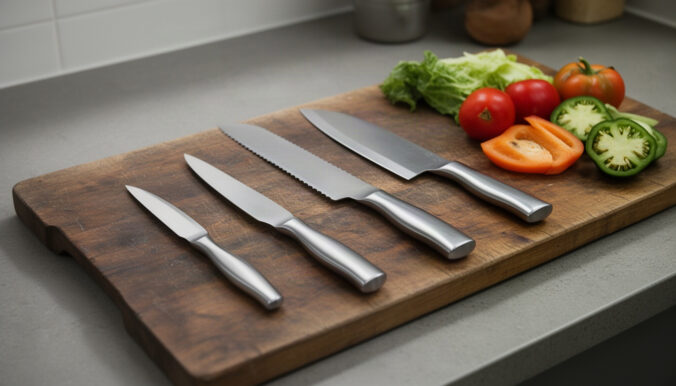
TL;DR: – A three-knife core (chef's knife, paring knife, bread knife) covers 95% of home cooking tasks – most knife sets waste money on pieces you'll never use.
- Price-per-knife math exposes padded sets: a 15-piece set at $89 may deliver only 6 usable cooking knives at ~$14.83 each, while a focused 5-piece at $150 yields $30/knife of far higher quality.
- German steel (softer, tougher) suits heavy-duty cutting; Japanese steel (harder, sharper) holds a finer edge but chips more easily on bones and hard foods.
What Makes a Knife Set Worth Buying for Home Cooks?
According to testing by Consumer Reports, a chef's knife alone can handle about 95% of your cutting in the kitchen. When you buy a large set, you're often paying for knives that will sit unused in your block for years.
A true core knife set includes three essentials: a chef's knife (8-inch), a paring knife, and a serrated bread knife. You only really need these three knives, kitchen shears, and a honing rod. Everything else is nice-to-have, not need-to-have.
The problem with padded sets is the math. Roughly 50% of your budget should go toward the chef's knife, 20–30% toward the paring knife, and 10–15% toward the bread knife. A 15-piece set at $89 often includes six steak knives, kitchen shears, and a honing rod – leaving you with only six or seven actual cooking knives. That's roughly $14.83 per cooking knife. Compare that to a focused 5-piece set at $150, which gives you $30 per knife of far higher quality steel and construction.
Storage matters too. Knife blocks protect edges but can gradually dull blades at slot openings if knives are stored at the wrong angle. Magnetic strips eliminate blade-on-surface contact entirely, preserving edge geometry better – though they require wall mounting.
Key Takeaway: Skip sets with more than 7 pieces unless you're a professional cook. A three-knife core covers 95% of home cooking tasks; anything beyond that dilutes value-per-knife.
How Do You Choose the Right Knife Set for Your Cooking Style?
Everyday Home Cook (3–5 knives): You're making weeknight dinners, prepping vegetables, slicing bread. You need a chef's knife, paring knife, and bread knife. According to testing by multiple culinary sources, a home cook should own three to four knives at minimum.
Meal-Prep Focused (5–7 knives): You're batch-cooking on Sundays, breaking down whole chickens, dicing large quantities. Add a utility knife (6-inch) and a boning knife to your core three.
Occasional Entertainer (7+ knives): You're hosting dinner parties, carving roasts, plating with precision. A santoku knife adds versatility. But be honest: do you really need steak knives in your set, or will you use them twice a year?
German vs. Japanese Steel – The Real Difference:
Japanese steel is harder, so it keeps an edge longer, but it's more prone to chipping if you're cutting through bones or hard items like squash. German steel is softer, so it gets dull quicker, but it's also less brittle and can be kept sharp by a home cook with basic technique. If you're aggressive with your knife, German steel is more forgiving. If you're precise and careful, Japanese steel rewards you with a sharper edge and longer edge retention.
The Break-Even Math:
According to Bon Appétit, buying every knife piecemeal adds a 15–20% tax compared to buying a set – but only if the set includes knives you actually want. Three individual quality knives from Victorinox or Wusthof might cost $50 (chef's) + $30 (paring) + $25 (bread) = $105. A focused 5-piece set from the same brand often retails for $120–$140, saving money and including a utility knife and honing rod. But if you already own a good chef's knife, buying individual paring and bread knives might be cheaper than a full set.
Key Takeaway: Match knife count to cooking frequency: 3 knives for weeknight cooking, 5–7 for meal prep, 7+ only if you entertain regularly. German steel tolerates aggressive use; Japanese steel rewards precision.
Best Knife Sets by Budget: Our Top Picks
Best Knife Sets Under $75
At this price point, you're buying stamped steel (not forged), which means thinner blades and lower edge retention. Under $75, you're better off buying three individual Victorinox knives than a padded set. Victorinox Fibrox knives are Swiss-made and deliver quality at a fraction of the price of German or Japanese competitors (~$95–$120 total for three core knives).
The Mercer Culinary Genesis 6-piece forged knife set (~$90–$110) is worth the slight stretch for beginners. Mercer is widely used in culinary school programs. Price-per-knife: $100 ÷ 6 knives = $16.67/knife. Limitation: the handle grip is narrower than premium brands and may not suit large hands.
| Set Name | Pieces | Steel Type | Price | Best For |
|---|---|---|---|---|
| Mercer Genesis | 6 | Forged German | $90–$110 | Budget-conscious beginners |
| Victorinox Fibrox (individual knives) | 3 core | Stainless | $95–$120 | Cooks who want to buy à la carte |
Best Knife Sets $75–$150
This is the sweet spot for most home cooks. The Victorinox Fibrox Pro 7-piece knife block set (~$120–$140) is a leading recommendation: Swiss-made, full tang construction, comfortable handle. Price-per-knife: $130 ÷ 7 knives = $18.57/knife. Includes 8-inch chef's knife, 6-inch utility knife, 3.25-inch paring knife, serrated bread knife, kitchen shears, honing rod, and wooden block.
The Henckels Modernist 7-piece set (~$130–$160) offers forged German steel at a price that undercuts Wusthof Classic by 60–70%. Note: the Modernist line is entry-level forged; Zwilling J.A. Henckels is the premium line. Price-per-knife: $145 ÷ 7 knives = $20.71/knife.
| Set Name | Pieces | Steel Type | Price | Best For |
|---|---|---|---|---|
| Victorinox Fibrox Pro | 7 | Stainless | $120–$140 | Budget-conscious home cooks |
| Henckels Modernist | 7 | Forged German | $130–$160 | Cooks who want German steel affordably |
Victorinox edges out Henckels for comfort; Henckels edges out Victorinox for edge retention.
Best Knife Sets $150–$300
The Victorinox Fibrox Pro 10-piece set (~$180–$220) adds a 6-inch boning knife and 8-inch carving knife to the 7-piece core. Price-per-knife: $200 ÷ 10 knives = $20/knife. If you don't break down whole birds, stick with the 7-piece.
The Shun Classic 6-piece knife block set (~$350–$400) features VG-MAX steel core with Damascus cladding, sharpened to 16° per side. Price-per-knife: $375 ÷ 6 knives = $62.50/knife. Limitation: Japanese knives require professional sharpening or a whetstone with proper angle guidance – a standard honing rod designed for German knives can damage a Japanese edge. Budget an extra $50–$100 for sharpening tools.
| Set Name | Pieces | Steel Type | Price | Best For |
|---|---|---|---|---|
| Victorinox Fibrox Pro 10-piece | 10 | Stainless | $180–$220 | Cooks who break down whole birds |
| Shun Classic 6-piece | 6 | Japanese VG-MAX | $350–$400 | Precision-focused cooks |
Best Knife Sets $300 and Above
The Wusthof Classic 7-piece slim knife block set is the top pick for home cooks who want a complete, long-lasting German knife collection. Made of molybdenum high carbon steel, it strikes a balance between the brittle (but extra-sharp) steel used in Japanese blades and the softer, more durable steel typical of a Western knife. Price-per-knife: $450 ÷ 7 knives = $64.29/knife. Forged German steel, full tang construction, riveted handles, and knives that will last 20+ years with proper care.
| Set Name | Pieces | Steel Type | Price | Best For |
|---|---|---|---|---|
| Wusthof Classic 7-piece | 7 | Forged German | $400–$500 | Long-term investment |
| Shun Classic 8-piece | 8 | Japanese VG-MAX | $450–$550 | Precision-focused collectors |
Key Takeaway: At $400+, Wusthof Classic and Shun Classic are 20-year investments. Wusthof tolerates aggressive use; Shun rewards precision. Both require proper maintenance to justify the cost.
What Knives Should Every Home Cook's Set Include?
The Non-Negotiable Three:
- Chef's Knife (8-inch): A sharp chef's knife is the most essential tool in your kitchen. Chopping vegetables, slicing meat, mincing herbs – if you buy only one quality knife, make it this one.
- Paring Knife (3–4 inch): For detail work – peeling, deveining shrimp, removing seeds. A cheap paring knife is fine; you're not doing heavy work with it.
- Serrated Bread Knife (8–10 inch): Good for cutting through things like loaves of bread and tomatoes. The serrated edge does the work; you don't need to apply pressure.
Worth-Having Additions:
- Utility Knife (6-inch): Bridges the gap between chef's knife and paring knife for smaller tasks.
- Boning Knife (5–6 inch): Only if you break down whole chickens or trim fat regularly.
- Santoku (7-inch): Japanese alternative to the chef's knife; great for precision slicing, less ideal for rocking motions.
Red Flags in Knife Sets:
- Too many steak knives: A 15-piece set with six steak knives is padding.
- Hollow-handle knives: Prone to breakage at the handle-blade junction under heavy use.
- Unspecified steel type: If the manufacturer won't tell you what steel is in the blade, it's probably low-grade stamped steel.
How to Keep Your Knife Set Sharp and Long-Lasting
Honing vs. Sharpening – The Critical Distinction:
A honing rod doesn't sharpen – it realigns the microscopic edge. Sharpening actually grinds away metal to form a new bevel. You need a honing rod to keep your chef's knife in working order in between sharpening sessions. Use it every 2–3 cooking sessions. A whetstone or pull-through sharpener should be used only 1–2 times per year for typical home cooking frequency. If you cook daily, sharpen quarterly.
The Dishwasher Question: Never put a knife in the dishwasher. The heat, humidity, and jostling dull edges and loosen handles. Even "dishwasher safe" knives last longer with handwashing.
Storage Ranked by Edge Preservation:
- Knife block (edge-up storage): Protects the blade; takes up counter space
- Magnetic strip: Eliminates blade-on-surface contact; requires wall mounting
- Drawer with blade protector: Functional but less protective
- Loose drawer: Worst option; blades bang against other utensils and dull quickly
Key Takeaway: Hone every 2–3 uses; sharpen 1–2 times yearly. Never dishwash. Store edge-up in a block or on a magnetic strip.
Frequently Asked Questions About Kitchen Knife Sets
How much should a home cook spend on a knife set?
$120–$150 for a solid 7-piece set that will last 10+ years, or $50–$80 for three individual quality knives if you prefer à la carte shopping. Roughly 50% of your budget should go toward the chef's knife, 20–30% toward the paring knife, and 10–15% toward the bread knife.
Is it better to buy a knife set or individual knives?
Buy a set if it includes knives you'll use; buy individual knives if you already own a good chef's knife. According to Bon Appétit, buying every knife piecemeal adds a 15–20% tax compared to buying a set, but only if the set includes knives you actually want.
How many knives does a home cook actually need?
Three: a chef's knife, paring knife, and bread knife. Add a utility knife for detail work, or a boning knife only if you break down whole birds regularly.
Are expensive knife sets worth it for everyday cooking?
Only if you'll keep them for 15+ years and maintain them properly. A $120–$150 set delivers strong performance at a fraction of premium pricing. A knife set that cost $150 can last almost a decade if you're meticulous with care.
What knife sets do professional chefs recommend for home use?
Wusthof Classic (German) and Shun Classic (Japanese) are most frequently recommended for home cooks willing to invest $300+. Most chefs won't actually recommend you buy a large knife set – they recommend buying a quality chef's knife and adding others as needed.
Wrapping It Up
You don't need a 15-piece knife set to cook well. You need a sharp chef's knife, a paring knife, a bread knife, and the discipline to maintain them properly.
The best knife set is the one you'll actually use. A $50 Victorinox chef's knife maintained properly will outperform a $200 Wusthof that lives in the dishwasher. The real differentiator is whether you'll treat your knives like tools that deserve care.
Ready to upgrade your kitchen? Knife Depot carries quality options across all budget tiers, from entry-level Victorinox to premium Wusthof and Shun sets. Browse their collection to find the set that matches your cooking style and budget.

Leave a Reply