TL;DR: – The Morakniv Companion (
$20–25, 1095 carbon) is the best budget pick for most campers; the ESEE-5 ($140–155, full tang) dominates heavy-duty backcountry use.
- A 4–5 inch blade balances camp utility with legal carry across most U.S. jurisdictions; full-tang construction outperforms partial-tang under batoning stress.
- Weight matters: a typical fixed blade (5–7 oz) vs. a folding knife (3–4 oz) compounds on long hikes – choose based on trip length and pack weight tolerance.
What Makes a Survival Knife Good for Camping and Hiking?
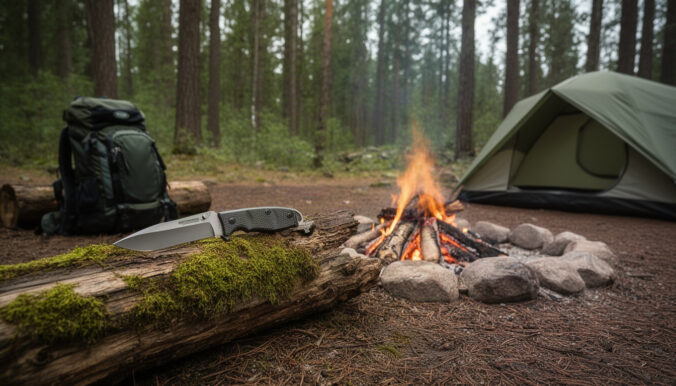
You're standing at the trailhead with a 20-mile day ahead. Your knife needs to handle food prep, fire-starting, and emergency repairs without weighing you down. But what separates a genuinely useful camp knife from gear-store filler?
Here's the thing: day hikers and multi-night backcountry campers have different needs. A day hiker prioritizes weight and packability – a 3-ounce folder or lightweight fixed blade works fine. A backcountry camper doing heavy wood processing needs a robust full-tang blade that can handle batoning (driving the spine through hardwood to split kindling). That's a different knife entirely.
A good rule of thumb is selecting a blade between 4 and 6 inches, which offers control without excess weight. The blade thickness should fall between 1/8 and 1/4 inch, balancing durability with cutting precision.
Handle material matters too. Micarta, G-10, and quality polymer all work – the key is grip security when wet and durability over years of field use. Avoid hollow-handle "survival knives" with compass and fire-starter kits built in; they fail catastrophically under real stress.
How Do Blade Steel Types Affect Survival Knife Performance?
Steel choice is where most campers get confused. You'll see 1095, D2, S30V, VG-10 thrown around – but what do these actually mean for your trip?
High-carbon steel knives are generally tougher and easier to sharpen, while stainless steel knives are generally more brittle but hold their edge longer. That trade-off defines your entire experience in the field.
1095 Carbon Steel is the bushcrafter's choice. It's soft enough to sharpen on a basic whetstone – even a smooth river stone works in a pinch. 1095 carbon resharpens in under 3 minutes on a basic whetstone, critical when you're processing firewood for three days straight. The downside: it rusts if you don't dry it after use. On a humid backcountry trip, you'll need to wipe the blade regularly and apply a thin coat of food-safe mineral oil each night.
Sandvik 12C27 Stainless (used in Mora knives) splits the difference. It's a high-quality Swedish stainless that resists corrosion far better than 1095 while remaining reasonably easy to sharpen. You won't get the field-sharpening speed of carbon steel, but you'll avoid the rust paranoia.
S30V and S35VN are premium stainless grades that hold an edge dramatically longer – S30V holds an edge 2–3x longer than 1095 carbon. The catch: S30V requires 8–12 minutes with diamond equipment to resharpen, and you won't have diamond equipment at camp. These steels suit week-long trips where you can tolerate a dulling edge and sharpen properly at home.
VG-10 is a Japanese stainless favored for wet environments. It resists corrosion exceptionally well, making it ideal for coastal camping or rainforest trips. However, it's harder and more brittle than carbon steel – it can chip under lateral stress like prying or batoning.
| Steel Type | Edge Retention | Ease of Sharpening | Corrosion Resistance | Best For |
|---|---|---|---|---|
| 1095 Carbon | 2–3 days heavy use | Excellent (river stone works) | Poor (needs oil) | Multi-day trips with fire prep |
| 12C27 Stainless | 4–5 days | Good (ceramic rod) | Excellent | Wet environments, casual camping |
| S30V/S35VN | 1–2 weeks | Poor (needs diamond) | Excellent | Week-long trips, minimal sharpening |
| VG-10 | 5–7 days | Good | Excellent | Coastal/humid climates |
For most campers, 1095 carbon or 12C27 stainless hits the sweet spot. You get reliable edge retention, field-sharpenability, and reasonable corrosion resistance without premium pricing.
Key Takeaway: 1095 carbon steel resharpens in minutes on basic stones but requires nightly oil coating in humid conditions; S30V lasts 2–3x longer between sharpenings but demands diamond abrasives and home maintenance.
Top 7 Best Survival Knives for Camping and Hiking (2026)
You've got options at every price tier. Here are the knives that consistently earn field respect across independent reviews and real-world use.
Best Budget Pick: Morakniv Companion (1095 Carbon, ~$20–25)
The Morakniv Companion remains the best value fixed-blade survival knife on the market. Its 1095 carbon steel blade, Scandinavian grind, and polymer handle deliver performance that knives costing 5x more struggle to match. At under $25, it's the knife to buy if you want to test whether you actually like fixed-blade camping knives before investing in premium options.
The 4.1-inch blade handles food prep, fire-starting, and light wood processing. The flat grind excels at feather-sticking for tinder. Weight is negligible – around 3.5 ounces. The only real downside: you'll need to oil it regularly in humid conditions, and the plastic sheath is basic.
Best for: Budget-conscious campers, weekend trips, testing fixed-blade carry before upgrading.
Best Value Fixed Blade: Gerber StrongArm (420HC Stainless, ~$50–60)
The StrongArm's 420HC blade won't win edge-retention competitions, but its rubber handle, full tang, and included Molle-compatible sheath make it an excellent entry point for occasional campers. At $50–60, you get a genuinely durable fixed blade with a sheath that actually works.
The 4.8-inch blade is longer than the Companion, giving you more reach for camp tasks. 420HC stainless won't rust, so you can ignore the nightly oil routine. The trade-off: it dulls faster than carbon steel under sustained cutting, so plan on a touch-up mid-trip.
Best for: Casual campers who prioritize corrosion resistance over edge retention.
Best Lightweight Option: Fallkniven F1 (VG-10 Laminate, ~$100–120)
The F1's VG-10 laminate gives it excellent corrosion resistance with better toughness than solid VG-10. It's the survival knife issued to Swedish Air Force pilots and performs as well in salt spray as in the forest. At 3.8 inches and under 4 ounces, it's the lightest full-tang option here.
The laminate construction – VG-10 stainless sandwiched between softer steel – gives you corrosion resistance without the brittleness of pure VG-10. The Scandinavian grind excels at wood processing. This is the knife for ultralight backpackers who won't compromise on durability.
Best for: Weight-conscious hikers, wet environments, multi-week trips where corrosion matters.
Best for Bushcraft: TOPS Fieldcraft B.O.B. (1095 Carbon, ~$150–175)
The Fieldcraft B.O.B. was designed with survival expertise in mind. Its 1095 blade and Scandi grind make it purpose-built for fire prep, feather sticking, and trap carving. At 4 inches, it's shorter than the ESEE-5 but optimized for the specific geometry that makes bushcraft tasks effortless.
This knife rewards skill. If you're comfortable with wood-processing techniques and want a blade specifically designed for those tasks, the Fieldcraft B.O.B. is worth the premium. The Scandi grind is aggressive – it pushes wood fibers cleanly rather than crushing them.
Best for: Skill-based bushcrafters, fire-starting specialists, multi-day wilderness trips.
Best Full-Tang Fixed Blade: ESEE-5 (1095 Carbon, ~$140–155)
The ESEE-5 is a powerhouse in the world of survival knives, known for its rugged build and dependable performance. With a 5.25-inch full tang, high-carbon steel blade, this knife is built to withstand the toughest conditions. It's the knife for people who will actually put a blade through hell – batoning, prying, heavy chopping. The thick stock and Micarta handles make it one of the most abuse-resistant production knives available.
At 5.25 inches, it's longer than most camp knives, giving you serious chopping power. The 1095 steel resharpens easily in the field. The Kydex sheath holds retention securely even after years of carry. This is the knife that won't fail you on a week-long backcountry expedition.
Best for: Heavy-duty backcountry use, batoning and chopping, multi-week trips where reliability is non-negotiable.
Best Folding Survival Knife: Spyderco Para Military 2 (S35VN, ~$165–185)
The Para Military 2 is arguably the finest production folding knife made. S35VN steel, a compression lock that rivals fixed blades in one-handed deployment security, and G-10 scales that grip in wet and muddy conditions. If you prefer folding knives for EDC carry and want a single blade for both daily use and camping, this is it.
The 3.4-inch blade is shorter than fixed-blade options, but the compression lock mechanism means you get fixed-blade security without the sheath. Weight is around 3.5 ounces. The S35VN edge lasts through a full week-long trip before needing attention.
Best for: EDC enthusiasts, weight-conscious hikers, readers who prefer folding knives for legal carry concerns.
Best Premium Pick: Benchmade Bushcrafter (S30V, ~$180–200)
Benchmade's Bushcrafter earns its price with S30V steel, a Scandinavian grind optimized for wood-processing tasks, and a Boltaron sheath that holds up to years of field carry. At 4.43 inches, it's a mid-size blade that balances reach with packability. The S30V steel holds an edge through extended trips, and the grind geometry is specifically designed for bushcraft work.
This is the knife for readers who've tested budget options and want to invest in something that will last decades. The Boltaron sheath is nearly indestructible, and Benchmade's warranty is solid.
Best for: Serious campers, multi-week trips, readers willing to invest in a knife that becomes a lifelong tool.
Key Takeaway: Budget tier ($20–60) uses 1095 carbon or 420HC stainless; mid-range ($100–155) offers 1095 or 12C27 with full-tang construction; premium ($165+) delivers S30V or S35VN with superior edge retention and refined geometry.
Fixed Blade vs. Folding Knife: Which Should You Choose for Camping?
This decision hinges on your trip type and legal concerns.
Fixed blades are stronger under stress. A full tang knife means that the blade extends the entire length of the handle, providing superior strength and balance. You can baton (drive the spine through hardwood), pry, and abuse the blade without worrying about handle failure. They're faster to deploy – no opening mechanism to fumble with when you need the blade immediately. The downside: they require a sheath, adding bulk to your pack.
Folding knives are lighter and more packable. A quality folder like the Para Military 2 weighs 3–4 ounces versus 5–7 ounces for a comparable fixed blade. They're legal to carry in more jurisdictions – many states restrict fixed-blade length in public spaces but allow folders. The trade-off: folding knives are far more prone to failure than fixed blades because of the mechanism that allows them to collapse, and you can't baton with a folder.
| Factor | Fixed Blade | Folding Knife |
|---|---|---|
| Weight | 5–7 oz (4–5" blade) | 3–4 oz |
| Batoning Capability | Excellent | Poor/impossible |
| Legal Carry | Restricted in some states | Generally more permissive |
| Deployment Speed | Instant | 2–3 seconds |
| Durability Under Stress | Superior | Moderate |
| Packability | Requires sheath | Pocket-carry ready |
For day hikes: A folding knife or lightweight fixed blade (Mora Companion, Fallkniven F1) is ideal. You're not doing heavy wood processing, and weight matters.
For car camping: A fixed blade is overkill, but if you're already carrying one, it works fine. A folder is more practical.
For backcountry trips (3+ nights): A full-tang fixed blade in 1095 carbon or quality stainless is the right choice. You'll process firewood daily, and you need a blade that won't fail under batoning stress.
Key Takeaway: Fixed blades excel at batoning and abuse; folding knives win on weight and legal carry. Choose fixed blade for backcountry trips, folding knife for day hikes or EDC.
How to Maintain Your Survival Knife in the Field
A sharp knife is a safe knife. A dull blade requires more force, increasing accident risk. Here's the three-step field sharpening method that works on most survival knife steels:
Step 1: Reset the bevel. Use a medium-grit pocket whetstone (1000–2000 grit) to restore the blade angle. Work the blade spine-first across the stone at roughly 15–20 degrees, then flip and repeat on the other side. This takes 2–3 minutes on 1095 carbon steel.
Step 2: Refine the edge. Follow with a ceramic rod or fine-grit stone to polish the edge. This removes the scratches from the coarser stone and creates a sharper, more refined edge. One minute per side is usually enough.
Step 3: Strop. If you have a leather strop (a thin piece of leather on a handle), drag the blade spine-first across it to realign the edge. This doesn't remove metal – it just straightens microscopic edge deformation. A strop is optional but dramatically improves edge feel.
For carbon steel blades like 1095, this entire process takes 5–10 minutes. For S30V or S35VN, you'll need diamond abrasives instead of ceramic rod, and it takes 15–20 minutes.
Corrosion prevention: After cleaning your 1095 blade, apply a thin film of food-grade mineral oil or beeswax. This prevents oxidation during humid nights. Wipe it off before food prep the next morning – it's food-safe, but you don't want oily meals.
Sheath care: Kydex sheaths are nearly indestructible but can lose retention tension after 12–18 months of UV exposure. Leather sheaths require occasional conditioning but develop character over time. Check retention monthly and replace if the knife slides out too easily.
Key Takeaway: A three-step field sharpening method (medium stone → ceramic rod → strop) restores working edges on 1095 and stainless steels in under 10 minutes; carbon steel blades need nightly oil coating in humid conditions.
Frequently Asked Questions About Survival Knives for Camping
How much should I spend on a survival knife for camping?
Direct Answer: Budget $20–50 for casual camping, $80–150 for serious backcountry use, and $150+ only if you're committing to a knife as a lifelong tool.
Full-tang fixed blades in 1095 carbon or 420HC steel dominate the $50–$120 sweet spot for most campers. The Morakniv Companion at $20–25 is genuinely capable – it's not a compromise, it's just efficient. If you're doing multi-week backcountry trips with heavy wood processing, the $140–155 ESEE-5 is worth the investment. Premium options ($180+) are for collectors or readers who've tested multiple knives and know exactly what they want.
What is the best blade length for a hiking survival knife?
Direct Answer: 4–5 inches is optimal for most camping and hiking scenarios, balancing utility with legal carry and packability.
A blade length of 4 to 6 inches is generally considered ideal for survival knives, offering a balance between control and cutting power. Anything under 3.5 inches feels cramped for food prep and fire-starting. Anything over 6 inches adds weight and crosses blade-length restrictions in several states. The sweet spot is 4–5 inches – long enough for camp tasks, short enough to remain legal in most U.S. jurisdictions.
Is a fixed blade or folding knife better for backcountry camping?
Direct Answer: Fixed blades are superior for backcountry camping because they handle batoning and heavy wood processing without failure risk.
Folding knives are far more prone to failure than fixed blades because of the mechanism that allows them to collapse. On a multi-night trip where you're processing firewood daily, a full-tang fixed blade is the right choice. Folding knives are ideal for day hikes and EDC, where weight matters and you're not doing heavy chopping.
What blade steel is best for wet or humid outdoor environments?
Direct Answer: VG-10 laminate or quality stainless like 12C27 excel in wet conditions; avoid pure carbon steel unless you're willing to oil the blade nightly.
High-carbon steel knives are generally tougher and easier to sharpen, while stainless steel knives are generally more brittle but hold their edge longer. For coastal camping or rainforest trips, the Fallkniven F1 (VG-10 laminate) or Mora Garberg (12C27 stainless) are ideal. If you choose 1095 carbon steel, plan on a nightly oil routine to prevent rust.
Can I carry a survival knife while hiking on public trails or national parks?
Direct Answer: National parks don't have a universal knife ban, but individual parks and state laws impose blade-length restrictions – typically 3–4 inches in public spaces.
Check your specific state's knife laws before driving to the trailhead. California, New York, and Massachusetts have specific restrictions on fixed-blade carry in public spaces. The NPS website (nps.gov) lists park-specific regulations. Most states allow fixed blades on hiking trails but restrict them in towns and parking areas. A 4–5 inch blade is legal in most jurisdictions, but verify before your trip.
How do I sharpen a survival knife without a whetstone in the field?
Direct Answer: A smooth river stone, ceramic mug rim, or even a leather belt can restore a working edge in a pinch – the key is consistent angle and pressure.
The classic field method: find a smooth river stone, wet it, and work the blade spine-first across it at roughly 15–20 degrees. Flip and repeat on the other side. This takes 5–10 minutes but works on 1095 carbon steel. A ceramic mug rim works similarly. The goal isn't a razor edge – it's a functional blade that cuts food and processes wood. Once you're home, use a proper whetstone for a refined edge.
What is a full-tang knife and why does it matter for survival use?
Direct Answer: A full-tang knife has the blade extending through the entire handle, making it dramatically stronger under stress than partial-tang designs.
A full tang knife means that the blade extends the entire length of the handle, providing superior strength and balance. When you're batoning (driving the spine through hardwood), the stress distributes across the entire handle rather than concentrating at the blade-handle junction. Partial-tang and hollow-handle designs fail catastrophically under batoning. For any serious camping knife, full tang is non-negotiable.
Conclusion
You're standing at the trailhead again. This time, you've got a knife that actually works.
The best survival knife for camping and hiking depends on your trip type and budget. If you're testing fixed-blade carry or hiking weekends, the Morakniv Companion at $20–25 is genuinely capable. For serious backcountry trips with heavy wood processing, the ESEE-5 or Benchmade Bushcrafter justify their premium price through reliability and edge retention.
Steel choice matters: 1095 carbon resharpens in minutes but needs nightly oil; S30V lasts 2–3x longer between sharpenings but demands diamond abrasives. A 4–5 inch full-tang blade covers ~90% of camping tasks while remaining legal in most jurisdictions.
The knife you choose becomes part of your kit. It processes firewood, preps meals, handles emergencies. Pick one that matches your trip type and commit to maintaining it. A sharp, well-maintained blade is a safe blade – and a reliable companion on the trail.
Leave a Reply