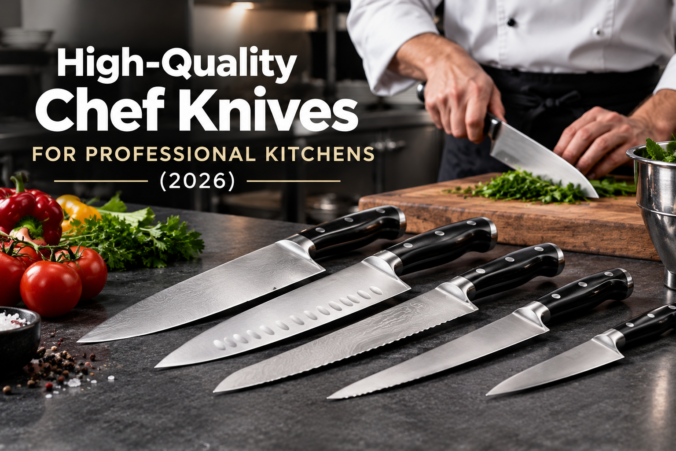
TL;DR: – Professional-grade chef knives are defined by HRC 57–62 hardness, full-tang construction, and NSF-certified handles – not brand prestige.
- German steel (X50CrMoV15 at 56–58 HRC) chips less under bone stress; Japanese steel (VG-10 at 60–62 HRC) holds an edge 3× longer between sharpenings.
- Best value: Victorinox Fibrox Pro (
$45, NSF-certified); mid-tier: Wüsthof Classic ($160); elite: Shun Premier (~$200). - Maintenance determines lifespan more than initial quality – neglect honing and monthly sharpening, and a $300 knife degrades to $50 performance within 18 months.
What Makes a Chef Knife “Professional Quality”?
You’re standing in a commercial kitchen evaluating two 8-inch chef knives. One costs $45; the other costs $300. The difference isn’t marketing – it’s measurable metallurgy and construction standards that directly impact your workflow.
Professional-grade chef knives are defined by four non-negotiable criteria: blade steel hardness (HRC rating), full-tang construction, edge angle precision, and handle materials that meet commercial food safety standards. According to Consumer Reports, “A chef’s knife can really do about 95 percent of your cutting in the kitchen,” which means your primary knife must perform across diverse tasks – from breaking down proteins to fine vegetable work.
Blade Steel: The Single Biggest Quality Factor
Steel hardness, measured on the Rockwell Hardness Scale (HRC), determines how long your knife stays sharp and how difficult it is to resharpen. According to The Cooking Guild, “For kitchen knives the useful window is narrow: 54–57 HRC is soft, very tough, dulls quickly; 57–59 HRC is the German sweet spot; 59–62 HRC is the Japanese sweet spot; 62+ HRC is specialist territory.”
Here’s what this means in practice:
- German steel (X50CrMoV15) at 56–58 HRC: Tougher, more forgiving under lateral stress (like hitting bone), but requires sharpening every 2–3 weeks with heavy use.
- Japanese steel (VG-10, AUS-10) at 59–62 HRC: Holds an edge significantly longer between sharpenings, but chips more easily if twisted or used on frozen items.
The Cooking Guild clarifies the trade-off: “Harder steel holds an edge longer but is more brittle; tougher steel forgives a careless twist but dulls sooner.”
Construction Standards: Full Tang, Bolster, and Handle Materials
Full-tang construction – where the steel runs the entire length of the handle – distributes weight evenly and prevents handle loosening after months of heavy use. Cozzini Bros notes that “with proper care, forged knives will last a lifetime,” but this assumes full-tang construction and appropriate materials.
NSF/ANSI Standard 2 certification is non-negotiable for commercial kitchens. Wood handles fail this standard because they absorb bacteria and moisture. Victorinox Fibrox Pro handles are NSF-certified, making them appropriate for use in commercial foodservice environments. Polypropylene and composite handles meet food safety requirements that wood cannot.
Key Takeaway: Professional knives require HRC 57–62 hardness, full-tang construction, and NSF-certified handles. German steel suits high-volume protein prep; Japanese steel suits precision vegetable work. Handle material matters more than blade aesthetics in commercial settings.
German vs Japanese Chef Knives: Which Is Right for Your Kitchen?
The German vs. Japanese knife debate isn’t about tradition – it’s about operational fit. Your choice depends on what you’re cutting, how often you sharpen, and whether your line cooks have access to professional sharpening services.
German-style knives (Wüsthof, Henckels) use lower hardness steel (56–58 HRC) with a 14° edge angle per side. They’re forgiving under stress and require less frequent sharpening. Japanese-style knives (MAC, Shun, Global) use harder steel (59–62 HRC) with a 15° edge angle or less, producing a more acute, sharper edge that dulls faster but cuts more cleanly.
| Factor | German (Wüsthof, Henckels) | Japanese (MAC, Shun, Global) |
|---|---|---|
| Steel Hardness | 56–58 HRC | 59–62 HRC |
| Edge Angle | 14° per side | 15° per side |
| Edge Retention | 2–3 weeks (heavy use) | 4–6 weeks (heavy use) |
| Chip Resistance | High (forgiving) | Moderate (requires care) |
| Sharpening Frequency | Monthly | Every 4–6 weeks |
| Best For | Bone work, high-volume prep | Precision vegetable work, fine dining |
| Maintenance Difficulty | Low | Moderate |
When German-Style Knives Win in Professional Settings
High-volume protein stations demand durability over edge retention. If your line cooks are breaking down 200 chickens per shift, a German knife’s toughness prevents chips and handle stress. Cozzini Bros emphasizes that “a Chef’s Knife will work great for meats, fish, vegetables and fruit, whether you’re chopping, mincing, slicing or dicing,” but German construction excels under repetitive bone contact.
German knives also tolerate inconsistent sharpening. If your kitchen lacks a professional sharpening service, a German knife at 56–58 HRC remains serviceable longer than a Japanese knife that chips when neglected.
When Japanese-Style Knives Are Worth the Investment
Fine-dining kitchens and prep-focused stations benefit from Japanese precision. A 15° edge angle produces paper-thin vegetable slices impossible with a 14° German blade. Bon Appétit’s testing found that “this great knife from Japanese brand Mac checked all of the boxes in head-to-head knife tests: It’s sharp enough to glide through food and produce paper-thin slices, lightweight enough to allow for nimble movements, and comfortable enough for you to make your way through a mountain of onions without your hand cramping up.”
Japanese knives also reduce fatigue on long shifts. Lighter weight and sharper edges mean less force required per cut – critical for preventing repetitive strain injuries.
Key Takeaway: German knives suit high-volume protein prep and inconsistent maintenance; Japanese knives suit precision work and kitchens with professional sharpening access. Choose based on your primary task, not tradition.
Top High Quality Chef Knives by Price Tier (2026)
Professional knife selection isn’t about finding the “best” – it’s about matching your budget to realistic durability and performance expectations. Here’s how to evaluate each tier.
$80–$150: Best Value Professional Chef Knives
Victorinox Fibrox Pro 8-inch (~$45–$50)
This is the dominant value knife in culinary schools and commercial kitchens. Bon Appétit’s testing notes that “the Victorinox Fibrox Pro is our top pick for budget-minded cooks and culinary students – its stamped blade and Swiss stainless steel hold a serviceable edge at a price point no forged knife can match.”
Stamped construction (not forged) means lower hardness (~56 HRC) and softer steel, requiring more frequent honing. But the NSF-certified Fibrox handle meets commercial food safety standards, and the cost-per-year calculation is unbeatable: $45 ÷ 5 years = $9/year.
Mercer Culinary Genesis 8-inch (~$40–$55)
Cozzini Bros identifies Mercer as the primary supplier to US culinary schools. The Genesis features German X50CrMoV15 steel in a forged construction with full tang and NSF-certified Santoprene handle – appropriate for commercial compliance.
$150–$250: Mid-Tier Knives Used in Professional Kitchens
Wüsthof Classic 8-inch (~$160–$175)
Tech Gear Lab’s testing found that “the Wusthof Classic 8″ offers the best balance of cutting performance, practicality, and build quality.” Their lab measured the hardness of its X50CrMoV15 steel at 54 HRC (note: manufacturer specs vary slightly).
The Classic features a full bolster, triple-riveted handle, and precision-ground edge. Cost-per-year: $160 ÷ 5 years = $32/year. The higher cost reflects superior steel and construction that reduces sharpening labor costs over time.
MAC Professional Series MTH-80 (~$145–$165)
Bon Appétit identifies MAC as a top performer: “After years of testing this knife against other models, it’s continually come out on top.” The MTH-80 features high-carbon steel at approximately 59–61 HRC with a 15° edge angle and comfortable handle.
$250–$400+: Elite Chef Knives for Serious Professionals
Shun Premier 8-inch (~$180–$210)
The Shun Premier uses VG-MAX steel core (evolution of VG-10) at approximately 60–61 HRC clad in 68 layers of Damascus stainless. This is a Japanese precision knife for kitchens with professional sharpening access and fine-dining standards.
Miyabi Birchwood SG2 8-inch (~$300–$380)
Miyabi Birchwood knives feature SG2 micro-carbide powder steel core hardened to 63 HRC, surrounded by 100 layers of flower Damascus steel. This is specialist territory – SG2 requires diamond whetstones for field sharpening, making it impractical for most line cooks during service. Reserve this for head chefs or dedicated prep stations with professional sharpening infrastructure.
Key Takeaway: Victorinox Fibrox Pro ($45, 5-year cost = $9/yr) dominates culinary schools; Wüsthof Classic ($160, $32/yr) balances durability and cost; Shun Premier ($200) suits fine-dining precision work. Choose based on sharpening access and primary task, not prestige.
How Do You Maintain a Professional Chef Knife to Last 10+ Years?
Here’s the uncomfortable truth: maintenance determines lifespan more than initial quality. A $300 knife neglected for 18 months performs worse than a $50 knife maintained weekly.
Professional knife maintenance requires two distinct practices: honing (realigning the edge) and sharpening (removing steel to create a new edge). Most cooks conflate these, leading to under-sharpening and over-honing.
Honing vs Sharpening: What Professional Kitchens Actually Do
Honing realigns a bent edge without removing metal. Sharpening removes metal to create a new edge geometry. For a line cook using a knife 6 hours/day, the schedule is:
- Before every shift: 2-minute honing on a honing rod (realigns edge)
- Monthly: Whetstone sharpening session (creates new edge)
- Quarterly: Professional sharpening service (if available)
Serious Eats’ guidance emphasizes: “For professional use, hone before each shift on a honing rod to maintain alignment. A whetstone sharpening session every 4-6 weeks is appropriate for daily professional use.”
The whetstone grit progression for professional maintenance:
- 220–400 grit: Chipped edge repair
- 1000 grit: Routine sharpening
- 3000–6000 grit: Refinement
- 8000+ grit: Polishing (fine-dining prep work)
Professional Knife Storage That Protects Your Investment
Storage method directly impacts blade longevity and kitchen safety. Food & Wine’s guidance identifies three professional approaches:
- Knife rolls: Ideal for cooks moving between stations or kitchens. Protects blade and handle during transport.
- Magnetic strips: Preferred for fixed workstations. Requires non-ferromagnetic wall surface.
- Blade guards: Essential for transport and shared storage spaces. Prevents edge damage and cuts.
Never store knives loose in drawers – this dulls edges and creates injury hazards.
Key Takeaway: Hone before every shift (2 min); sharpen monthly on whetstones; use professional sharpening quarterly if available. Storage method (knife roll vs. magnetic strip) matters less than consistency. Neglect maintenance, and a $300 knife becomes a $50 performer within 18 months.
What Should You Look for When Buying a Chef Knife for a Commercial Kitchen?
Professional procurement differs from home cook shopping. You’re evaluating compliance, durability under high-volume use, and total cost of ownership – not aesthetics.
Your professional knife buying checklist:
- NSF/ANSI 2 certification: Verify the handle is NSF-certified. Wood handles fail commercial kitchen health inspections. Polypropylene and composite handles meet food safety standards.
- Full-tang construction: Ensures weight distribution and prevents handle loosening after months of heavy use. Avoid partial-tang or rat-tail designs.
- Steel hardness (HRC rating): Confirm the blade is 56–62 HRC. Below 56 HRC dulls too quickly; above 62 HRC requires diamond whetstones most line cooks lack access to.
- Edge angle: German knives (14° per side) suit high-volume protein work; Japanese knives (15° per side) suit precision vegetable work. Verify the angle matches your primary task.
- Weight and balance: Consumer Reports emphasizes that “an 8-inch chef’s knife is the most common size, and in culinary circles it’s widely viewed as hitting the sweet spot: long enough to cut through large foods like a roast but not so long that it’s unwieldy or difficult to hold.” A knife that’s too heavy causes fatigue on 8-hour shifts; too light feels unstable.
- Handle ergonomics: OSHA identifies repetitive motion injuries as a top occupational hazard in food preparation. Ergonomic handle design reduces cumulative injury risk over long shifts.
- Sharpening accessibility: Can your kitchen sharpen this steel in-house? SG2 powder steel (63 HRC) requires diamond whetstones; German steel (56–58 HRC) works with standard water stones.
- Warranty and support: Professional knives should include a warranty covering manufacturing defects. Verify the manufacturer offers replacement or repair services.
Key Takeaway: Prioritize NSF certification, full-tang construction, and HRC 57–62 hardness. Match edge angle to your primary task (German for protein, Japanese for vegetables). Verify your kitchen can sharpen the steel in-house. Compliance and maintainability matter more than brand prestige.
Frequently Asked Questions
How much should a professional chef knife cost?
Direct Answer: Budget $45–$160 for a professional-grade knife that will last 5+ years with proper maintenance. Elite knives ($250–$400+) offer marginal performance gains unless you have professional sharpening access and fine-dining precision requirements.
The cost-per-year calculation reveals the true value. A Victorinox Fibrox Pro at $45 costs $9/year over 5 years; a Wüsthof Classic at $160 costs $32/year. The Wüsthof’s superior steel reduces sharpening labor costs, but for most commercial kitchens, the Victorinox delivers strong performance at a significantly lower cost.
What is the difference between a German and Japanese chef knife?
Direct Answer: German knives (56–58 HRC, 14° edge angle) are tougher and more forgiving under stress; Japanese knives (59–62 HRC, 15° edge angle) hold an edge longer but chip more easily. Choose German for high-volume protein prep; choose Japanese for precision vegetable work.
The Cooking Guild clarifies: “Harder steel holds an edge longer but is more brittle; tougher steel forgives a careless twist but dulls sooner.” German knives require sharpening every 2–3 weeks with heavy use; Japanese knives require sharpening every 4–6 weeks.
Which chef knife steel is best for professional kitchen use?
Direct Answer: German X50CrMoV15 (56–58 HRC) for high-volume protein stations; Japanese VG-10 or AUS-10 (59–62 HRC) for precision vegetable work. Avoid SG2 powder steel (63 HRC) unless your kitchen has professional diamond whetstone sharpening access.
The Cooking Guild recommends: “For most home cooks, a Japanese stainless steel in the 59–61 HRC range such as AUS-10 or 10Cr15CoMoV gives the best balance of sharpness, edge retention and low maintenance.” This guidance applies equally to professional kitchens with consistent sharpening access.
How often should a professional chef sharpen their knife?
Direct Answer: Hone before every shift (2 minutes); sharpen on whetstones monthly; use professional sharpening quarterly if available. Neglecting this schedule degrades even elite knives within 18 months.
The honing-vs-sharpening distinction is critical. Honing realigns the edge without removing steel; sharpening removes steel to create a new edge. Most cooks hone too often and sharpen too rarely, leading to premature dulling.
Are expensive chef knives worth it for home cooks?
Direct Answer: No. Home cooks use knives 2–3 hours per week; professionals use them 6+ hours per day. A $50 Victorinox Fibrox Pro meets home cook needs indefinitely. Spend $150+ only if you’re sharpening monthly and using the knife professionally.
Bon Appétit’s testing confirms: “the quest for the best chef’s knife has a lot to do with you – your skill level, your commitment to knife care, even how big your hands are.” Home cooks typically lack the maintenance discipline to justify elite knives.
What chef knife brands do professional chefs actually use?
Direct Answer: Victorinox Fibrox Pro (culinary schools), Wüsthof Classic (high-volume kitchens), MAC Professional (fine-dining precision work), and Mercer Culinary (commercial training). Brand prestige matters less than NSF certification and steel hardness.
Bon Appétit’s extensive testing found that “I’ve spent the past several years testing 42 models both in my home kitchen and in the BA Test Kitchen.” Professional kitchens prioritize durability and compliance over brand recognition.
Can you put a high quality chef knife in the dishwasher?
Direct Answer: No. Never put any chef knife in the dishwasher. High heat, harsh detergents, and vibration damage the blade edge, dull the edge permanently, and loosen handle rivets. Hand wash immediately after use and dry with a cloth.
Dishwasher damage is irreversible and voids manufacturer warranties. This applies equally to $50 and $300 knives.
Conclusion
Professional-grade chef knives aren’t defined by brand prestige or price – they’re defined by measurable standards: HRC 57–62 hardness, full-tang construction, NSF-certified handles, and edge angles matched to your primary task.
The Victorinox Fibrox Pro at $45 delivers strong performance for a fraction of the cost of a $300 Shun Premier. The Wüsthof Classic at $160 balances durability and cost-per-year value. Elite knives ($250–$400+) offer marginal gains only if your kitchen has professional sharpening access and fine-dining precision requirements.
Maintenance determines lifespan more than initial quality. Hone before every shift, sharpen monthly on whetstones, and use professional sharpening quarterly. Neglect this schedule, and even a $300 knife degrades to $50 performance within 18 months.
Ready to upgrade your kitchen? Knife Depot offers professional-grade chef knives across all price tiers, with NSF-certified handles and verified steel specifications. Start with a Victorinox Fibrox Pro if you’re testing the waters, or invest in a Wüsthof Classic if you’re committing to professional-level maintenance.

Leave a Reply