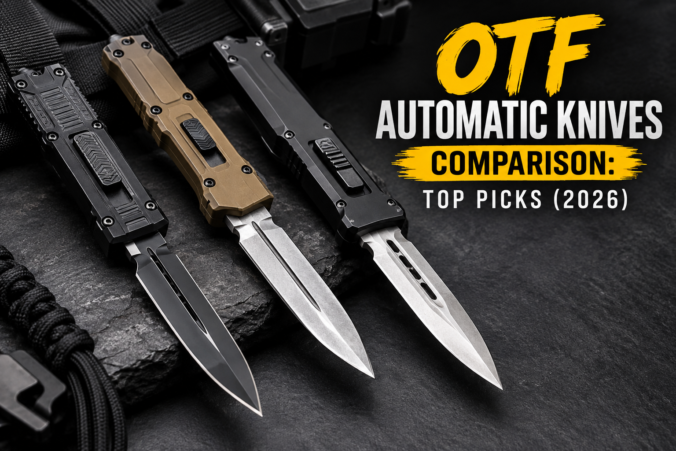
TL;DR: – OTF knives deploy the blade straight out the front via a button or slider; double-action models retract with the same mechanism, while single-action requires manual reset
- Budget OTFs ($30–$80) use 440C steel; mid-range ($80–$200) step up to D2 or 154CM; premium ($200+) feature M390 or S35VN
- OTF legality varies dramatically by state – legal in 46+ states but banned or heavily restricted in California (under 2"), New York, Illinois, and Washington
- Double-action OTFs have more moving parts but offer safer EDC carry; single-action designs are simpler and favored by duty professionals
What Makes an OTF Knife Different From Other Automatics?
An OTF (Out-the-Front) knife is a type of automatic knife where the blade travels forward through the front of the handle and locks into the open position, then retracts back into the handle with the same trigger mechanism. This axial deployment is the defining characteristic – the blade shoots straight out, not to the side like a traditional switchblade or assisted opener.
Here's where mechanism type matters: OTF knives are a type of switchblade – that is, an automatic knife which deploys the blade 'automatically' on pressing a button or switch. But within that category, there are two types of OTF knives: single action and dual action. A single-action OTF fires open when you press the button but requires you to manually push the blade back in. A double-action OTF both deploys and retracts using the same slider – press once to open, press again to close. This functional difference affects reliability, maintenance, and how safely you can carry the knife.
According to the Best Automatic Knives of 2026: From Budget EDC to High-End guide from pvk.com, the choice between OTF and side-opening automatics isn't about which is objectively better – it's about which design fits how you actually carry and use your knife. OTF designs excel when axial deployment suits your workflow; side-opening automatics offer a different ergonomic profile that some users prefer.
Why does this matter for your purchase? Double-action mechanisms contain more internal components (dual springs, cam systems) than single-action designs, which increases potential failure points but improves safe carry utility. If you're buying an OTF for everyday carry, the mechanism type directly impacts how you'll use it in real situations.
Key Takeaway: OTF knives deploy axially (straight out the front), not sideways. Single-action requires manual reset; double-action retracts with the same button. Choose based on your carry style and maintenance comfort level.
How Do OTF Knife Price Tiers Compare?
Price tiers in OTF knives correlate directly to blade steel grade, handle material, and manufacturing tolerance. Understanding what you gain or lose at each tier prevents buyer's remorse.
Budget tier ($30–$80): These OTFs typically use 440C stainless or Chinese equivalents like 8Cr13MoV. Handles are usually zinc alloy (Zamak) or cast aluminum. Spring consistency varies, and lock-up play (the wiggle in the blade when deployed) is often noticeable. Warranty coverage is minimal or nonexistent. Real-world edge retention is poor – you'll notice dulling after moderate cutting tasks. These knives work for novelty carry or collection, but don't expect thousands of reliable deployment cycles.
Mid-range tier ($80–$200): This is where premium brands engineer their spring systems to last tens of thousands of cycles. Blade steel steps up to D2 or 154CM. Handles are 6061-T6 aluminum or glass-filled nylon. Lock-up is tighter. Manufacturer warranties typically cover defects for 1–2 years. These knives are genuinely reliable for EDC and light duty use. The jump from budget to mid-range is the most meaningful upgrade you can make.
Premium tier ($200+): Blade steels are M390, S35VN, or CPM-20CV – all powder metallurgy steels with superior edge retention and corrosion resistance. Handles are titanium, G10, or aerospace-grade aluminum. Fit and finish are meticulous. Warranties are often lifetime. A quality OTF knife from a reputable manufacturer is designed to handle tens of thousands of deployment cycles before the spring shows meaningful wear. These are professional-grade tools or serious collector pieces.
The math: A $50 budget OTF with 440C steel will dull noticeably faster than a $180 model with D2 – roughly 3–4x fewer edge-holding cycles in real-world cutting. If you replace the budget knife twice, you've spent $100 and still have an inferior tool. One mid-range OTF with a manufacturer warranty equals three budget knives in total cost of ownership.
California-legal OTFs (blades under 2 inches) typically fall into the $60–$150 range, depending on brand and steel. You're paying a slight premium for the legal compliance engineering, but the price tier logic remains the same.
Key Takeaway: Mid-range OTFs ($80–$200) offer the best value – D2 or 154CM steel, reliable springs, and manufacturer support. Budget models dull 3–4x faster; premium models justify cost only if you need titanium handles or collector-grade aesthetics.
OTF Automatic Knives Comparison: 6 Top Models Ranked
| Model | Blade Steel | Blade Length | Mechanism | Handle Material | Price | Best For |
|---|---|---|---|---|---|---|
| Kershaw Launch 1 | CPM-154CM | 3.4" | Single-Action | 6061-T6 Aluminum | ~$160 | Mid-range EDC |
| Boker Warcom | D2 | 3.54" | Double-Action | Aluminum | ~$90 | Budget value |
| Hogue HK Exemplar | 154CM | 3.5" | Double-Action | Glass-filled Nylon | ~$130 | Humid climates |
| Microtech Ultratech | M390 | 3.46" | Double-Action | 6061-T6 Aluminum | ~$270–$320 | Premium DA benchmark |
| Benchmade Infidel | D2 | 3.91" | Single-Action | 6061-T6 Aluminum | ~$500+ | Duty/tactical |
| CobraTec Speedloader | 154CM | 3.5" | Double-Action | Aluminum | ~$110 | Compact carry |
Budget Pick (Under $80)
The Boker Warcom delivers surprising value at street price around $90. It features a 3.54" D2 blade with a double-action mechanism and aluminum handle. D2 steel at this price point is a verified value proposition – you're getting tool-steel edge retention without paying premium prices. The deployment is snappy, and the retraction is smooth. Real-world feedback from the enthusiast community is positive for the price. The catch: tolerances aren't as tight as mid-range models, and the warranty is limited. If you're testing whether OTF carry suits your workflow before investing in a premium knife, this is a solid entry point.
Mid-Range Pick ($80–$200)
The Kershaw Launch 1 sits at approximately $160 and represents the sweet spot for EDC. It uses CPM-154CM blade steel (a powder metallurgy variant of 154CM with more consistent carbide distribution), a 3.4" blade, and a button-activated single-action mechanism. Note: the Launch uses a side-panel button rather than a traditional slider – technically a "button-activated automatic" rather than a slider-OTF, but it functions identically for carry purposes. The aluminum handle is comfortable, and the deployment is reliable. Companies like Benchmade, CRKT, Kershaw, and Buck, all make automatic knives to the same standards as their other hardworking blades. This knife balances performance, price, and brand reputation. It's the model most first-time OTF buyers choose, and for good reason.
Premium Pick ($200+)
The Microtech Ultratech is the benchmark double-action OTF. At $270–$320 depending on configuration, it features a 3.46" Bohler M390 blade, 6061-T6 aluminum handle, and dual-action deployment. M390 is a premium stainless powder steel that holds an edge exceptionally well and resists corrosion. The Ultratech has been refined over decades and represents the reliability standard for double-action OTFs. If you want a knife that will deploy smoothly 10,000+ times without failure, this is it. The premium price reflects engineering precision, not marketing hype.
Key Takeaway: Kershaw Launch 1 ($160) is the best mid-range EDC choice; Boker Warcom ($90) offers budget value with D2 steel; Microtech Ultratech ($270–$320) is the premium DA benchmark for collectors and professionals.
Single-Action vs. Double-Action OTF: Which Should You Choose?
Direct answer: Single-action OTFs are simpler, cheaper, and favored by duty professionals. Double-action OTFs are safer for EDC because you can close the blade without a surface to push against.
Here's the mechanical difference: A single-action OTF has one spring that fires the blade forward. You press the button, the blade shoots out, and it locks. To retract, you manually push the blade back in – it requires a surface or your hand to apply pressure. A double-action OTF has a more complex spring or cam system that allows the same button to both deploy and retract. Press once, blade opens. Press again, blade closes.
| Criterion | Single-Action | Double-Action |
|---|---|---|
| Deployment Speed | Faster (single spring) | Slightly slower (dual mechanism) |
| Retraction | Manual (requires surface) | Button-activated |
| Moving Parts | Fewer (lower failure risk) | More (higher complexity) |
| EDC Safety | Riskier (blade stays out) | Safer (controlled retraction) |
| Price | Lower | Higher |
| Maintenance | Simpler | More involved |
Use case guidance: If you're a collector or duty professional who understands knife safety and has a controlled environment, single-action is fine. If you're carrying an OTF in your pocket for everyday use, double-action is the smarter choice. You don't want your blade locked open in your pocket if you need to close it quickly.
Durability note: Single-action mechanisms have fewer moving parts, which theoretically means fewer failure points. But double-action designs have been refined for decades. The added complexity doesn't translate to unreliability if the knife is well-engineered. The real difference is maintenance frequency – double-action OTFs benefit from periodic lubrication more than single-action models.
Key Takeaway: Single-action OTFs are simpler and cheaper; double-action OTFs are safer for EDC because you control retraction. Choose SA for duty/collection, DA for everyday carry.
Are OTF Automatic Knives Legal in Your State?
Direct answer: OTF legality varies dramatically by state and blade length. OTF knives are legal to own and carry in 46+ states as of 2026, but several states impose strict restrictions or bans.
The Federal Switchblade Act of 1958 restricts interstate commerce of automatic knives. The federal law restricts interstate commerce of automatic knives but does not prohibit personal ownership or carry in most states. However, individual states have their own rules, and those rules shift regularly.
Quick-reference legality table (10 most-searched states):
| State | Status | Notes |
|---|---|---|
| California | Restricted | Blade must be under 2" |
| Texas | Legal | No restrictions as of 2017 |
| Florida | Legal | No specific OTF prohibition |
| New York | Prohibited | All automatic knives banned |
| Illinois | Prohibited | Switchblade carry illegal |
| Arizona | Legal | No restrictions for adults |
| Washington | Prohibited | Spring-blade knives banned |
| Michigan | Legal | Automatic knives legal since 2017 |
| Connecticut | Restricted | Blade must be under 1.5" |
| Pennsylvania | Legal | No specific restrictions |
California-legal OTF explanation: Under state law, you can legally own and carry an automatic knife, but if you want a california legal otf knife, the blade must be strictly under 2 inches in length. A California-legal OTF has a blade under 2 inches, which exempts it from the switchblade definition under California Penal Code §17235. You can own and carry these knives in California without legal risk. Knife Depot carries California-compliant red OTF models if you're shopping in the state.
Critical disclaimer: This is general guidance only. Knife laws change, and local ordinances may be stricter than state law. Consult your local law enforcement or a lawyer before carrying an OTF in any state. Ignorance of the law is not a defense.
Key Takeaway: OTF knives are legal in 46+ states but banned in New York, Illinois, and Washington. California allows blades under 2". Always verify your local laws before purchase or carry.
What to Look for When Comparing OTF Knives
When you're narrowing down your choices, focus on five key criteria:
1. Blade steel: This determines edge retention and maintenance burden. D2 holds an edge well but requires diligent maintenance in humid climates (it will rust without care). 154CM and CPM-154CM offer better corrosion resistance and are ideal for coastal or humid EDC. M390 and S35VN are premium choices – M390 holds an edge longer but is more brittle under impact stress; S35VN balances toughness with corrosion resistance. For EDC, prioritize 154CM or D2 over 440C, which dulls noticeably faster.
2. Deployment mechanism: Single-action or double-action? Single-action is simpler and cheaper; double-action is safer for EDC. Consider your carry environment and comfort level with manual blade retraction.
3. Blade length: Most OTF blades range from 3" to 4". Shorter blades (under 3") are easier to conceal but less versatile. Longer blades (3.5"+) offer more cutting utility but are bulkier. Check your state's legal limits – some states cap blade length at 2" or 1.5".
4. Handle ergonomics: Does the knife fit your hand comfortably? Aluminum handles are lightweight; titanium is premium but heavier. Glass-filled nylon is durable and affordable. Test the grip if possible before buying.
5. Warranty and service: Reputable manufacturers (Benchmade, Microtech, Kershaw) offer warranties and repair services. Budget brands often don't. A $150 knife with a lifetime warranty is better than a $100 knife with no recourse if the spring fails.
Maintenance note: OTF tolerances are tighter than folding knives, which means they require periodic cleaning and lubrication. If you're not willing to maintain your knife, buy a simpler folding model. Microtech recommends periodic lubrication of OTF mechanisms with light oil applied to the deployment channel. Avoid WD-40, which attracts debris.
Key Takeaway: Prioritize blade steel (154CM or D2 for EDC), mechanism type (DA for carry safety), and warranty coverage. OTF knives require periodic maintenance – factor that into your decision.
Frequently Asked Questions About OTF Knife Comparisons
What Makes an OTF Knife Different From Other Automatics?
An OTF (Out-the-Front) knife is a type of automatic knife where the blade travels forward through the front of the handle and locks into the open position, then retracts back into the handle with the same trigger mechanism. This axial deployment is the defining characteristic – the blade shoots straight out, not to the side like a traditional switchblade or assisted opener.
How Do OTF Knife Price Tiers Compare?
Price tiers in OTF knives correlate directly to blade steel grade, handle material, and manufacturing tolerance. Understanding what you gain or lose at each tier prevents buyer's remorse.
Single-Action vs. Double-Action OTF: Which Should You Choose?
Direct answer: Single-action OTFs are simpler, cheaper, and favored by duty professionals. Double-action OTFs are safer for EDC because you can close the blade without a surface to push against.
Are OTF Automatic Knives Legal in Your State?
Direct answer: OTF legality varies dramatically by state and blade length. OTF knives are legal to own and carry in 46+ states as of 2026, but several states impose strict restrictions or bans.
How much should I spend on an OTF automatic knife?
Direct Answer: Budget $80–$200 for a reliable EDC OTF. Budget models ($30–$80) dull quickly; premium models ($200+) justify cost only if you need collector-grade aesthetics or professional duty use.
The mid-range tier ($80–$200) offers the best value-to-performance ratio. You get D2 or 154CM blade steel, reliable springs, and manufacturer support. A $150 OTF with a warranty is better long-term than a $50 knife with no recourse if it fails.
Are OTF knives legal to carry in California?
Direct Answer: OTF knives with blades under 2 inches are legal in California. Blades 2 inches or longer are classified as switchblades and are illegal to carry in public.
California has a 2-inch blade length limit for automatic knives. You can own a full-size OTF at home, but carry is restricted to sub-2" models. Always verify current law before purchase.
Which OTF knife blade steel is best for everyday carry?
Direct Answer: 154CM or CPM-154CM is the best EDC choice – it balances edge retention, corrosion resistance, and sharpenability. D2 is a close second if you're in a dry climate and willing to maintain it.
154CM resists corrosion better than D2 and resharpens more easily than harder powder metallurgy steels. M390 holds an edge longer but is overkill for EDC and more brittle under impact stress. For everyday carry, 154CM is the practical sweet spot.
How durable are budget OTF knives compared to premium models?
Direct Answer: Budget OTF knives (440C steel, $30–$80) dull 3–4x faster than mid-range models (D2 or 154CM, $80–$200) in real-world cutting tests. Spring consistency is also less reliable.
Budget knives work for novelty carry or collection, but don't expect thousands of reliable deployment cycles. If you replace a budget knife twice, you've spent more than one mid-range OTF and still have an inferior tool.
What blade length should I look for in an OTF knife?
Direct Answer: 3" to 3.5" is the practical range for EDC. Shorter blades (under 3") are easier to conceal; longer blades (3.5"+) offer more cutting utility but are bulkier.
Check your state's legal limits – some states cap blade length at 2" or 1.5". Most OTF knives fall into the 3" to 4" range. Choose based on your carry environment and intended use.
Can OTF automatic knives be sharpened and maintained at home?
Direct Answer: Yes, but OTF maintenance is more involved than folding knives. You'll need to disassemble the knife, clean the deployment channel, and apply light oil periodically.
Microtech recommends periodic lubrication of OTF mechanisms with light oil applied to the deployment track. Avoid petroleum-based solvents like WD-40, which can wash away lubrication and attract debris. If you're not comfortable with disassembly, send your knife to the manufacturer for service.
Ready to Get Started?
For personalized guidance, visit Knife Depot to learn how we can help.
Conclusion
Choosing an OTF automatic knife comes down to three decisions: mechanism type (single-action or double-action), blade steel (D2, 154CM, or premium powders), and price tier (budget, mid-range, or premium). For most EDC users, a mid-range double-action OTF with 154CM or D2 steel offers the best balance of reliability, cost, and safety. Budget models are tempting but dull quickly and lack warranty support. Premium models are justified only if you need collector-grade aesthetics or professional duty use.
Before you buy, verify your state's OTF legality – blade length restrictions vary dramatically. California allows sub-2" blades; New York and Illinois ban automatics entirely. Once you've confirmed legality, focus on blade steel and mechanism type. A $150 OTF with a manufacturer warranty will outlast three $50 knives in both performance and total cost of ownership.
Ready to find your next OTF? Knife Depot carries a curated selection of OTF knives across all price tiers, including California-legal variants. Start with the mid-range tier, test the deployment feel, and upgrade to premium models once you understand your carry preferences.
Leave a Reply