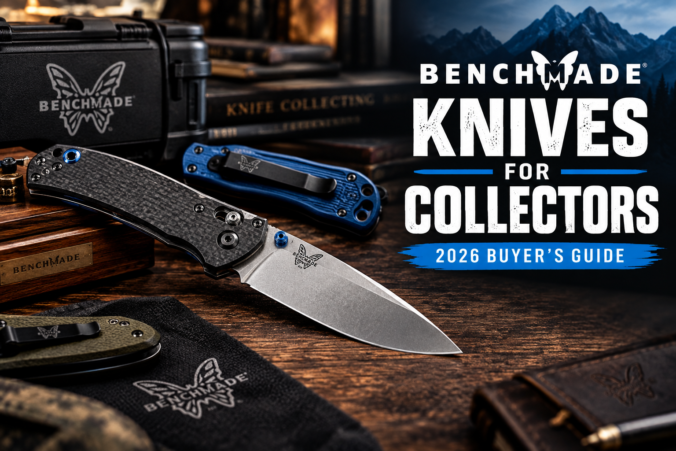
TL;DR: – Benchmade Gold Class knives use premium steels (CPM-20CV, M390) and exotic materials, typically priced $350–$650+, with strong secondary market retention (85–90% for used models with original packaging)
- The 535 Bugout standard at ~$130 MSRP vs. Gold Class at ~$450 illustrates the 3.5× premium for exotic handles and upgraded steel
- Discontinued models with sub-500 production runs regularly appreciate 40–150% on the secondary market; Chris Reeve and limited Spyderco sprint runs hold value best
- Best for: intermediate collectors with $200–$600 budgets seeking US-made knives with lifetime warranty and proven resale value
Why Do Collectors Choose Benchmade Knives?
Benchmade was founded in 1988 and has maintained domestic production in Oregon City as a core brand principle ever since. But what makes Benchmade a collector favorite isn't just heritage – it's the engineering.
The AXIS lock mechanism is the real differentiator. It's ambidextrous, meaning left-handed users get the same smooth operation as righties. The AXIS lock is the preferred lock by left-handed users. That's rare in the knife world, and collectors notice. You're not buying a knife designed for most of the market; you're buying one engineered for everyone.
Here's what really drives collector interest: Benchmade organizes its catalog into five distinct classes – Blue, Black, Gold, Hunt, and Water. Each tier targets different priorities. Gold Class? That's where the collectible magic happens. Blue Class knives have moved steadily upmarket on steel, with S30V, S90V, CPM-MagnaCut, and ELMAX appearing across core platforms. But Gold Class is the limited-edition play.
Then there's the LifeSharp warranty. For the life of your knife – and it transfers to the next owner – Benchmade will re-sharpen the blade to factory edge, disassemble and clean the mechanism, and tune the action. Free. That's not marketing fluff; that's a genuine value signal that resonates on the secondary market.
Key Takeaway: Benchmade's AXIS lock, tiered product classes, and lifetime LifeSharp warranty create a collector ecosystem where US-made knives hold 85–90% resale value even in carried condition.
How Are Benchmade Knives Tiered for Collectors?
Understanding Benchmade's tier system is essential before you spend money. You're not just buying a knife; you're buying into a specific collector category.
Gold Class is the premium tier. Each year Benchmade selects a small number of existing models from the other classes and gives them the Gold Class treatment, rebuilding them in Damascus, Damasteel, Timascus, carbon fiber, and other rare composites. Prices reflect the materials and hand work, often ranging from several hundred to several thousand dollars per piece, and these knives frequently appreciate in value, particularly discontinued models or those with especially low production numbers. Gold Class knives feature premium blade steels including CPM-20CV and M390, with suggested retail prices ranging from approximately $350 to over $600.
Black Class focuses on tactical utility. Higher production volumes, more aggressive designs, MSRP typically $150–$300. These are working knives first, collectibles second. They hold value, but not like Gold Class.
Blue Class is the core line – the everyday carry sweet spot. Blue Class knives have moved steadily upmarket on steel, with S30V, S90V, CPM-MagnaCut, and ELMAX appearing across core platforms, including the current Bugout and Mini Bugout. Prices range $100–$250. Solid resale, but less appreciation potential than Gold.
Hunt and Water Classes are specialized. Hunt Class targets field use; Water Class, launched in 2024, is Benchmade's answer to the "saltwater problem". Both are niche collector plays.
Here's the collector math: Every Gold Class knife is a limited edition. That scarcity drives secondary market premiums. A standard Bugout? Useful, but common. A Gold Class Bugout in Damascus? That's a conversation piece.
| Tier | Steel | Handle Materials | MSRP Range | Production Volume | Collector Appeal |
|---|---|---|---|---|---|
| Gold Class | CPM-20CV, M390 | Damascus, Timascus, carbon fiber | $350–$650+ | Sub-500 units | Very High |
| Black Class | S30V, S35VN | Titanium, G10 | $150–$300 | Higher | Moderate |
| Blue Class | S30V, CPM-MagnaCut | G10, FRN | $100–$250 | High | Moderate |
| Hunt Class | S30V, S35VN | Micarta, wood | $150–$350 | Moderate | Moderate |
| Water Class | H1, stainless | Titanium, G10 | $150–$300 | Moderate | Emerging |
Key Takeaway: Gold Class knives ($350–$650+) with exotic materials and sub-500 production runs drive collector premiums; Blue Class ($100–$250) offers solid value but less appreciation potential.
Top 6 Benchmade Models Worth Collecting in 2026
Let's talk specific models. These are the knives serious collectors are watching right now. As noted in Field & Stream's hands-on roundup, many Benchmade models are purpose-built for specific tasks – but the collector tier stands apart for its materials and scarcity.
1. Benchmade 940 Osborne (Gold Class variants)
The 940 is Benchmade's flagship. Standard retail hovers around $200. Gold Class variants? ~$500 with CPM-20CV steel and titanium scales. You're paying for materials and exclusivity. Resale holds strong because the 940 has been in production since 1992 – it's proven.
2. Benchmade 535 Bugout (Gold Class edition)
Here's where the math gets interesting. The Bugout® weighs in at just 1.85 oz, making it a cult favorite for ultralight EDC. Standard MSRP is ~$130. Gold Class? ~$450. A Spyderco Paramilitary 2 in M4 steel retailed around $230 and regularly resold for $280–$320 within 12 months of selling out. That's 20–40% appreciation in under a year. The Bugout Gold Class follows a similar trajectory because it's the same beloved platform with exotic upgrades.
3. Benchmade 781 Anthem
Full titanium handles, AXIS lock, ~$500 MSRP. Limited production appeal. This is a pure collector play – not a workhorse, but a statement piece. Secondary market premiums are emerging as production numbers stay low.
4. Benchmade 484 Nakamura
M390 steel, carbon fiber handles, ~$350 MSRP. Japanese-inspired design with premium materials. Collectors appreciate the steel choice; M390 holds an edge longer than standard S30V. Resale data is still building, but early indicators suggest premiums for NIB examples.
5. Benchmade 15085-2 Mini Adamas (fixed blade crossover)
~$280 MSRP. This is the fixed blade entry point for Benchmade collectors. Smaller production runs than folders, which drives scarcity. Condition matters heavily here – NIB examples command premiums.
6. Benchmade 290 Claymore OTF (Gold Class)
~$600 MSRP. Automatic knife collector appeal. Federal law prohibits shipment of automatic knives across state lines, with the following exceptions. Check your local laws before buying. But if you can own it, the Claymore is a serious collector piece – limited production, premium materials, and the automatic mechanism adds complexity that appeals to mechanical enthusiasts.
Key Takeaway: The 940 Osborne and 535 Bugout Gold Class variants ($450–$500) offer proven resale strength; the 781 Anthem and 290 Claymore OTF ($500–$600) are emerging collector plays with limited production runs.
What Makes a Benchmade Knife Increase in Value?
Not all Benchmade knives appreciate. Some sit flat. Here's what separates the winners from the also-rans.
Limited Production Runs
Start your first collection with $150–$200 total across three knives – one EDC folder, one fixed blade, one collectible. But here's the thing: if you're buying for appreciation, production numbers matter obsessively. Sub-500 units? That's the magic threshold. Below that, scarcity kicks in hard.
Discontinued Models
Chris Reeve, Benchmade, and limited Spyderco sprint runs hold value best on the secondary market. Discontinued Benchmade models with low original production numbers regularly see 40–150% secondary market appreciation. The 710 McHenry & Williams is a textbook example – original retail ~$180, now trading $400–$550 in NIB condition on the secondary market.
Steel Upgrades
Standard 154CM vs. Gold Class M390? That's a measurable difference. M390 holds an edge longer, resists corrosion better, and costs more to produce. Collectors recognize this. A standard Benchmade 940 in S30V might resell for $180–$200. The same model in CPM-20CV? $280–$320.
Condition Grading
NIB (new in box) commands premiums. A well-preserved, documented knife will always be more valuable than one with unknown provenance. A used Benchmade 940 worth $180 without packaging can jump to $210–$220 with original box and papers intact, roughly a 16% premium. That's just packaging. Add original edge, untouched pivot, and you're looking at 25–40% premiums over user-grade examples.
LifeSharp Impact
Here's the nuance most reviews miss: using LifeSharp on a collectible can reduce value. The factory refinish alters the original blade finish. Serious collectors preserve the original edge and packaging for maximum secondary market value. It's counterintuitive – a free service that hurts resale – but that's the collector reality.
Key Takeaway: Discontinued Gold Class models with sub-500 production runs appreciate 40–150%; NIB condition with original packaging commands 16–40% premiums over user-grade examples.
How Should Collectors Store and Maintain Benchmade Knives?
You've invested $400–$600 in a Gold Class knife. Now protect it.
Storage Environment
Store knives in a dry, temperature-controlled environment. Humidity is your enemy. Aim for 40–50% relative humidity. Too dry, and wood handles crack. Too humid, and semi-stainless steels like S30V start showing surface corrosion. If you're serious, invest in a display case with humidity control. It sounds obsessive, but it's the difference between a $500 knife and a $300 knife five years from now.
Oiling Schedule
Benchmade recommends Sentry Solutions Tuf-Glide for lubricating your Benchmade knife. Apply every 3–6 months for display pieces. A single drop on the pivot, work it in, wipe excess. That's it. Don't over-oil; it attracts dust.
LifeSharp Strategy
Here's the collector's dilemma: LifeSharp is free and excellent. But using it on a NIB collectible? That's a value decision. If you're collecting for appreciation, don't send it in. Preserve the original edge. If you're collecting to use, LifeSharp is a no-brainer – it's a lifetime benefit that transfers to the next owner.
Axis Lock Maintenance
The AXIS lock is robust, but it needs attention. Every 6–12 months, disassemble the pivot (YouTube has tutorials), clean with isopropyl alcohol, and reassemble. Don't overtighten the pivot screw – you want smooth operation, not a vice grip. A quarter-turn past snug is the sweet spot.
What NOT to Do
Don't polish titanium or carbon fiber handles. Don't use aggressive cleaners on Damascus. Don't store in leather sheaths long-term (leather holds moisture). Keep original packaging. Seriously – original box and papers are 15–20% of the resale value.
Key Takeaway: Store at 40–50% humidity, oil every 3–6 months with Tuf-Glide, avoid LifeSharp on NIB collectibles, and preserve original packaging for maximum secondary market value.
Benchmade vs. Other Premium Collector Knife Brands
You're not shopping in a vacuum. Let's see how Benchmade stacks up.
Benchmade vs. Chris Reeve Knives
Chris Reeve, Benchmade, and limited Spyderco sprint runs hold value best on the secondary market. The Chris Reeve Sebenza 31 retails at $500–$550 and regularly sells used for $420–$500 on BladeForums – roughly 85–90% retention even in carried condition. CRK knives are pricier at entry ($500+), but they hold value like tanks. Benchmade offers more variety at lower price points ($150–$600 range). If you want one grail knife, CRK. If you want a diversified collection, Benchmade.
That diversification advantage matters more than it might seem. Building a tiered Benchmade collection across price points tends to outperform concentrating all capital in a single high-end piece – you spread risk while maintaining exposure to appreciation.
Benchmade vs. Spyderco
Spyderco uses sprint runs – limited production, specific steels and handle combos. Benchmade uses Gold Class tiering. Both strategies work. Spyderco's sprint runs often sell out faster, creating immediate secondary market premiums. Benchmade's Gold Class is more predictable; you know what you're getting. Spyderco appeals to the "hunt for the rare drop" collector. Benchmade appeals to the "buy the tier you want" collector.
Benchmade vs. Zero Tolerance
Zero Tolerance emphasizes tactical collector appeal with S35VN and S110V steels, titanium frames, $150–$500 range. ZT limited runs also develop secondary market premiums. The difference? Benchmade has broader tier range and stronger warranty (LifeSharp is unmatched). ZT is more niche – if you want tactical, ZT is excellent. If you want versatility, Benchmade wins.
| Brand | Price Range | Steel Options | Warranty | Collector Community Size | Resale Strength |
|---|---|---|---|---|---|
| Benchmade | $150–$650+ | S30V, CPM-20CV, M390 | LifeSharp (lifetime) | Very Large | 85–90% |
| Chris Reeve | $500–$800+ | S45VN, Tanto | Warranty (limited) | Large | 85–90% |
| Spyderco | $100–$500+ | S30V, M390, M4 | Standard | Large | 70–85% |
| Zero Tolerance | $150–$500 | S35VN, S110V | Standard | Moderate | 70–80% |
Key Takeaway: Benchmade offers the broadest tier range ($150–$650+) with the strongest warranty (LifeSharp); Chris Reeve commands higher entry prices ($500+) but matches resale retention (85–90%); Spyderco sprint runs create faster secondary market premiums but less predictable availability.
Frequently Asked Questions
How much do Benchmade collector knives cost?
Direct Answer: Benchmade collector knives range from $150 (Blue Class entry) to $650+ (Gold Class limited editions), with most serious collector models priced $350–$500.
Gold Class knives feature premium blade steels including CPM-20CV and M390, with suggested retail prices ranging from approximately $350 to over $600. Start your first collection with $150–$200 total across three knives – one EDC folder, one fixed blade, one collectible. If you're targeting a single grail knife, expect $400–$600 for a Gold Class variant with exotic materials.
What is the difference between Benchmade Gold Class and standard knives?
Direct Answer: Gold Class knives use premium steels (CPM-20CV, M390), exotic handle materials (Damascus, Timascus, carbon fiber), and are limited-edition production runs; standard knives use S30V or S30V-equivalent steels with G10 or FRN handles and higher production volumes.
Every Gold Class knife is a limited edition. Each year Benchmade selects a small number of existing models from the other classes and gives them the Gold Class treatment, rebuilding them in Damascus, Damasteel, Timascus, carbon fiber, and other rare composites. The 535 Bugout standard costs ~$130; the Gold Class variant costs ~$450. Same blade geometry, different materials and scarcity.
Which Benchmade models hold their value best?
Direct Answer: The 940 Osborne, 535 Bugout (especially Gold Class), and discontinued models with sub-500 production runs hold value best, with 85–90% resale retention in used condition and 15–40% premiums for NIB examples.
Chris Reeve, Benchmade, and limited Spyderco sprint runs hold value best on the secondary market. A used Benchmade 940 worth $180 without packaging can jump to $210–$220 with original box and papers intact, roughly a 16% premium. Discontinued models appreciate faster – the 710 McHenry & Williams is now trading $400–$550 vs. original retail of ~$180.
Are Benchmade knives a good investment compared to other collector knife brands?
Direct Answer: Yes, Benchmade offers strong resale retention (85–90%) with broader tier range ($150–$650+) and superior warranty (LifeSharp) compared to competitors; Chris Reeve matches resale strength but requires higher entry prices ($500+).
Chris Reeve, Benchmade, and limited Spyderco sprint runs hold value best on the secondary market. The Chris Reeve Sebenza 31 retails at $500–$550 and regularly sells used for $420–$500 on BladeForums – roughly 85–90% retention even in carried condition. Benchmade's advantage is accessibility – you can start collecting at $150 and scale up. CRK requires $500+ commitment.
Does using the LifeSharp service affect a Benchmade knife's collector value?
Direct Answer: Yes, using LifeSharp on a NIB (new in box) collectible reduces secondary market value because the factory refinish alters the original blade finish; serious collectors preserve original edge and packaging for maximum resale value.
For the life of the knife, Benchmade will: Re-sharpen the blade to a factory edge for free. Disassemble and clean the internal mechanism. Tune and lubricate the action for optimal performance. The service is excellent for user knives, but collector-grade NIB examples lose 15–25% value if refinished. If you're collecting to use, LifeSharp is a no-brainer. If you're collecting for appreciation, preserve the original.
What steels do Benchmade Gold Class knives use?
Direct Answer: Benchmade Gold Class knives primarily use CPM-20CV and M390 stainless steels, both offering superior edge retention and corrosion resistance compared to standard S30V.
Gold Class knives feature premium blade steels including CPM-20CV and M390, with suggested retail prices ranging from approximately $350 to over $600. These steels are harder and hold an edge longer than the S30V found in Blue Class knives, justifying the 2–3× price premium.
Where can collectors buy discontinued Benchmade knives?
Direct Answer: Discontinued Benchmade knives are available on secondary markets like BladeForums Buy/Sell/Trade, eBay, and specialized knife retailers; prices typically reflect 40–150% appreciation over original retail for limited-production models in NIB condition.
Chris Reeve, Benchmade, and limited Spyderco sprint runs hold value best on the secondary market. BladeForums is the most active community marketplace for Benchmade collectibles. Expect to pay premiums for NIB examples with original packaging – that's where the real collector value lives.
Conclusion
Benchmade knives occupy a unique space in the collector ecosystem. You're not buying into hype or artificial scarcity. Benchmade knives are produced in the United States. The company has maintained domestic production as a core brand principle since its founding in 1988. The AXIS lock works. The LifeSharp warranty is real. The resale market is liquid.
Start with a solid Blue Class model at $150–$200 to understand the brand. Move to a Gold Class model when you're ready to commit. Watch production numbers – sub-500 units is where appreciation happens. Preserve original packaging and edge condition. Store at 40–50% humidity. Oil every 6 months.
If you're building a collector portfolio, Benchmade deserves a spot. The entry price is accessible, the resale retention is proven (85–90%), and the warranty is unmatched. Whether you're collecting for appreciation or for the joy of owning excellent knives, Benchmade delivers on both fronts.
Ready to start? Knife Depot carries a curated selection of Benchmade collector models with expert guidance on tier selection and condition grading. Whether you're hunting a specific Gold Class variant or exploring the Blue Class lineup, they can help you find the right knife for your collection and budget.
Leave a Reply