TL;DR: – Japanese professional knives are hardened to HRC 60–67, delivering finer edges than German knives but requiring technique adjustment to avoid chipping
- VG-10 stainless ($80–$200) is the entry point; SG2 ($200–$450) holds edges 30–40% longer for professionals
- A 210mm gyuto is the single most versatile first purchase for cooks transitioning from Western knives
- Best value: $150 gyuto + $40 whetstone + $15 strop ($205 total) outperforms a $600 knife with no maintenance tools
Introduction
Based on our analysis of professional knife retailer guides, culinary publications, and specialist importer documentation collected through 2026, here’s what separates professional-grade Japanese kitchen knives from the rest.
You’re standing in front of a knife display. The German chef’s knife feels familiar – heavy, balanced, forgiving. The Japanese gyuto next to it looks thinner, almost delicate. But that apparent fragility masks something crucial: Japanese knives are typically hardened to between 60 and 67 HRC, compared to 56–58 HRC for most German knives, enabling a much thinner, more acute edge geometry.
This guide cuts through the mystique. We’ll walk you through steel grades, knife styles, real 2026 pricing, and the maintenance reality that separates casual buyers from people who actually use these knives daily. Whether you’re a home cook upgrading from a $30 block set or a culinary professional evaluating Japanese options, you’ll find the framework to choose the right knife for your kitchen – and your budget.
What Makes a Japanese Kitchen Knife Professional-Grade?
Professional-grade Japanese knives share three defining characteristics: extreme hardness, thin blade geometry, and a specific edge angle that demands technique modification.
The hardness difference is physical. Higher HRC hardness increases edge retention but reduces toughness – a knife at HRC 65 will hold an edge longer than one at HRC 58, but it will also chip or crack if used on bones or frozen food. This inverse relationship is the core tradeoff you’re making when you choose Japanese over German.
Blade geometry follows from hardness. Japanese knives taper to a 10–15 degree edge angle per side (20–30 degrees total), versus 20 degrees per side (40 degrees total) for German knives. That acute angle is only possible because the harder steel resists chipping. But it also means you can’t use the rocking chop motion that works on German knives – you’ll chip the blade.
Professional-grade means the knife is designed for high-volume, repetitive cutting in a kitchen where edge retention matters more than durability against abuse. It’s not about price; it’s about purpose.
| Characteristic | Japanese | German |
|---|---|---|
| HRC Hardness | 60–67 | 56–58 |
| Edge Angle | 10–15° per side | 20° per side |
| Edge Retention | Excellent | Good |
| Toughness | Lower (chips easier) | Higher (more forgiving) |
| Sharpening Frequency | Every 3–6 months | Every 2–4 months |
| Maintenance | Hand wash, immediate dry | Dishwasher-safe options exist |
Key Takeaway: Professional Japanese knives sacrifice toughness for sharpness. HRC 60–67 hardness enables 10–15° edge angles, but requires technique modification and careful maintenance to avoid chipping.
Which Japanese Knife Styles Do You Actually Need?
Most home cooks buy too many knives. Here’s what actually matters.
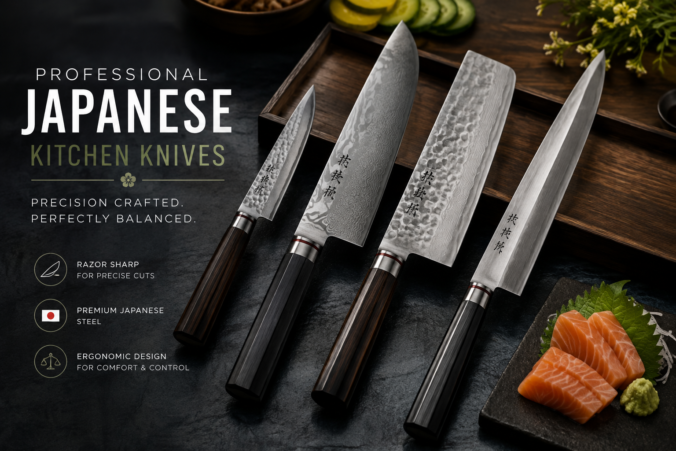
The gyuto (210–270mm) is the Japanese equivalent of the Western chef’s knife and the most versatile professional Japanese knife. At 210–270mm, it handles most kitchen tasks and is the best starting point for anyone new to Japanese knives. If you only buy one knife, buy a 210mm gyuto.
The santoku (165–180mm) is shorter, with a flat edge and a straighter profile. It’s the home-kitchen favorite – easier to control than a gyuto, better for precise vegetable work, but less versatile for proteins. Think of it as the Japanese answer to a 6-inch chef’s knife.
The nakiri (165–180mm) is a vegetable specialist. Its rectangular blade and flat edge excel at push-cutting through vegetables, but it’s not designed for proteins or bones. Professional vegetable prep stations use these; home cooks rarely need one.
The yanagiba (270–330mm single-bevel) is the professional standard for sashimi and raw fish fabrication. A 270mm is standard for most tasks; sushi chefs working with large fish like salmon typically prefer 300mm or longer. Single-bevel geometry means you sharpen only the front face – a different skill entirely.
The deba (single-bevel, 165–210mm) is specifically designed for breaking down whole fish. The hon-deba has a thicker spine for bone-chopping; the mioroshi-deba is thinner for filleting in one tool.
The sujihiki (240–300mm) is a slicing knife for roasts and proteins. It’s narrower and longer than a gyuto, designed for long, smooth slicing motions.
| Knife Type | Best For | Blade Length | Skill Level | Single or Double Bevel |
|---|---|---|---|---|
| Gyuto | All-purpose, proteins, vegetables | 210–270mm | Beginner+ | Double |
| Santoku | Vegetables, precise work, home kitchens | 165–180mm | Beginner+ | Double |
| Nakiri | Vegetable prep specialist | 165–180mm | Intermediate+ | Double |
| Yanagiba | Sashimi, raw fish | 270–330mm | Advanced | Single |
| Deba | Breaking down whole fish | 165–210mm | Intermediate+ | Single |
| Sujihiki | Slicing roasts, proteins | 240–300mm | Intermediate+ | Double |
Key Takeaway: Start with a 210mm gyuto. Add a santoku only if you do high-volume vegetable prep. Single-bevel knives (yanagiba, deba) require different sharpening technique – don’t buy them until you’re comfortable with whetstones.
Steel Types: What Matters Most for Sharpness and Maintenance?
This is where most buyers get lost. Steel choice determines edge retention, rust risk, and maintenance burden.
VG-10 stainless steel, hardened to approximately HRC 60–61, is the dominant entry-level Japanese professional steel, offering low maintenance and broad availability. It’s used in many mass-market Japanese knives. You’ll spend $80–$200 for a gyuto. VG-10 resists rust well enough for home kitchens, and you can hand-wash it without paranoia. The tradeoff: it doesn’t hold an edge quite as long as premium steels.
SG2 (also called R2) powder steel is a premium stainless option with ultra-fine carbide distribution that allows a keener, longer-lasting edge than conventional stainless steels like VG-10. Under heavy daily use, SG2 holds a working edge roughly 30–40% longer, justifying a ~$100–$150 price premium. You’ll find it in premium knives ($200–$450).
Shirogami (White Steel) #1 and #2 are highly reactive high-carbon steels capable of extreme sharpness, used in professional Japanese kitchens. Shirogami #1 contains 1.25–1.35% carbon and is one of the purest carbon steels available. It takes an exceptionally keen edge but rusts quickly if not dried and oiled after each use. Professional sushi chefs use these; home cooks rarely do.
Aogami Super (Blue Super Steel) adds tungsten and chromium to a high-carbon base, increasing hardness (HRC 65–67) and wear resistance while retaining excellent sharpenability. It’s reactive (carbon steel) – still requires rust prevention despite added chromium. You’ll find it in premium knives ($200–$600).
| Steel | HRC | Edge Retention | Rust Resistance | Price Range | Best For |
|---|---|---|---|---|---|
| VG-10 | 60–61 | Good | Excellent | $80–$200 | Home cooks, low maintenance |
| SG2/R2 | 63–64 | Excellent | Very good | $200–$450 | Professionals, edge retention priority |
| Shirogami #1 | 64–65 | Exceptional | Poor | $150–$400 | Professional kitchens, daily oiling |
| Aogami Super | 65–67 | Exceptional | Fair | $200–$600 | Professional kitchens, reactive care |
The budget math changes everything. A $150 gyuto with VG-10 steel plus a $40 whetstone plus a $15 strop ($205 total setup) provides better practical performance value than a $600 knife purchased without maintenance tools.
Key Takeaway: VG-10 ($80–$200) is the entry point – low maintenance, good edge retention. SG2 ($200–$450) holds edges 30–40% longer. Carbon steels (Shirogami, Aogami Super) require daily oiling but deliver exceptional sharpness for professionals.
Top Japanese Knife Brands and What They Cost in 2026
Here’s the brand tier breakdown with verified 2026 pricing.
Shun Classic uses VG-10 steel and retails $100–$200 for gyuto/chef knife styles. The 8-inch chef’s knife runs ~$160–$180. Shun is mass-market professional – widely available, reliable, low maintenance.
Global uses CROMOVA 18 steel (a proprietary 18% chromium stainless) and retails $80–$180. The seamless one-piece construction and hollow handles filled with sand for balance are iconic. Global’s HRC 56–58 is lower than most Japanese knives in this guide – more German-range hardness in a Japanese form factor.
MAC Professional uses molybdenum-vanadium steel and retails $90–$200. The MTH-80 (8-inch) runs ~$155–$175. MAC is a restaurant workhorse – thin grind, lightweight balance, significantly lighter than German alternatives.
Miyabi combines a SG2 powder steel core with German manufacturing precision (~$150–$350). The result is a knife with exceptional edge retention and a beautiful layered Damascus finish. It’s a premium German-Japanese hybrid suitable for home and professional users.
Masamoto uses white steel (Shirogami) and blue steel (Aogami) and is considered top-tier for professional sushi and traditional Japanese cuisine. Knives retail ~$200–$600. Masamoto is one of Japan’s most respected knife makers, producing blades used by professional sushi chefs.
Sakai Takayuki produces handmade and semi-handmade knives with Damascus and single-material options (~$150–$500). Sakai-region craftsmen hand-finish each blade. It represents the artisan tier below honyaki custom production.
| Brand | Steel | Price Range | Best For | Maintenance Level |
|---|---|---|---|---|
| Shun Classic | VG-10 | $100–$200 | Mass-market professional | Low |
| Global | CROMOVA 18 | $80–$180 | Budget-conscious, lightweight | Low |
| MAC Professional | Molybdenum-vanadium | $90–$200 | Restaurant workhorse | Low |
| Miyabi | SG2 core | $150–$350 | Premium German-Japanese hybrid | Medium |
| Masamoto | Shirogami/Aogami | $200–$600 | Professional sushi, traditional | High |
| Sakai Takayuki | Handmade options | $150–$500 | Artisan, Damascus | Medium |
The performance gap between a $160 knife and a $280 knife is narrower than the price gap for most home cooks. A well-made VG-10 knife competes at its price point. Higher-tier options offer a noticeably thinner grind and superior fit and finish, but the difference matters most to experienced users.
Key Takeaway: Entry-level options ($80–$200, stainless, low maintenance) → Premium options ($150–$500, SG2/Damascus) → Professional options ($200–$600, white/blue carbon steel, professional kitchens). Choose based on maintenance tolerance and use case, not brand prestige.
How Do You Choose the Right Japanese Knife for Your Skill Level?
Your experience determines which knife will actually work for you.
Beginner path: Start with a stainless clad, double-bevel, 210mm gyuto in the $100–$150 range. VG-10 stainless is your friend – low maintenance, forgiving, no rust paranoia. Pair it with a 1000-grit whetstone ($25–$40) and learn the basics. A quality entry-level option or MAC MTH-80 fits here perfectly.
Intermediate path: You’re comfortable with whetstones and want better edge retention. Move to SG2 or blue steel in the $200–$350 range. These hold edges longer under heavy use. You’ll sharpen every 3–6 months instead of every 2–4. A premium option or artisan Damascus knife fits here.
Professional/advanced path: You’re sharpening weekly, you understand ura-oshi (back-side maintenance for single-bevel knives), and you’re willing to oil carbon steel daily. White steel (Shirogami) or Aogami Super ($300+) delivers exceptional sharpness. Professional-grade options fit here.
Handle style matters. Wa (Japanese octagonal/D-shaped) handles shift balance toward the blade and reduce overall weight. Yo (Western) handles with bolsters add weight and stability preferred by cooks transitioning from German knives. If you’re new to Japanese knives, Yo handles feel more familiar.
The one-knife rule: Invest most of your budget in one primary knife. A $150 gyuto + $40 whetstone + $15 strop ($205 total setup) beats a $600 knife with no maintenance investment.
Key Takeaway: Beginners: VG-10 stainless, $100–$150, Yo handle. Intermediate: SG2 steel, $200–$350, either handle. Advanced: Carbon steel, $300+, Wa handle. Always prioritize one excellent knife over multiple mediocre ones.
How to Maintain and Sharpen Professional Japanese Knives
This is where most people fail. Maintenance separates a $150 knife that lasts 20 years from a $600 knife that chips in six months.
Whetstone progression is the correct path. Start at 400 grit for repair or reprofiling damaged edges. Move to 1000 grit for primary sharpening. Refine at 3000 grit. Finish at 6000+ grit for a polished edge. A standard progression for sharpening Japanese knives is to start at 400–800 grit for damaged edges, move to 1000 for primary bevel work, then 3000 for refinement, and finish at 6000 or higher for a polished edge.
Never use a grooved honing steel. Grooved honing steels cause micro-fracture and chipping in high-hardness Japanese blades (HRC 60+) due to the brittle carbide structure. Use a ceramic rod or leather strop for daily edge maintenance instead.
Storage matters. Use a magnetic strip or knife block – never loose in a drawer. Loose storage causes edge damage and safety hazards.
Cleaning is non-negotiable. Hand wash only. Dry immediately. No dishwasher. Prolonged moisture causes corrosion even on stainless knives, and will loosen or crack wa handles.
Sharpening frequency: Touch up every 2–4 weeks of regular use with a ceramic rod or strop. Full sharpen every 3–6 months. Professional sharpening services typically charge $10–$25 per knife depending on blade length and condition, with discounts for multiple knives.
For single-bevel knives (yanagiba, deba), the process is different. Single-bevel knives require sharpening on the front face only, with the back (ura) maintained flat using a technique called ura-oshi. Incorrect back-side sharpening will permanently alter the geometry.
Key Takeaway: Whetstone progression: 400→1000→3000→6000+ grit. Never use grooved honing steel. Hand wash, dry immediately. Touch up every 2–4 weeks; full sharpen every 3–6 months. Professional sharpening: $10–$25 per knife.
Frequently Asked Questions About Professional Japanese Knives
How much should you spend on a professional Japanese kitchen knife?
Direct Answer: Start with $100–$150 for a quality VG-10 gyuto. Add $40 for a whetstone and $15 for a strop. Total: $205. This setup outperforms a $600 knife with no maintenance tools.
The biggest mistake new Japanese knife buyers make is spending $500 on a knife and then having nothing to maintain it with. A $150 knife with a proper whetstone setup will outperform an expensive knife sharpened on a pull-through sharpener. Budget for maintenance tools – they’re not optional.
Are Japanese knives better than German knives for professional kitchens?
Direct Answer: Japanese knives are better for high-volume, repetitive cutting where edge retention matters. German knives are better for abuse tolerance and forgiving technique.
Japanese knives are typically hardened to between 60 and 67 HRC, compared to 56–58 HRC for most German knives, enabling a much thinner, more acute edge geometry. This means longer edge retention but less toughness. Professional sushi kitchens use Japanese knives. Butcher shops use German knives. Choose based on your cutting style, not prestige.
Can beginners use professional Japanese knives safely?
Direct Answer: Yes, but only if you start with stainless clad, double-bevel knives (VG-10 steel) and learn proper technique before advancing to carbon steel or single-bevel designs.
Japanese knives are designed for push-pull cutting and slicing motions. Cooks who use the rocking chop common with German knives risk chipping the more brittle Japanese blade, especially near the tip. Take 30 minutes to learn the cutting motion. Watch a video. Practice on vegetables first.
What is the difference between a gyuto and a santoku?
Direct Answer: A gyuto (210–270mm) is the Japanese chef’s knife – all-purpose, works for proteins and vegetables. A santoku (165–180mm) is shorter, with a flat edge, better for precise vegetable work and home kitchens.
The gyuto is more versatile. The santoku is easier to control. If you only buy one knife, buy a gyuto. If you do high-volume vegetable prep, add a santoku.
Do Japanese kitchen knives rust easily?
Direct Answer: VG-10 and SG2 stainless steels resist rust well. Carbon steels (Shirogami, Aogami Super) rust quickly if not dried and oiled after each use.
Shirogami #1 contains 1.25–1.35% carbon and is one of the purest carbon steels available. It takes an exceptionally keen edge but rusts quickly if not dried and oiled after each use. If you’re not willing to oil your knife daily, stick with stainless clad options.
How often do professional Japanese knives need sharpening?
Direct Answer: Touch up every 2–4 weeks with a ceramic rod or strop. Full sharpen every 3–6 months with a whetstone. Professional sharpening services cost $10–$25 per knife.
Frequency depends on use volume and cutting surface. Cutting on wood is gentler than cutting on plastic. High-volume kitchens sharpen more often. Home cooks sharpen less frequently.
Is a single-bevel or double-bevel knife better for home cooks?
Direct Answer: Double-bevel knives (gyuto, santoku, nakiri) are better for home cooks. Single-bevel knives (yanagiba, deba) require different sharpening technique and are designed for professionals.
Single-bevel knives require sharpening on the front face only, with the back (ura) maintained flat using a technique called ura-oshi. This is a skill that takes practice. Start with double-bevel. Add single-bevel knives only after you’re comfortable with whetstones.
Conclusion
Professional Japanese kitchen knives aren’t mystical objects. They’re engineered tools optimized for edge retention over toughness, requiring technique modification and consistent maintenance.
Start with a 210mm VG-10 gyuto in the $100–$150 range. Add a 1000-grit whetstone and a ceramic strop. Learn the push-pull cutting motion. Sharpen every 3–6 months. Hand wash and dry immediately.
If you’re upgrading from German knives, expect a learning curve. The thinner edge geometry demands different technique. But once you adapt, you’ll notice the difference: longer edge retention, finer cuts, and a tool that rewards precision.
Ready to upgrade your kitchen? Compare the Kanetsune KC-722 210mm AUS-8 gyuto with the Kanetsune KC-102 210mm VG-10 Damascus gyuto. Both are Japanese chef knives made in Seki. Browse our chef knives and Japanese chef knives to find your next essential tool.

Leave a Reply