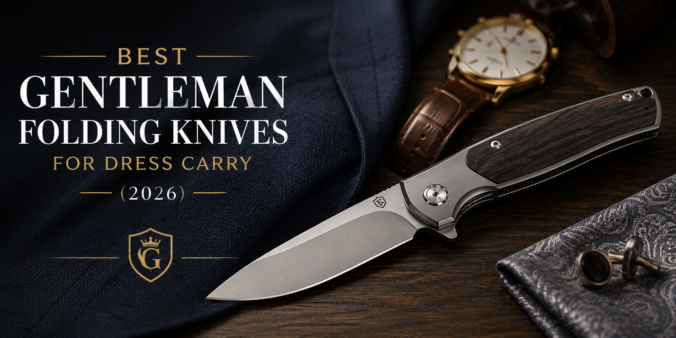
Best Gentleman Folding Knives for Dress Carry (2026)
TL;DR:
- A gentleman’s folding knife prioritizes blades under 3 inches, slim handles, and low-profile clips – not tactical aesthetics.
- CIVIVI Elementum at ~$45 with 9Cr18MoV steel is the best budget pick for dress carry; Benchmade 533 Mini Bugout at ~$130 with CPM-S30V offers meaningfully better corrosion resistance.
- Chris Reeve Small Sebenza 31 ($475, CPM-S35VN, titanium scales) holds 70–80% resale value and won’t snag suit fabric.
- Shop all seven knives at Knife Depot — the complete source for gentleman’s folding knives with verified specs, community reviews, and expert guidance.
What Makes a Folding Knife a “Gentleman’s Knife”?
A gentleman’s folding knife isn’t defined by what it does – it’s defined by what it doesn’t look like. (Nyc.gov) You’re not carrying a tactical folder with aggressive texturing, aggressive colors, or a clip that screams “I’m armed.” Instead, you want something that disappears into a suit pocket.
The essentials are straightforward: blade length under 3 inches, slim handle profile, neutral finish (satin or polished, not black or camo), and a clip that either sits deep in the pocket or can be removed entirely. The lock mechanism matters too. Slip-joint knives rely on backspring tension rather than a mechanical lock, making them the traditional choice – and often the legal choice in restrictive jurisdictions.
Here’s the practical checklist:
- Blade length: 2.5–3 inches max
- Handle material: Bone, titanium, carbon fiber, or polished aluminum (avoid textured G10 – it snags fabric)
- Clip visibility: Deep-carry or removable
- Finish: Satin or polished (mirror finishes show fingerprints)
- Lock type: Slip joint for formal contexts, liner lock for daily light tasks
The difference between a gentleman’s knife and a tactical EDC folder is aesthetic restraint. You’re not sacrificing function; you’re choosing form that fits a dress code.
Key Takeaway: A gentleman’s folding knife is defined by blades under 3 inches, slim handles, neutral finishes, and low-profile clips – the opposite of tactical aesthetics. Slip joints are traditional; liner locks offer one-handed security.
Top 7 Gentleman Folding Knives for Dress Carry (2026)
These seven knives span three price tiers and cover the range of what works for office carry, business travel, and formal everyday use. All are available at Knife Depot with full specifications and community reviews.
| Model | Blade Steel | Blade Length | Handle Material | Weight | Lock Type | Price |
|---|---|---|---|---|---|---|
| CIVIVI Elementum | 9Cr18MoV | 2.96″ | Carbon Fiber | 2.47 oz | Liner Lock | ~$45 |
| Victorinox Alox Pioneer | Stainless | 2.4″ | Aluminum | 1.5 oz | Slip Joint | ~$48 |
| Spyderco Manbug | 8Cr13MoV | 2.1″ | FRN | 1.2 oz | Liner Lock | ~$35 |
| Benchmade 533 Mini Bugout | CPM-S30V | 2.82″ | Grivory | 1.5 oz | Liner Lock | ~$130 |
| Böker Kwaiken Slip Joint | VG-10 | 3.07″ | Stainless | 2.8 oz | Slip Joint | ~$95 |
| Case Smooth Bone Stockman | Carbon Steel | 2.1″ (main) | Bone | 2.2 oz | Slip Joint | ~$60 |
| Chris Reeve Small Sebenza 31 | CPM-S35VN | 2.94″ | Titanium | 2.3 oz | Integral Lock | ~$475 |
Best Budget Pick (Under $60)
The CIVIVI Elementum is the entry point that doesn’t feel like a compromise. At ~$45, you get a 2.96-inch blade in 9Cr18MoV steel – a stainless steel optimized for knife applications with excellent corrosion resistance at a budget price. The carbon fiber scales are slim and won’t snag suit fabric. The liner lock opens smoothly one-handed, and the clip sits low enough to hide on flat-front trousers.
The Victorinox Alox Pioneer is the alternative if you prefer slip-joint tradition. At ~$48, you get aluminum scales (smooth, no snagging), a 2.4-inch blade, and the iconic Swiss Army aesthetic. It’s lighter and more formal-looking than the Elementum, though the smaller blade limits utility.
Key Takeaway: CIVIVI Elementum ($45, 9Cr18MoV) is the best budget gentleman’s knife at Knife Depot — slim profile, low-profile clip, and corrosion-resistant steel. Victorinox Alox Pioneer ($48) wins if you prefer slip-joint tradition and aluminum scales.
Best Mid-Range Pick ($60–$150)
The Benchmade 533 Mini Bugout at ~$130 is where the steel upgrade matters. You jump from 9Cr18MoV to CPM-S30V – a premium stainless that delivers superior corrosion resistance and edge retention. The 2.82-inch blade is slightly shorter than the Elementum, and the Grivory handle is slim and neutral. At 1.5 oz, it’s feather-light. The clip sits deep, and the overall aesthetic is understated enough for business casual or formal wear.
The Böker Kwaiken Slip Joint at ~$95 offers a modern Japanese aesthetic with VG-10 steel – a premium Japanese stainless with excellent corrosion resistance and edge retention. At 3.07 inches, it’s at the upper limit for dress carry, but the slip-joint mechanism and sleek profile make it work. If you want non-tactical elegance, this is it.
Key Takeaway: Benchmade 533 Mini Bugout ($130, CPM-S30V) delivers meaningfully better corrosion resistance than budget options. Böker Kwaiken Slip Joint ($95, VG-10) offers Japanese elegance with slip-joint tradition.
Best Premium Pick ($150+)
The Chris Reeve Small Sebenza 31 at ~$475 is the dress-carry knife that becomes an heirloom. CPM-S35VN steel – developed in collaboration with Chris Reeve himself – adds niobium to S30V for improved toughness and easier sharpening. The 2.94-inch blade is perfectly proportioned. Titanium scales don’t snag fabric and develop a beautiful patina over time. The integral lock is secure and mechanically elegant.
Critically: based on sold listings on secondary markets, the Small Sebenza 31 holds approximately 70–80% resale value after 2 years of use. A $475 knife selling for $320–$380 used is exceptional value retention for a premium tool.
Key Takeaway: Chris Reeve Small Sebenza 31 ($475, CPM-S35VN, titanium) holds 70–80% resale value and won’t snag suit fabric. Premium steel and materials justify the price for collectors and professionals.
Which Blade Steel Should You Choose for a Dress Carry Knife?
Dress carry is light-duty carry. You’re opening mail, trimming threads, slicing food – not batoning wood or processing game. This reframes steel selection: corrosion resistance and appearance matter more than edge retention.
9Cr18MoV (CIVIVI Elementum, Spyderco Manbug): A budget-optimized stainless with solid corrosion resistance and easy sharpening. Fine for light tasks. Fingerprints show slightly more than premium steels.
VG-10 (Böker Kwaiken): A premium Japanese stainless with 1% carbon, offering excellent corrosion resistance and edge retention. Easier to sharpen than S30V. Satin finishes hide fingerprints well.
CPM-S30V (Benchmade 533 Mini Bugout): Crucible’s premium stainless balancing toughness, wear resistance, and corrosion resistance. Holds an edge longer than 9Cr18MoV. Slightly harder to sharpen, but worth it for dress carry where you’ll sharpen infrequently.
CPM-S35VN (Chris Reeve Small Sebenza 31): S30V with added niobium for improved toughness and machinability. The best all-around steel for dress carry – excellent corrosion resistance, edge retention, and sharpening ease. Premium pricing reflects the metallurgy.
CPM-20CV (premium variants): Highest corrosion resistance among knife steels, but significantly harder to sharpen. Overkill for dress carry unless you’re in a marine environment.
For dress carry, skip mirror-polished finishes. Satin finishes hide fingerprints better and look more refined than mirror polish, which requires constant wiping.
Key Takeaway: CPM-S35VN offers the best balance of corrosion resistance, toughness, and sharpening ease for dress carry. 9Cr18MoV is fine for light tasks; VG-10 and CPM-S30V are solid mid-range upgrades. Satin finishes hide fingerprints better than mirror polish.
Slip Joint vs Locking Blade: Which Is Better for Dress Carry?
This is a legal and aesthetic question, not a functional one.
Slip-joint knives have no mechanical lock. The blade stays open via backspring tension. Slip joints are the traditional gentleman’s pocket knife pattern and are legal in more U.S. jurisdictions than locking blades. For example, New York City Administrative Code §10-133 restricts certain locking blades, but traditional slip joints often fall outside these restrictions. They’re quieter to open, require two hands, and look more refined.
Locking blades (liner locks, frame locks) engage automatically when the blade opens, providing a secure one-handed platform. Liner locks offer mechanical security that slip joints don’t, but their mechanical profile skews slightly more tactical. They’re louder to deploy and may be restricted in some jurisdictions.
For dress carry, the choice depends on context:
- Formal/travel: Slip joint. Legal everywhere, quieter, more refined.
- Daily light tasks: Liner lock. One-handed opening, secure blade, practical.
- Restrictive jurisdiction: Slip joint. Check local laws before carrying any locking blade.
Key Takeaway: Slip joints are legal in more jurisdictions and look more refined; liner locks offer one-handed security. Choose slip joint for formal contexts, liner lock for daily light tasks.
How to Carry a Folding Knife Without Ruining a Dress Outfit
Clip visibility is the enemy of dress carry. A standard pocket clip exposes 0.5–0.75 inches above the pocket edge on flat-front dress trousers – enough to ruin the line of a suit.
Deep-carry clips sit lower. The Spyderco Manbug’s wire clip is designed for deep carry, minimizing clip exposure above the pocket line. If your knife doesn’t have a deep-carry option, remove the clip entirely and carry in your watch pocket or inner jacket pocket.
Handle material matters. G10’s woven glass-fiber texture creates friction against fine fabrics; titanium, carbon fiber, bone, and polished aluminum don’t snag. If you’re carrying in a trouser pocket, avoid textured scales.
Blade length and local laws: Check your state and city knife laws before carrying. Most jurisdictions allow blades under 3 inches, but some restrict locking blades. NYC, for example, has specific restrictions on gravity knives and certain folders.
Pocket choice: Front trouser pocket is visible. Watch pocket is invisible but tight. Inner jacket pocket is ideal for business carry – the knife stays secure and completely hidden.
Key Takeaway: Use deep-carry clips or remove the clip entirely. Avoid textured G10 scales; choose titanium, carbon fiber, or bone. Carry in watch pocket or inner jacket pocket to hide the knife completely.
How Do You Maintain a Gentleman Folding Knife?
Slim folding knives carried regularly need minimal maintenance, but consistency matters.
Pivot cleaning: Clean the pivot every 30–60 days with regular carry to prevent grit accumulation that degrades action. Use a small brush or compressed air to remove lint and dust.
Lubrication: Low-viscosity nano-oils minimize lint and pocket debris adhesion compared to heavier lubricants. A single drop on the pivot is enough; excess oil attracts lint.
Polished blade care: Wipe fingerprints with a soft cloth. Avoid abrasive cloths or steel wool, which scratch the finish.
Sharpening frequency: Dress-carry knives used for light tasks rarely need sharpening more than twice per year. Light cutting – mail, threads, food – doesn’t dull edges quickly.
Storage: Keep the knife dry. If you carry it daily, the pocket environment is fine. If storing long-term, apply a light coat of oil to prevent corrosion.
Key Takeaway: Clean the pivot every 30–60 days with low-viscosity nano-oil. Dress-carry knives need sharpening only 1–2 times per year due to light use. Wipe fingerprints regularly; avoid abrasive cloths.
Frequently Asked Questions
How much should I spend on a gentleman folding knife for dress carry?
Direct Answer: Budget $45–$130 for a reliable dress-carry knife; premium options ($300+) are for collectors and professionals who value resale value and heirloom quality.
CIVIVI Elementum at ~$45 handles light tasks perfectly. Benchmade 533 Mini Bugout at ~$130 upgrades to CPM-S30V steel for meaningfully better corrosion resistance. If you want a knife that holds value and becomes an heirloom, Chris Reeve Small Sebenza 31 at ~$475 retains 70–80% resale value after 2 years. Knife Depot stocks all price tiers with expert guidance to match your budget and use case.
What is the difference between a slip joint and a locking gentleman knife?
Direct Answer: Slip joints have no mechanical lock and are legal in more jurisdictions; locking blades (liner locks, frame locks) engage automatically and offer one-handed security but may be restricted in some cities.
Slip joints rely on backspring tension and are quieter, more refined, and legal everywhere. Locking blades provide mechanical security but skew slightly more tactical. For formal contexts, slip joint wins. For daily light tasks, liner lock is more practical.
Are gentleman folding knives legal to carry at the office?
Direct Answer: Most offices allow small folding knives (under 3 inches, slip joint preferred), but check your employee handbook and local laws first.
New York City restricts certain locking blades, but slip joints are generally legal. Federal buildings, airports, and courthouses prohibit all knives. If you work in a secure facility, ask HR before carrying.
Which handle material is least likely to snag suit fabric?
Direct Answer: Titanium, carbon fiber, polished bone, and smooth aluminum don’t snag; avoid textured G10, which creates friction against fine fabrics.
G10’s woven glass-fiber texture creates friction against suit fabric. Smooth materials like titanium (Chris Reeve Sebenza), carbon fiber (CIVIVI Elementum), bone (Case Stockman), and polished aluminum (Victorinox Alox) are ideal for dress carry. Knife Depot prioritizes these materials in its gentleman’s knife selection.
What blade length is considered polite or low-profile for dress carry?
Direct Answer: Blades under 3 inches are the standard for dress carry; 2.5–2.8 inches is ideal for formal contexts.
Gentleman’s knives are defined by blades under 3 inches. Anything longer looks tactical. The Benchmade 533 Mini Bugout at 2.82 inches and CIVIVI Elementum at 2.96 inches hit the sweet spot – functional without looking aggressive.
Is a gentleman folding knife a good gift for someone who does not collect knives?
Direct Answer: Yes, if you choose a slip-joint knife with a recognizable brand (Case, Victorinox, Böker) and neutral aesthetics. Avoid tactical-looking options.
Victorinox Alox Pioneer at ~$48 is the safest gift – iconic, affordable, and universally recognized. Case Smooth Bone Stockman at ~$60 is a classic American pattern. Both are slip joints, which feel less intimidating to non-collectors. Include a note explaining the practical uses (opening mail, trimming threads, light cutting).
Conclusion
A gentleman’s folding knife isn’t about tactical capability or aggressive aesthetics. It’s about refinement: a blade under 3 inches, a slim handle that doesn’t snag suit fabric, a clip that disappears into your pocket, and steel that resists corrosion without requiring constant maintenance.
Start with CIVIVI Elementum at ~$45 if you’re testing the category. Upgrade to Benchmade 533 Mini Bugout at ~$130 if you want meaningfully better steel. Invest in Chris Reeve Small Sebenza 31 at ~$475 if you want a knife that holds value and becomes part of your professional identity.
The best gentleman’s knife is the one you’ll actually carry – one that fits your pocket, matches your dress code, and handles the light tasks that define everyday life. At Knife Depot, you’ll find all seven knives mentioned here with full specifications, community reviews, and expert guidance. Browse the gentleman’s folding knife collection to compare options side-by-side and find your perfect dress-carry knife.
Carry well.
I loved your insights on choosing the perfect gentleman’s folding knife! I remember carrying a sleek blade to my first formal event; it was subtly stylish and sparked some great conversations. Your tips will definitely help others make a refined choice! By the way, have you checked out https://sloperun2.io? It’s got some nice gear reviews too!