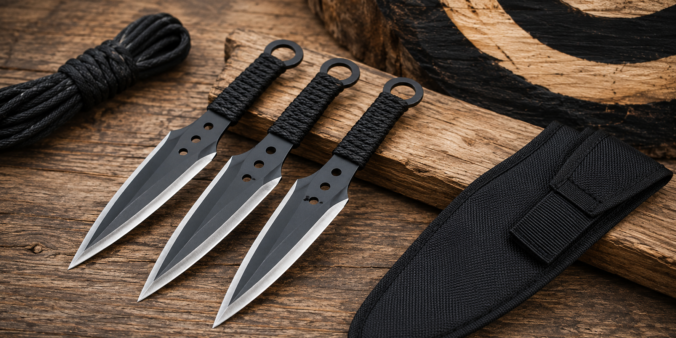
TL;DR: – Best overall starter setup: a 3-knife set in the 12–16 inch range + a DIY pine log target for under $40 total
- No-spin technique is the fastest path to your first stick – no rotation math required
- Most beginners land consistent throws within a few hours of focused practice at the right distance
You’re reading this because you’ve seen someone throw a knife and thought, “I want to do that.” Good instinct. Knife throwing is one of those hobbies that looks intimidating but is genuinely accessible – you just need the right gear and a basic understanding of technique before your first throw.
This guide covers the best throwing knives for beginners hobby guide style: what specs actually matter, six solid product picks across price tiers, how to throw, how to set up a safe practice space, and what the whole thing costs. No fluff, no guesswork.
Note: Product recommendations are based on verified specs from manufacturer pages, established knife publications, and community consensus as of June 2026. Review ratings referenced are from Amazon listings verified at time of writing.
What Makes a Throwing Knife Good for Beginners?
A beginner throwing knife is a purpose-built tool – not a hunting knife, not a tactical folder, not anything with a handle bolted onto a blade.
The single most important spec: single-piece (full-tang) construction. According to the World Knife Throwing League, competition knives must be constructed from a single piece of metal with no moving parts or separate handle material. That rule exists for a reason – handle-and-blade assemblies fail under repeated impact. Every time.
Beyond construction, here’s what to look for:
| Spec | Beginner Sweet Spot | Why It Matters |
|---|---|---|
| Length | 12–16 inches | Affects rotation distance; longer = more forgiving |
| Weight | 5–16 oz (150–450g) | Heavier = more stable flight, more margin for error |
| Balance | Center or near-center | Forgiving flight path for beginners |
| Blade thickness | ~5–7mm | Penetrates soft wood without bending easily |
| Steel | 420 stainless or 1055/1075 carbon | Stainless resists rust; carbon bends vs. snaps |
The World Knife Throwing League puts it plainly: heavier knives are more stable because more mass means more inertia – small technique errors don’t ruin the flight. That’s exactly what beginners need.
On steel: 420 stainless is fine for budget sets and resists rust with zero maintenance. Carbon steel (1055 or 1075) is tougher long-term – it bends under hard impact rather than snapping, and you can straighten it. If you’re throwing outdoors in wet conditions, stainless is more forgiving. If you’re throwing seriously and want durability, carbon steel wins. You can dig into the tradeoffs further in a good knife steel hardness guide or a carbon steel vs stainless steel comparison.
As IKTHOF notes, throwing knives are specifically designed for balance, durability, and aerodynamics – unlike regular knives. That distinction matters when you’re shopping.
Key Takeaway: Single-piece construction is non-negotiable. Target 12–16 inches, center-balanced, in 420 stainless or 1055 carbon steel. Everything else is secondary.
Top 6 Throwing Knives for Beginners (Tested & Ranked)
Here’s a quick comparison before the breakdowns:
| Knife | Length | Steel | Best For | Price Range |
|---|---|---|---|---|
| Cold Steel Sure Flight | 12 in | 1055 carbon | No-spin, overall best | ~$20–25 each |
| Smith & Wesson SWTK10CP (3-pack) | 10 in | 420 stainless | Budget set | ~$22–28 |
| Perfect Point RC-595-3 (3-pack) | 12 in | 420 stainless | Value set | ~$15–22 |
| Condor Dismissal Thrower | 12.8 in | 1075 carbon | Mid-range, rotational | ~$45–55 |
| Whetstone Cutlery 12-pack | 12 in | 420 stainless | Best set value | ~$25–35 |
| BeaverCraft TK_SET1 (3-pack) | 12 in | High-carbon | Heavy practice | ~$35–50 |
Best Overall: Cold Steel Sure Flight
The Cold Steel Sure Flight earns its reputation. It holds a 4.8 out of 5 stars on Amazon – one of the highest ratings in this category. At 12 inches and made from 1055 carbon steel, it’s center-balanced and built to absorb impact without fracturing.
The Sure Flight particularly excels in no-spin throwing but handles other techniques well too. That versatility makes it the smartest first knife – you’re not locked into one style.
Best Budget Set Under $30: Smith & Wesson SWTK10CP
Three knives, 10 inches each, 420 stainless, single-piece construction. The Smith & Wesson set consistently shows up as the entry-level recommendation for good reason: it checks every beginner box at the lowest price point.
The 10-inch length is slightly shorter than ideal for full-spin throwing, but for learning grip, release, and basic mechanics? It works. Verified at ~$22–28 for the 3-pack as of June 2026.
Best for No-Spin Technique: Cold Steel Sure Flight
No-spin throwing works best up to 10 feet from the target, according to IKTHOF’s no-spin guide. The Sure Flight’s center balance is purpose-built for this – the knife flies straight without needing to calculate rotation distance. For beginners who want their first stick fast, this is the path.
A commonly cited guideline for no-spin technique holds that a knife should ideally weigh 1 to 1.4 ounces per inch of blade – a formula attributed to professional knife thrower Harry McEvoy. The Sure Flight hits that range.
Best Mid-Range Pick ($30–$60): Condor Dismissal Thrower
Step up to 1075 high-carbon steel at 12.8 inches and you’re in Condor territory. The Dismissal Thrower is slightly blade-heavy, which suits rotational throwing once you’ve got the basics down.
It’s the knife to buy when you’ve outgrown your starter set and want something that’ll last years of serious practice. Carbon steel means you’ll need a light oil wipe after sessions, but the durability payoff is real.
Best Set (3+ Knives): Whetstone Cutlery 12-Pack
More knives means more throws per session without constantly retrieving. The Whetstone Cutlery set carries a 4.4 out of 5 stars on Amazon and gives you twelve 12-inch 420 stainless knives in one package.
For pure practice volume – which is how you actually improve – this set is hard to beat at its price point. You’ll spend more time throwing and less time walking to the target.
Most Durable for Heavy Practice: BeaverCraft TK_SET1
According to BeaverCraft, the TK_SET1 is a hand-forged set of three high-carbon steel knives designed specifically for beginners. Hand-forged construction means better grain alignment and impact resistance compared to stamped steel alternatives.
If you’re planning to throw 50+ times per session multiple days a week, the extra durability of high-carbon forged steel pays off over time.
Key Takeaway: Start with the Cold Steel Sure Flight or Smith & Wesson 3-pack depending on budget. Upgrade to Condor or BeaverCraft once you’re throwing consistently.
How Do You Actually Throw a Knife? Basic Technique for Beginners
Knife throwing has three main methods. Pick one and stick with it until you’re consistent.
Half-spin: The knife completes half a rotation before hitting the target. Start at 10 feet. According to Knife Depot’s beginner guide, standing about 10 feet from your target is the standard starting point for learning.
Full spin: One complete rotation. Move back to 15–18 feet. The World Knife Throwing League confirms these as the standard competition distances – 10 feet for one rotation, 15 feet for two.
No-spin: The knife travels straight without rotating. This is a much quicker action that eliminates all the rotation calculations – it works best within 10 feet of the target. For beginners who want their first stick in the first session, no-spin is the move.
Grip Types
Blade grip: Hold the blade (not the edge) with your fingertips. More common for half-spin distances. Since practice throwing knives are typically unsharpened, this is safer than it sounds.
Handle grip: Hold the handle like a hammer. Used for full-spin distances.
A key technique tip: keep your wrist stiff when releasing. Don’t snap it. Let the power come from your body – the same motion as throwing a football or javelin.
The Distance Problem (And How to Fix It)
The most common beginner mistake is standing at the wrong distance. If the knife hits handle-first, you’re too close. If it over-rotates, you’re too far. Adjust in 1-foot increments until it sticks.
According to Knife Depot, with regular practice you can learn knife throwing in about 6 months practicing 6 hours a week – but most beginners start landing consistent sticks much faster than that once they find their distance.
Many beginners find they can start sticking throws within their first session once they dial in the correct distance and technique.
Key Takeaway: Start with no-spin at 10 feet or half-spin at 10 feet. Don’t move back until you’re sticking consistently. Distance is the variable that fixes most beginner problems.
What Do You Need to Set Up a Safe Practice Space?
A safe setup is non-negotiable. Knives ricochet. They bounce off hard targets unpredictably.
The target: Use softwood. Pine and cottonwood are the standard recommendations – soft enough for clean penetration, dense enough to hold the knife on impact. Hardwoods like oak damage knife tips and don’t accept throws reliably. A 12–18 inch diameter round, at least 10 inches deep, is the standard format.
Safety zone: According to eKnives, keep 10 to 15 feet of open space behind your throwing line and ensure a clear area around the target board to catch ricochets. Never throw with anyone in the retrieval zone.
Indoor vs. outdoor: Outdoor setups are simpler – more space, natural backstop options. Indoor throwing requires more planning. IKTHOF’s indoor setup guide recommends a minimum 15-foot throwing lane with adequate width for safety. A rubber mat behind the target catches bounced knives.
Target longevity: At moderate practice intensity (30 throws per session, a few times a week), a 12-inch pine round typically lasts 6–8 weeks before the center becomes too fragmented to hold throws reliably. Budget for replacement rounds.
Legal note: Knife throwing as a sport has no federal prohibition in the US. Organizations like the WKTL have established structured rules making it a recognized sport. That said, local ordinances vary – check your municipality’s rules before setting up in a public space. Private property practice is generally straightforward.
For fixed blade knife construction details relevant to why full-tang matters for target penetration, it’s worth reading up on fixed blade knife construction basics.
Key Takeaway: Pine or cottonwood target, 12–18 inches diameter. Clear 10–15 feet behind your throwing line. Never retrieve while someone is throwing. Check local ordinances before outdoor public practice.
How Much Does It Cost to Start Knife Throwing as a Hobby?
This is the question nobody answers directly. So here are the actual numbers.
| Item | Minimum Setup | Mid-Range Setup |
|---|---|---|
| Knife set | $22 (S&W 3-pack) | $50 (Condor + extras) |
| Target | $0 (DIY pine log) | $60 (commercial foam) |
| Safety gear (gloves) | $8 | $15 |
| Total | ~$30 | ~$125 |
The minimum viable setup: a Smith & Wesson 3-pack at ~$22 plus a pine log from your backyard or a lumber yard (under $20, often free) gets you throwing for under $40. That’s it.
Mid-range means better knives, a commercial foam target that lasts longer and doesn’t need replacement as often, and proper gloves for blade-grip handling.
Ongoing costs: Target replacement is your main recurring expense. A pine round at moderate practice runs 6–8 weeks. Budget $10–$20 every couple of months. Knives themselves rarely need replacing if you’re buying solid steel construction – the Cold Steel Sure Flight or Condor Dismissal will outlast dozens of targets.
If you enjoy working with wood, building your own targets is a natural complement to the hobby – similar skills apply to beginner woodworking projects.
You can browse a solid range of throwing knives at Knife Depot – they carry options across the budget and mid-range tiers covered here, with fixed blade and full-tang construction throughout.
Key Takeaway: You can start knife throwing for under $40. The knives are a one-time cost; targets are the ongoing expense at $10–$20 every few months.
Frequently Asked Questions About Throwing Knives
Should throwing knives be sharp or dull for beginners?
Direct Answer: Practice throwing knives should have a sharp tip but do not need a sharp edge. Practice knives are deliberately unsharpened or blunted – a sharp edge is unnecessary for target work and increases risk when gripping the blade. The tip does the work of penetrating the target; edge sharpness is irrelevant.
What is the best throwing knife weight for beginners?
Direct Answer: Knifeinformer recommends knives in the 5–16 oz range for most throwers. The World Knife Throwing League explains why heavier is better for beginners: more mass means more inertia, which means small technique errors don’t ruin the flight. Start in the middle of that range – around 8–12 oz – and adjust based on what feels controllable.
How far should a beginner stand from the target?
Direct Answer: Start at 10 feet. According to Knife Depot’s beginner guide, 10 feet is the standard starting distance for learning. The World Knife Throwing League sets 10 feet as the 1-rotation competition distance and 15 feet for 2-rotation throws. If the knife hits handle-first, step back 1 foot. If it over-rotates, step forward 1 foot.
What is no-spin knife throwing and is it easier for beginners?
Direct Answer: No-spin throwing means the knife travels straight to the target without rotating. It is a quicker action that eliminates rotation calculations entirely – it works best within 10 feet of the target. Beginners often start with no-spin for exactly this reason. If you want your first stick in your first session, no-spin at close range is the fastest path.
Is knife throwing legal in the US?
Direct Answer: Knife throwing as a sport has no federal prohibition in the United States. Organizations like the WKTL have established structured rules making it a recognized sport. Local ordinances vary by municipality – some restrict blade length for carry or public display. Practice on private property is generally straightforward; always verify local rules before setting up in public spaces.
How do beginner throwing knives differ from professional competition knives?
Direct Answer: The core specs overlap significantly – single-piece construction, 12–16 inch length, center balance. The main differences are steel quality, finish precision, and weight consistency. Competition knives are machined to tighter tolerances so every knife in a set behaves identically. For beginners, that level of precision isn’t necessary. A good blade shape guide can help you understand how geometry affects throwing performance as you advance. Budget sets in 420 stainless are entirely adequate for learning; the upgrade to competition-grade makes sense once you’re throwing consistently at multiple distances.
How many throwing knives do you need to start practicing?
Direct Answer: Three is the practical minimum. With three knives, you throw a set, retrieve, and repeat – enough volume to build muscle memory without constant interruption. eKnives recommends throwing for 20 minutes a few times a week and tracking progress. More knives (like the Whetstone 12-pack) mean more throws per session, which accelerates learning. Start with three; add more once you’re hooked.
The Bottom Line
Knife throwing is a genuinely accessible hobby. The gear is affordable, the skill curve is real but short, and the satisfaction of a clean stick never gets old.
Start with a 3-knife set in the 12-inch range – the Cold Steel Sure Flight for no-spin, the Smith & Wesson set if budget is the priority. Build a pine log target. Stand 10 feet back. Focus on consistent release before worrying about distance.
Once you’re sticking throws reliably, you’ll naturally want to explore longer distances, different techniques, and better knives. That’s when knife collecting as a hobby starts to make a lot of sense – and the rabbit hole goes deep.
For now: get the knives, build the target, and throw.
Ready to Get Started?
For personalized guidance, visit Knife Depot to learn how we can help.


Thanks for sharing this helpful guide! It offers clear tips and practical advice for anyone interested in learning something new. I appreciate the effort put into making the information easy to understand. Thanks!