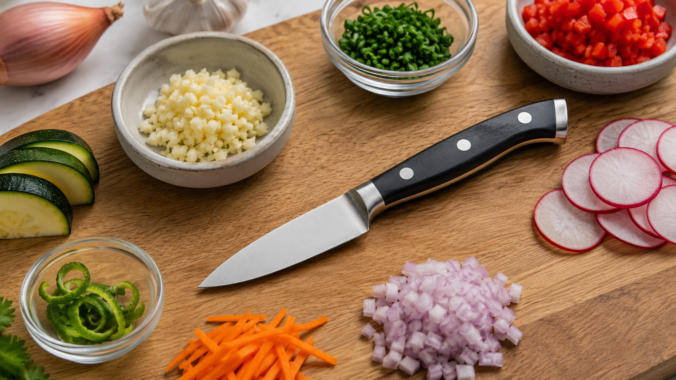
TL;DR: – Best overall for precision: Victorinox Fibrox Pro 3.25-inch – sharp, lightweight, under $15
- Best Japanese pick: Mac Knife PKF-30 – harder steel, longer edge retention, ~$45–$55
- Best for tourné and decorative cuts: Wüsthof Classic 3.5-inch – German reliability, full bolster, ~$65–$95
- Who this is for: Home cooks doing detailed prep – peeling, segmenting, deveining, decorative cuts – who want a reliable knife under $100
What Makes a Paring Knife Good for Detailed Work?
The best paring knife for detailed kitchen prep work isn’t the most expensive one. It’s the one that disappears in your hand while you’re hulling strawberries or segmenting a grapefruit at 7am.
Based on our analysis of testing data from Serious Eats, Wirecutter, Bon Appétit, Epicurious, and Reviewed – plus manufacturer spec pages and culinary school technique guides – four variables separate a precision paring knife from a mediocre one.
Blade length. According to Reviewed, you should “prioritize a blade size of 3.25 to 3.5 inches for optimal maneuverability.” Serious Eats tested blades between 3.25 and 4 inches, noting that “any longer and you’re veering into petty knife territory.” The sweet spot: 3–3.5 inches.
Tip geometry. This is the most underdiscussed variable. Three shapes exist:
- Spear point – pointed tip, curved belly. Most versatile. Good for peeling, trimming, segmenting.
- Bird’s beak – curved blade, inward-curving tip. Purpose-built for tourné cuts and round-surface peeling.
- Sheep’s foot – straight edge, blunt tip. Safest for in-hand work; limited for tip-precision tasks.
Steel hardness (HRC). The 56–62 HRC range covers all practical paring knife options. Below 56 HRC and the edge dulls too fast. Above 63 HRC and you’re risking chips when the blade contacts a hard seed or pit. Understanding HRC ratings and what they mean for kitchen knives helps you match steel to your actual prep habits.
Handle grip when wet. According to Serious Eats, “textured polypropylene and Fibrox handles maintain grip when wet, while natural wood can swell and become slippery.” If you’re peeling citrus or working with wet produce, handle material matters more than most buyers realize.
Key Takeaway: Blade length of 3–3.5 inches, tip geometry matched to your tasks, HRC between 56–62, and a non-slip handle are the four variables that determine precision paring knife performance. Everything else is secondary.
How Do Japanese and German Paring Knives Compare for Precision?
The Japanese vs. German debate isn’t about prestige. It’s about trade-offs that directly affect how you prep food.
| Feature | Japanese (e.g., Mac, Shun) | German (e.g., Wüsthof, Mercer) |
|---|---|---|
| Edge angle | ~15° per side | ~20° per side |
| Typical HRC | 59–62 | 56–58 |
| Bevel type | Often asymmetric | Symmetric |
| Weight | Lighter | Heavier |
| Edge retention | 4–6 months (moderate use) | 2–3 months (moderate use) |
| Chip risk | Higher (hard seeds/pits) | Lower |
| Best for | Segmenting, fine trimming | All-purpose, tourné, peeling |
puts it plainly: “Harder Japanese steels like VG-10 at 60+ HRC hold their edge considerably longer than softer German steels, but require more care to avoid chipping.”
So what does that mean for your prep work?
For peeling round fruit (apples, pears, potatoes): German steel wins. The slightly softer edge is more forgiving when you accidentally nick a seed or hit a fibrous core. Less chip risk.
For segmenting citrus: Japanese spear-point. The thinner, harder edge slices membrane cleanly without tearing. According to Serious Eats, “a pointed spear-tip paring knife allows clean entry and a straight-line cut along the membrane.”
For tourné cuts: Either works, but blade shape matters more than steel origin here. A bird’s beak in German steel beats a spear-point in Japanese steel for this task every time.
One important caveat on Japanese knives: many use asymmetric bevels designed for right-handed users. If you’re left-handed, a symmetric German bevel (Victorinox, Wüsthof) is the safer default. Understanding carbon steel vs stainless steel trade-offs also helps clarify why Japanese knives demand more careful maintenance.
Key Takeaway: Japanese paring knives (15°, 60+ HRC) hold edges longer and cut more precisely but chip more easily. German knives (20°, 56–58 HRC) are tougher and more forgiving. Match the style to your most frequent task.
Best Paring Knives for Detailed Kitchen Prep: Top Picks (2026)
Here are five knives that cover every tier and task. No filler picks.
Best Overall: Victorinox Fibrox Pro 3.25-Inch
Steel: High-carbon stainless | HRC: ~56–58 | Handle: Fibrox polymer | Blade: 3.25 inches
Reviewed calls it out for its “ultra-lightweight design” that “made it easy to use off the cutting board.” The Restaurant Warehouse notes that “Serious Eats named it their best overall paring knife.”
The Fibrox handle is the real differentiator. Grippy when wet, comfortable for extended prep sessions, and symmetrically beveled – so it works for left- and right-handed cooks equally.
Best task: Everyday peeling, hulling, trimming. The workhorse pick.
| Criteria | Score |
|---|---|
| Edge sharpness | 4/5 |
| Handle grip (wet) | 5/5 |
| Tip precision | 4/5 |
| Value | 5/5 |
Best Japanese Pick: Mac Knife PKF-30 3.25-Inch
Steel: High-carbon molybdenum | HRC: ~59–61 | Handle: Pakkawood | Blade: 3.25 inches
Serious Eats found the Mac “started out very keen” – taking only 33 grams of force to cut a thread on the sharpness reader. That’s exceptional out-of-box sharpness for a paring knife.
The trade-off: after extended testing, force required increased 375%. Edge retention is good but not permanent. Plan on whetstone maintenance every 4–6 months with moderate use. For VG10 vs AUS10 steel performance context, Mac’s proprietary molybdenum steel sits in similar HRC territory to both.
Best task: Citrus supreming, deveining shrimp, fine decorative scoring.
| Criteria | Score |
|---|---|
| Edge sharpness | 5/5 |
| Handle grip (wet) | 3/5 |
| Tip precision | 5/5 |
| Value | 3/5 |
Best Budget: Mercer Culinary Genesis 3.5-Inch
Steel: X50CrMoV15 German | HRC: ~56–58 | Handle: Santoprene | Blade: 3.5 inches
Bon Appétit confirms “it’s possible to get a great paring knife for around $20.” The Mercer Genesis is exactly that. German X50CrMoV15 steel – the same alloy family as Wüsthof – at a fraction of the price.
The Santoprene handle is NSF-certified and genuinely comfortable. This is the knife culinary schools hand to students for a reason. Handle material grip and durability matter more at this price tier than blade steel differences.
Best task: Daily prep, peeling, trimming. Replace every 3–5 years with heavy use.
| Criteria | Score |
|---|---|
| Edge sharpness | 3/5 |
| Handle grip (wet) | 4/5 |
| Tip precision | 3/5 |
| Value | 5/5 |
Best for Tourné & Decorative Cuts: Wüsthof Classic 3.5-Inch
Steel: X50CrMoV15 | HRC: 58 | Handle: POM polymer | Blade: 3.5 inches
notes the Wüsthof Classic “is on the high end of knives we tested.” Bon Appétit highlights its “comfortable extension-of-your-hand sort of feeling, which is exactly what you want.”
The full bolster adds balance for the controlled rocking motion tourné cuts require. HRC 58 means it’s tough enough to handle the repeated contact with dense root vegetables without chipping. The spear-point tip is precise enough for decorative scoring too.
Best task: Tourné cuts, decorative prep, extended peeling sessions.
| Criteria | Score |
|---|---|
| Edge sharpness | 4/5 |
| Handle grip (wet) | 4/5 |
| Tip precision | 4/5 |
| Value | 3/5 |
Best Bird’s Beak: Victorinox 2.75-Inch Bird’s Beak
Steel: High-carbon stainless | HRC: ~56–58 | Handle: Fibrox polymer | Blade: 2.75 inches
This is a specialty tool. Don’t use it as your everyday paring knife. But if you’re doing tourné cuts, mushroom trimming, or peeling round produce in-hand, the curved blade geometry is purpose-built for the job.
Bon Appétit recommends the Victorinox bird’s beak as “the most recommended entry-level option – inexpensive, sharp, and appropriately curved.” The Auguste Escoffier School of Culinary Arts confirms the bird’s beak is the classical tool for the seven-sided tourné cut.
Best task: Tourné cuts, curved-surface peeling, mushroom trimming.
Key Takeaway: For under $100, these five knives cover every precision prep scenario. The Victorinox Fibrox Pro is the default best overall. Add the bird’s beak if you do tourné work regularly.
Which Blade Shape Should You Choose for Your Task?
Blade shape is the most practical decision you’ll make – and most buyers skip it entirely.
According to Knife Planet, “the classic spear-tip paring knife is the most versatile shape, handling everything from peeling to trimming to delicate scoring.” But versatility doesn’t mean optimal for every task.
Here’s the task-to-blade-shape matching table that most paring knife articles don’t include:
| Task | Best Blade Shape | Why |
|---|---|---|
| Peeling round fruit (apples, pears) | Spear point or sheep’s foot | Curved belly follows contour; sheep’s foot safer in-hand |
| Segmenting citrus | Spear point | Pointed tip enters membrane cleanly |
| Tourné cuts (7-sided barrel) | Bird’s beak | Curved blade follows vegetable contour naturally |
| Deveining shrimp | Spear point | Tip precision for shallow scoring |
| Hulling strawberries | Spear point | Tip control for circular hull removal |
| In-hand peeling (beginners) | Sheep’s foot | Blunt tip reduces injury risk |
The Culinary Hill guide to tourné cuts explains it well: “the bird’s beak paring knife has a curved blade that follows the natural contour of vegetables like carrots and potatoes during the seven-sided tourné cut.”
For citrus work, the spear point wins. Serious Eats notes that “a bird’s beak tends to curve into the segment” – exactly what you don’t want when supreming.
Foldedsteel makes a point worth remembering: “a paring knife is going to be the only knife you can use in the air, safely.” That in-hand versatility is what makes blade shape selection so important – you’re not always working on a board.
Key Takeaway: Spear point handles 80% of detailed prep tasks. Add a bird’s beak only if tourné cuts or curved-surface peeling are regular parts of your prep routine.
How to Keep a Paring Knife Sharp for Precision Work
A dull paring knife is the fastest way to ruin detailed prep work. The edge is everything.
Honing vs. sharpening. These are different. America’s Test Kitchen explains: “Hone your knife before or after each use to realign the edge; sharpen only when honing no longer restores the edge – typically every few months for home cooks.”
Honing realigns a bent edge. Sharpening removes metal to create a new one. Do both, but on different schedules.
Angle matters. America’s Test Kitchen confirms: “Most Japanese knives are factory-sharpened to 15 degrees per side while European-style knives are typically set to 20 degrees.” Sharpen at the wrong angle and you’re undoing the factory geometry.
- German paring knives (Wüsthof, Mercer, Victorinox): 20° per side on a whetstone or honing rod
- Japanese paring knives (Mac): 15° per side; use a whetstone rather than a steel rod to avoid micro-chipping
Sharpening frequency by steel:
- HRC 56–58 (German): Sharpen every 2–3 months with regular home use
- HRC 59–62 (Japanese): Sharpen every 4–6 months – but hone more carefully
One often-overlooked factor: your cutting board. Glass and ceramic boards destroy edges fast. Wood or plastic boards extend edge life significantly – relevant whether you’re using a $15 Victorinox or a $65 Wüsthof. A whetstone sharpening guide for kitchen knives will walk you through grit progression for both steel types.
Bon Appétit notes that with quality steel, “you can continue to sharpen and resharpen with a whetstone or a pull-through knife sharpener, because of its superior steel quality” – a key reason mid-range knives outperform cheap ones over time.
Key Takeaway: Hone before each use, sharpen every 2–6 months depending on steel HRC, and always match your sharpening angle to the knife’s factory geometry (15° Japanese, 20° German).
Frequently Asked Questions About Paring Knives
How much should I spend on a good paring knife for home use?
Direct Answer: You can get an excellent paring knife for $15–$65. Budget under $30 covers daily prep well; $30–$65 gets you better steel and longer edge life.
Bon Appétit confirms “it’s possible to get a great paring knife for around $20.” The caveat: Bon Appétit also notes that “budget-friendly options tend to be less durable and don’t sharpen as well, meaning you may need to replace them after a few years.” Amortized over 10 years with proper care, a $65 Wüsthof and a $15 Victorinox converge in cost-effectiveness – the difference is how much maintenance you’re willing to do.
What is the difference between a paring knife and a peeling knife?
Direct Answer: “Paring knife” and “peeling knife” are often used interchangeably, but technically a peeling knife refers specifically to a bird’s beak style designed for curved surfaces.
A standard paring knife (spear point or sheep’s foot) handles a broader range of tasks including trimming, coring, segmenting, and scoring. According to Nogent Knives, “a paring knife excels at performing tasks such as peeling, trimming, coring, hulling, scoring, segmenting, mincing, and dicing with precision.” A dedicated peeling/bird’s beak knife is optimized for one thing: following curved contours.
Is a 3-inch or 3.5-inch paring knife better for detailed work?
Direct Answer: 3.25–3.5 inches is the consensus sweet spot. The difference is minimal; choose based on hand size.
recommends “a blade size of 3.25 to 3.5 inches for optimal maneuverability.” Smaller hands often prefer 3–3.25 inches for in-hand work; larger hands find 3.5 inches more efficient for board work. Serious Eats notes handles typically measure “between 3.5 and 4.5 inches” – handle length relative to blade length affects balance more than blade length alone.
Can I use a paring knife on a cutting board or should I hold the food?
Direct Answer: Both. Paring knives are designed for in-hand use but work fine on a board for tasks like mincing or scoring.
Foldedsteel makes the key point: “a paring knife is going to be the only knife you can use in the air, safely.” confirms they’re “essential for precision tasks off the cutting board, like peeling fruits and deveining shrimp.” Use a pinch grip on the blade base and guide with your non-dominant thumb for controlled in-hand cuts.
How often should a paring knife be sharpened with regular home use?
Direct Answer: Hone before each use. Sharpen every 2–3 months for German steel (HRC 56–58) or every 4–6 months for Japanese steel (HRC 60+).
America’s Test Kitchen recommends sharpening “every few months for home cooks” using a whetstone or pull-through sharpener. The interval depends on your cutting board material – wood and plastic boards extend edge life significantly versus glass or ceramic surfaces. For a deeper dive, a whetstone sharpening guide for kitchen knives covers grit progression for both steel types.
Are Japanese paring knives worth the extra cost over European ones?
Direct Answer: Yes, if you do fine precision work regularly. No, if you want a low-maintenance daily driver.
Japanese paring knives at 60+ HRC hold a thinner, sharper edge longer – ideal for citrus supreming, deveining, and fine scoring. But they chip more easily on hard seeds and require angle-specific whetstone maintenance. found that “with one notable exception, you generally get what you pay for” – the performance gap is real, but so is the maintenance commitment. If you want to explore the broader knife category beyond paring knives, the best chef knife for home cooking under $100 is a natural next step.
What paring knife do professional chefs recommend for intricate prep?
Direct Answer: Mac Knife and Wüsthof Classic are the most frequently cited professional recommendations for precision work.
Serious Eats found the Mac PKF-30 started with exceptional sharpness at just 33 grams of cutting force. For tourné and decorative cuts specifically, the Wüsthof Classic’s balance and full bolster make it the preferred German-style option. The Victorinox Fibrox Pro remains the top value recommendation across and multiple culinary publications for cooks who want professional-grade performance without the premium price. You can browse a wide selection of these styles at Knife Depot.
The Bottom Line
The best paring knife for detailed kitchen prep work comes down to one question: what are you actually cutting?
Spear point for segmenting and general prep. Bird’s beak for tourné and curved peeling. German steel for durability and low maintenance. Japanese steel for maximum edge precision with more careful upkeep.
The Victorinox Fibrox Pro handles 80% of home prep tasks at a price that makes it a no-brainer starting point. Add the Mac Knife PKF-30 if you want Japanese precision. Add the Victorinox bird’s beak if tourné cuts are in your rotation.
Keep it sharp. Use a wood or plastic board. Hone before each use. That’s the whole system.
Ready to Get Started?
For personalized guidance, visit Knife Depot to learn how we can help.


Leave a Reply