The official blog of Knife Depot

Category: Knife Stuff (Page 2 of 30)

Lightweight Hiking Knives for Backpacking (2026)

TL;DR: Start with the weight of everything you will carry, including sheath and accessories. The standard blue Bugout 535 is 1.85 ounces and $200.99 at Knife Depot at this check. The Pioneer X is 94 grams, about 3.32 ounces—not 2.47 ounces. A lower number is useful only if the knife still handles your planned cutting tasks.

Prices checked November 9, 2026. Knife Depot prices are USD before tax and shipping. Manufacturer list prices are labeled separately; configurations, offers, and availability can change.

Introduction: Why Weight Matters on the Trail

A backpacking knife has to earn its place alongside food, shelter and other equipment. For many trips the jobs are modest: opening packages, preparing food, cutting cord and making small repairs. Write down those tasks before deciding how much knife to carry.

Weight is easy to compare only when the figures use the same basis. A folder’s listed weight may include its clip, while a fixed blade’s listing may exclude its sheath. Optional scales, clips, lanyards and sharpeners can change the total.

What Makes a Knife Truly Lightweight for Backpacking?

There is no universal 1.5-ounce or two-percent-of-pack rule. Choose a personal weight budget, then test whether the knife’s grip and blade work for you. A small knife with poor control is not improved by being light; a heavier knife is not automatically more capable for the jobs you actually do.

Compare Why it matters
Knife-only weight Useful for comparing the tool itself
Ready-to-carry weight Includes sheath, attachment and optional handle parts
Maintenance kit Add the actual sharpener and lubricant you pack
Blade and handle dimensions Small weight differences are less useful if you cannot hold the tool securely

Top 7 Lightweight Hiking Knives for Backpacking in 2026

Knife / version Details to compare Weight basis Price reference
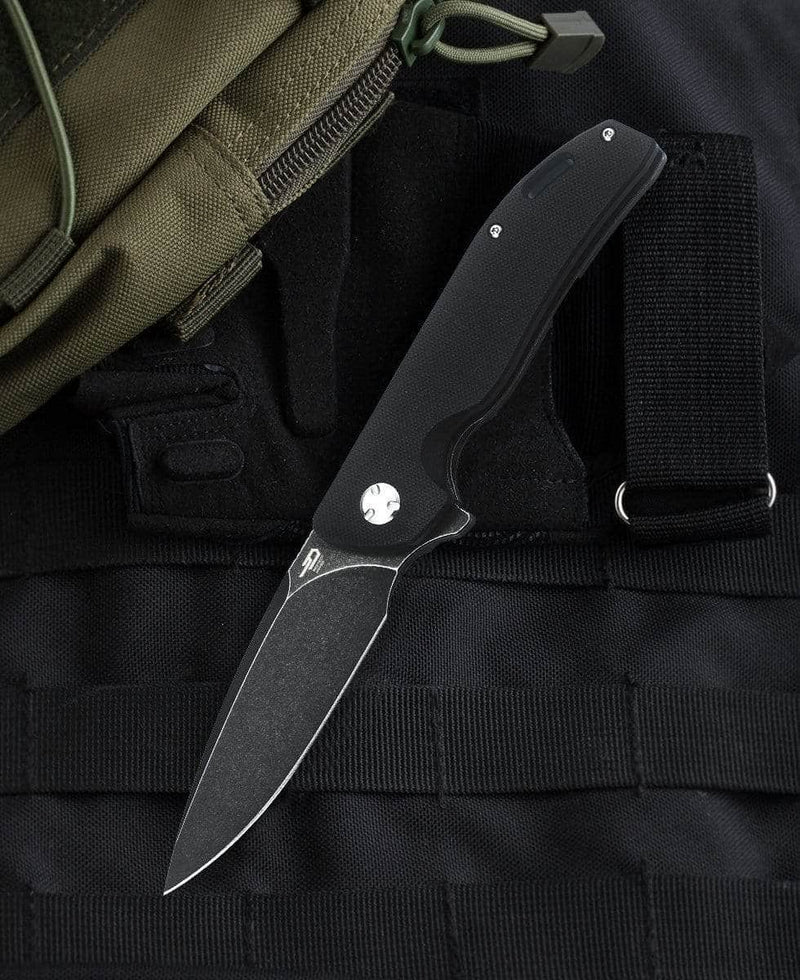
Benchmade Bugout 535 3.24-inch S30V; blue Grivory; AXIS lock 1.85 oz knife $200.99 at Knife Depot
Spyderco Dragonfly 2 C28PBK2 2.28-inch VG-10; FRN; back lock About 1.2 oz in the 2025 catalog Check current SKU
ESEE Izula, standard carbon version 2.63-inch 1095 blade; fixed blade 2.0 oz knife only; sheath extra Shop the black IZULA-B and check current price
Morakniv Companion S 104 mm / 4.1-inch 12C27 blade; standard tang Manufacturer product listing: 118.4 g / 4.18 oz; confirm package basis Check current version
Victorinox Pioneer X Alox 0.8231.26 93 mm body; scissors; 9 functions 94 g / about 3.32 oz Check current version
Spyderco Ladybug 3 Small back-lock folder; multiple steel and handle versions Use exact SKU weight Check current SKU
Opinel No.4 Small folding format; verify the exact version and locking arrangement Use exact version weight Check current version

The 2025 Spyderco product guide identifies the black FRN Dragonfly 2 configuration. Do not apply its weight or steel to every Dragonfly. Likewise, Ladybug versions should not share one price and specification without an exact SKU.

The official Pioneer X specifications are especially useful when comparing a multi-tool with a dedicated knife. Its scissors may save carrying another tool, but it is not an ultralight folder merely because its blade is compact.

For the Izula, ESEE’s weight excludes the sheath and optional handle scales. Morakniv’s Companion S listing uses a different product-weight presentation, so confirm exactly what is included before comparing complete carry systems. Avoid treating either number as blade-only weight.

Older Backpacking Light discussion of the Ultra Light Bushcrafter provides historical owner context. It is not a current Bark River price list or confirmation that every handle configuration has the same weight.

How Do You Choose the Right Backpacking Knife for Your Trip?

For a maintained trail and routine food or cord cutting, compare small folders first. If your trip includes sustained carving, compare a fixed blade with a comfortable full grip and a sheath you can secure. Choose around the work, weather, your skills, and the rest of your kit—not trip length alone.

Consider wet-hand control, cleaning access, and whether you can use the opening and closing controls safely. Ruike’s hiking-knife guide offers additional manufacturer context, while the exact model page remains the reference for specifications.

Fixed Blade vs Folding Knife: Which Is Better for Backpacking?

Fixed blades are not automatically lighter than folders. Compare actual ready-to-carry weights. A folder stores its edge inside the handle; a fixed blade needs a suitable sheath. Both can serve trail cutting tasks if the individual knife is appropriate and maintained.

No design establishes a universal failure rate. Follow the maker’s instructions and carry a suitable saw or other tool if the task calls for it. A knife’s presence does not replace navigation, first-aid supplies, communication or trip planning.

How to Maintain a Lightweight Hiking Knife on the Trail

Clean and dry the blade after use, including stainless blades. Remove grit from the handle, pivot, and sheath; use only cleaning products and lubricants the maker permits. If the knife touches food, use an appropriate food-contact lubricant. Store it dry and inspect the carry system before each trip.

Sharpen when cutting performance calls for it, using the maker’s recommended angle and suitable abrasives. Edge damage, geometry, steel, and technique affect the work required, so a steel name does not set a fixed number of minutes or days between sharpenings. A strop can refine an edge but does not replace sharpening a worn or damaged bevel.

Weigh the sharpening tool you actually pack. A 1.2-ounce rod is heavier than a 0.5-ounce stone; neither figure identifies which abrasive is right for every blade. Practice on your knife before leaving and protect the edge during transport.

For steel comparisons, Knife Steel Nerds’ metallurgy discussion is more useful than a promise of fixed sharpening times or a blanket claim that every carbon blade is tougher than stainless.

Frequently Asked Questions About Lightweight Backpacking Knives

Must a backpacking knife weigh under 1.5 ounces?

No. It is a preference, not a universal requirement. The Bugout 535 is 1.85 ounces; choose according to the cutting and grip you need.

How much does the Pioneer X weigh?

The referenced 0.8231.26 model is 94 grams, about 3.32 ounces. Include the weight of any pouch or accessories separately.

Does the Izula weight include the sheath?

No. ESEE lists the knife at 2.0 ounces without its sheath. Optional handle parts add weight too.

Is stainless steel maintenance-free?

No. Clean and dry it, especially after wet, salty or acidic exposure. Follow its manufacturer’s instructions.

What is the Bugout price in this guide?

The blue Grivory 535 was $200.99 at Knife Depot on November 9, 2026, before tax and shipping.

What is the best inexpensive option?

Compare the current Companion version and small folders against your budget and tasks. Check live prices rather than assuming an older $15–$20 offer is still available.

Conclusion: Your Lightweight Knife Awaits

Pick a knife you can control, maintain and carry comfortably. Compare current pocket knives and fixed-blade outdoor knives at Knife Depot, then weigh the complete system before packing.

Custom Handmade Knives for Serious Collectors (2026)

TL;DR: – Entry-level custom knives run $200–$450; mid-tier ABS Journeyman Smith damascus pieces cost $800–$2,750; investment-grade Master Smith integrals reach $4,000–$12,000+

  • ABS Master Smith designation (fewer than 130 smiths worldwide) is the most meaningful credential for collectors evaluating quality
  • Commission deposits typically run 25–50% with 3–18 month timelines; store pieces at 45–55% relative humidity to prevent cracking in natural handle materials

What Makes a Handmade Knife Worth Collecting?

A collectible handmade knife isn’t just a sharp blade – it’s a convergence of craftsmanship, material quality, maker reputation, and investment potential. (Si.edu) (Usfws.gov) Based on our analysis of collector forums, auction data, and maker credentials across 2024–2026, the defining traits that separate investment-grade pieces from commodity handmade knives come down to four factors: verifiable maker credentials, steel selection, construction integrity, and provenance documentation.

The most meaningful credential in the custom knife world is the ABS Master Smith designation. ABS Master Smith designation (fewer than 130 smiths worldwide) is the most meaningful credential for collectors evaluating quality. This isn’t marketing – it’s a verified performance standard. These are the fewer than 130 smiths worldwide who’ve passed the rigorous two-phase performance test – cutting rope, shaving arm hair, and bending the blade 90 degrees without fracture. That’s destructive testing. You’re not buying a name; you’re buying documented structural integrity.

Steel choice matters enormously for both aesthetics and resale. High-quality custom knives typically use premium steels like D2, ATS-34, RWL-34, BG-42, CPM-S30V, VG-10, or Damascus, but within that tier, certain steels command collector premiums. W2 tool steel with a visible hamon (the differential hardening line) appeals to collectors because it demonstrates both technical skill and aesthetic intention. Damascus (pattern-welded) steel is valued primarily for visual complexity and as proof of labor-intensive craftsmanship, not necessarily for functional superiority.

Construction method signals investment potential. Full-tang blades – where the steel extends the full length of the handle – allow collectors to see the entire construction and are generally preferred over hidden-tang designs in American collector markets. This transparency of build quality matters psychologically and practically for resale.

Key Takeaway: Collectible handmade knives combine ABS certification (or equivalent guild credentials), premium steel selection, full-tang construction, and documented maker provenance. These four factors drive 70–80% of secondary market value appreciation.

How Much Do Custom Handmade Knives Actually Cost?

Pricing in the custom knife market breaks into three distinct tiers, each with different labor-to-material ratios and maker reputation premiums.

Entry-Level ($200–$450): Entry-level custom knives run $200–$450. At this tier, you’re paying roughly $80–$150 in materials (steel, handle material, hardware) plus 4–6 hours of skilled labor at $30–$50/hour. These knives are functional and often beautiful, but they lack the maker reputation premium that drives secondary market appreciation.

Mid-Tier ($800–$2,750): This is where ABS Journeyman Smiths and established stock-removal makers operate. Mid-tier ABS Journeyman Smith damascus pieces cost $800–$2,750. A Damascus hunter at this level involves approximately $150–$200 in raw billet steel, 10–12 hours of skilled labor at $75–$100/hour, plus a 10–15% maker reputation premium. Waitlist scarcity matters here – established makers often run 6–12 month backlogs, and collectors report paying 15–25% premiums on the secondary market for pieces from waitlisted makers.

Investment-Grade ($4,000–$12,000+): These are ABS Master Smith pieces, deceased maker inventory, or knives from makers with Art Knife Invitational credentials. Investment-grade Master Smith integrals reach $4,000–$12,000+. At this tier, you’re paying for documented structural excellence (the ABS bend test), maker scarcity, and historical significance. An integral (where blade and handle are forged from a single piece of steel) at the Master Smith level involves 20–40 hours of labor, premium materials, and the maker’s reputation premium of 25–40% above cost basis.

Commission deposits typically run 25–50% of the estimated final price, paid at order placement. The balance is due on completion. Deposits above 50% without a formal contract are a red flag – that’s a known fraud vector in the custom knife space.

Key Takeaway: Entry-level custom knives run $200–$450 (emerging makers); mid-tier ABS Journeyman pieces run $800–$2,750 with 6–12 month waits; investment-grade Master Smith knives reach $4,000–$12,000+ with documented appreciation potential of 15–25% over 3–5 years.

Steel, Handle Materials, and Construction: What Collectors Prioritize

Steel selection is the most consequential technical variable for collectibility. The choice between high-carbon, stainless, and Damascus isn’t just functional – it signals the maker’s design intent and the knife’s intended audience.

High-Carbon Steels (W2, 1084, 1095, 52100): These are the traditional choice for forged blades and are prized by collectors for their ability to develop a visible hamon (differential hardening line) and patina over time. W2 is particularly valued because it produces dramatic hamon when differentially hardened. The trade-off: high-carbon steel requires active maintenance (oiling, humidity control) and will develop surface rust if stored above 60% relative humidity.

Stainless Steels (S35VN, M390, CPM-3V): Premium steel choices like S35VN, M390, and MagnaCut offer top performance. S35VN is the workhorse stainless for custom makers – it balances edge retention, toughness, and finishability. M390 offers the finest mirror polish capacity among stainless options and is preferred for display-quality pieces. CPM-3V is excellent for hard-use knives but resists mirror polish, limiting its appeal for display-oriented collectors.

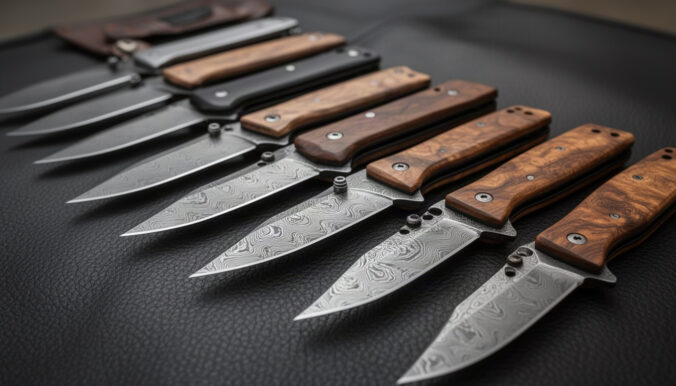
Damascus (Pattern-Welded Steel): Custom knives often feature unique, high-end materials such as Fossil Mammoth, Gem Quality Stones, Various Color Pear, stabilized wood, carbon fiber, or exotic animal bone. Damascus is valued aesthetically and as a demonstration of skill; its functional properties vary widely by steel combination, but the visual complexity is the primary collector driver at the $1,500+ tier.

Handle Materials: Stabilized wood (resin-impregnated burl or figured wood) is the practical collector choice – it resists humidity fluctuations while offering aesthetic variety at mid-tier prices. Mammoth ivory and fossil materials command top premiums but require documentation for legal compliance. G10 and Micarta are durable synthetics favored for functional pieces; natural materials (bone, wood, horn) appeal to traditionalists but require more careful storage.

Construction Method: Full-tang construction is generally preferred by collectors for structural integrity and long-term value. Hidden tang (stick tang) can be acceptable in traditional designs but signals lower build investment to many buyers. The exception is Japanese honyaki construction, which uses hidden/integral tang and commands high premiums in Japanese collector markets.

Key Takeaway: Collectors prioritize high-carbon steels with visible hamon, stabilized wood handles for humidity stability, and full-tang construction for transparency. Damascus appeals primarily to display collectors; stainless steels favor utility over prestige.

How Do You Find and Commission a Reputable Custom Knifemaker?

Finding a legitimate custom knifemaker requires vetting credentials, understanding the commission process, and knowing where to source verified makers.

Where to Find Makers:

The ABS member directory is the gold standard for verification. You can search by name and certification level (Journeyman Smith, Master Smith) to confirm credentials. The Knifemakers Guild provides a broader credentialing net, accepting both forging and stock-removal makers. Blade Show Atlanta attracts over 1,400 exhibitors and 10,000+ attendees annually, making it the primary venue for in-person maker evaluation. The Art Knife Invitational is invitation-only for both makers and buyers, serving as a reliable market signal for top-tier valuations.

Red Flags vs. Green Flags:

Green flags: The maker has an ABS or Guild credential, maintains a public portfolio with dated photos, provides a written commission contract, and has verifiable customer references. A genuine mark will be consistent across all knives made by that particular artisan. Consistency of maker marks across pieces signals professionalism.

Red flags: No verifiable credentials, vague timelines (“sometime next year”), deposits above 50% without a contract, maker mark that varies significantly across pieces, or reluctance to provide references. The market has unfortunately seen a growth in counterfeit or misrepresented knives, so skepticism is warranted.

The Commission Process:

  1. Design Brief: You provide specifications (blade length, steel type, handle material, intended use). The maker provides an estimate and timeline.
  2. Deposit: Commission deposits typically run 25–50% with 3–18 month timelines. A solid contract should specify deposit amount, timeline, final price, and cancellation terms.
  3. Production: The maker begins work. Expect 3–18 months depending on maker tier and backlog.
  4. Delivery & Payment: The knife ships upon final payment. Reputable makers provide photos during production and allow final inspection before release.

Expected Lead Times by Tier:

  • Hobbyist/emerging makers: 2–4 months
  • ABS Journeyman Smiths: 4–8 months
  • ABS Master Smiths: 12–24 months (often with waitlists)

Key Takeaway: Verify makers through the ABS directory or Knifemakers Guild, commission through written contract with 25–50% deposit, expect 4–18 month timelines depending on maker tier, and always request dated production photos and references before committing.

Caring For and Displaying Your Handmade Knife Collection

Post-purchase value depends entirely on storage, maintenance, and documentation. A $3,000 knife stored carelessly can lose significant value within 5 years.

Storage Environment:

Relative humidity is the critical variable. Store pieces at 45–55% relative humidity to prevent cracking in natural handle materials. Carbon steel stored above 60% RH develops surface oxidation within weeks; pitting can develop within months. Rapid humidity fluctuations are more damaging than sustained slightly-off levels – stability matters more than perfection.

Storage options range from climate-controlled display cases (ideal for high-value pieces) to knife rolls (practical for functional collections) to wall mounts with UV-filtering glass (for aesthetic display). Acid-free lining and UV-filtering glazing are essential for long-term preservation.

Maintenance by Steel Type:

High-carbon steel requires active protection. Renaissance Wax (a microcrystalline wax developed at the British Museum) is the preservation standard – it provides a stable, reversible barrier against moisture without altering the steel’s surface character. Food-grade mineral oil is acceptable for functional pieces that will be used. Never use ultrasonic cleaners on stabilized wood handles; they can degrade the resin bond.

Stainless steel requires less intervention but benefits from occasional waxing to prevent fingerprints and dust accumulation on display pieces.

Documentation & Provenance:

Keep purchase receipts, maker certificates, and dated photos of your collection. Provenance documentation directly impacts resale value – a knife with clear ownership history and maker authentication sells for 20–40% more than an identical piece without documentation. Insurance appraisals by a qualified appraiser are essential for collections exceeding $5,000 in total value.

Insurance Considerations:

Standard homeowner’s policies undervalue or exclude collectibles above $1,000–$2,000. Specialty knife collections require a floater or rider on your policy, or a standalone collectibles insurance policy. Replacement value appraisal is required to schedule items; Collectibles Insurance Services and American Collectors Insurance are known providers in the knife space.

Key Takeaway: Store at 45–55% RH in climate-controlled cases, maintain high-carbon steel with Renaissance Wax, document provenance with photos and receipts, and insure collections over $5,000 with a specialty rider or collectibles policy.

Custom vs. Production Knives: Is Handmade Worth the Premium?

The comparison between custom handmade and high-end production knives hinges on what you’re actually paying for.

Production Knives (Benchmade, Spyderco, CRKT): These typically cost $150–$400 and offer consistency, warranty coverage, and immediate availability. You’re paying for repeatability, predictable quality control, and the brand’s reputation. The trade-off: you have no input on design, materials are predetermined, and resale value plateaus quickly – a $170 knife rarely sells for more than $120 used.

Custom Handmade Knives: A custom equivalent – say, a mid-tier folding hunter from an ABS Journeyman Smith – costs $600–$1,200 and involves a 6–12 month wait. You’re paying for material choice, design customization, maker relationship, and scarcity. Collector-grade custom knives from top makers often hold or increase in value over time, especially when kept in excellent condition.

Where Production Wins:

  • Consistency and warranty
  • Immediate availability
  • Lower entry cost
  • Predictable performance

Where Handmade Wins:

  • Uniqueness and customization
  • Material choice and aesthetic control
  • Maker relationship and lifetime support
  • Secondary market appreciation potential
  • Collector prestige

Most serious collectors hold both categories. Production knives serve as functional daily-carry pieces; custom handmade knives are the investment and display pieces.

Key Takeaway: Production knives ($150–$400) offer consistency and warranty; custom handmade ($600–$2,000+) offer customization and appreciation potential. Serious collectors typically own both, using production knives functionally and custom pieces as investments.

FAQ: Custom Handmade Knives for Collectors

How much should a serious collector budget for a first custom handmade knife?

Direct Answer: Budget $600–$1,200 for your first custom piece from an ABS Journeyman Smith. This tier offers verifiable credentials, reasonable timelines (6–12 months), and strong secondary market value.

Entry-level custom knives run $200–$450; mid-tier ABS Journeyman Smith damascus pieces cost $800–$2,750. Entry-level custom knives are functional but lack maker reputation for resale appreciation. Investment-grade Master Smith pieces ($4,000+) require deeper collector knowledge to evaluate. The mid-tier sweet spot balances quality, wait time, and investment potential.

What is the difference between an ABS Journeyman Smith and a Master Smith?

Direct Answer: A Journeyman Smith has passed a cutting performance test on five submitted knives; a Master Smith has passed that test plus a destructive bend test on a forged blade.

These are the fewer than 130 smiths worldwide who’ve passed the rigorous two-phase performance test – cutting rope, shaving arm hair, and bending the blade 90 degrees without fracture. This is verified structural integrity. Journeyman Smiths demonstrate competence; Master Smiths demonstrate elite skill verified by destructive testing. Master Smith pieces command 30–50% premiums on the secondary market compared to Journeyman work.

Do custom handmade knives hold or increase in value over time?

Direct Answer: Yes, custom handmade knives from established makers typically appreciate 15–25% over 3–5 year holds, especially if kept in excellent condition.

Collector-grade custom knives from top makers often hold or increase in value over time, especially when kept in excellent condition. Appreciation depends on maker reputation, condition, and documentation. ABS Master Smith pieces appreciate most reliably. Non-certified makers rarely appreciate. Deceased maker inventory commands multiples of original price at auction.

How long does it take to commission a custom knife from a reputable maker?

Direct Answer: Expect 3–18 months depending on maker tier. Emerging makers: 2–4 months. ABS Journeyman Smiths: 4–8 months. ABS Master Smiths: 12–24 months.

Commission deposits typically run 25–50% with 3–18 month timelines. Top-tier makers often run waitlists; scarcity correlates with secondary market premiums of 15–25% above original commission price.

What steel is best for a collectible handmade knife – Damascus or high carbon?

Direct Answer: High-carbon steel with visible hamon (W2, 1084, 52100) is preferred by serious collectors for investment potential. Damascus appeals to display collectors but is valued primarily for aesthetics, not function.

W2 with a well-defined hamon commands premiums over plain high-carbon steels in the collector market. Damascus is labor-intensive and visually striking, but functional properties vary by steel combination. For investment-grade collecting, high-carbon with hamon offers better appreciation potential because it demonstrates both technical skill and aesthetic intention.

Are custom handmade knives better than high-end production knives for collecting?

Direct Answer: For collecting and investment, custom handmade knives from verified makers appreciate 15–25% over 3–5 years; high-end production knives plateau in resale value.

There is no universal rule defining exactly how much handwork a knife needs before it can be called handmade, nor is there a regulated boundary separating custom, mid-tech, semi-custom, and production knives. Production knives excel at consistency and warranty; custom knives excel at uniqueness and appreciation. Most serious collectors own both.

What should a collector look for when buying a handmade knife at a blade show?

Direct Answer: Verify the maker’s credentials (check the ABS directory on-site), examine the maker mark for consistency, inspect the blade for symmetry and finish quality, and request a written receipt with maker name and steel type.

A genuine mark will be consistent across all knives made by that particular artisan. Ask the maker about their process, timeline, and warranty. Blade shows like Blade Show Atlanta and the Art Knife Invitational are ideal venues because makers are present to answer questions and provide documentation on the spot.

Conclusion

Custom handmade knives represent a convergence of craft, material science, and investment potential that production knives cannot match. The market is stratified by maker credentials – ABS Master Smith designation being the most meaningful – and serious collectors recognize that the premium paid for a verified maker’s work translates directly to secondary market appreciation.

The entry point is accessible ($600–$1,200 for a solid Journeyman Smith piece), the timeline is reasonable (6–12 months), and the investment thesis is sound: documented appreciation of 15–25% over 3–5 years for pieces from established makers. Store pieces at 45–55% relative humidity to prevent cracking in natural handle materials, Renaissance Wax maintenance, and provenance documentation are non-negotiable for preserving that value.

Whether you’re building a collection for investment, aesthetic appreciation, or functional use, the framework is the same: verify credentials through the ABS directory, commission through written contract, and maintain meticulously. The custom knife market rewards informed collectors who understand the difference between commodity handmade work and investment-grade pieces.

Ready to start your collection? Knife Depot maintains resources on custom and handmade knives from verified makers, along with detailed guides on steel types, maker credentials, and collector best practices. Whether you’re sourcing your first commission or evaluating a secondary market acquisition, having access to expert resources and verified information makes the difference between a good purchase and a great investment.

Explore Damascus Knives
Interested in patterned steel? Browse our Damascus knife selection and compare the maker, materials and construction documented on each listing.
Damascus steel does not by itself establish custom manufacture or maker certification.
Check individual listings for current specifications and availability.
Shop Damascus Knives
Best Pocket Knives for Outdoor Enthusiasts (2026)

TL;DR: For a verified lightweight reference, the blue Bugout 535 is 1.85 ounces with a Grivory handle. The Leek 1660 is a 3-ounce assisted folder. Check current prices on the linked product pages. The original CRKT Pilar is 4.2 ounces, so it is a compact option rather than an ultralight substitute.

Prices checked November 9, 2026. Knife Depot prices are USD before tax and shipping. Manufacturer list prices are labeled separately; configurations, offers, and availability can change.

Introduction

The best outdoor pocket knife is the one that fits the cutting you do and the way you carry it. A trail lunch, wet fishing trip and workshop repair can call for different blade shapes, grips and cleaning routines. Treat the recommendations below as a comparison of designs, not the result of a controlled field test.

What Makes a Pocket Knife Good for Outdoor Use?

Begin with control. Can you hold the knife securely, open it as intended, and keep your fingers clear while closing it? Then compare the exact blade material, shape, thickness, and the maker’s permitted uses. A lock is a safety mechanism, not permission to pry or apply lateral force.

Use Features to prioritize
Day hiking Comfortable grip, manageable blade and secure pocket carry
Backpacking Complete carry weight and enough blade for your actual tasks
Fishing Corrosion-resistant configuration, grip when wet and a cleaning routine
Wood carving Controllable geometry and a handle comfortable during repeated cuts

There is no universal ranking in which every frame lock or AXIS lock is stronger than every liner lock. Construction, wear, adjustment and the exact mechanism matter. Para 3 and PM2 models use a Compression Lock; the Leek and original Pilar are frame-lock examples.

How Do Different Blade Steels Perform Outdoors?

Compare steel together with heat treatment and edge geometry. A named alloy does not promise a fixed number of cuts, weeks of use, or sharpening sessions. Rinse and dry an appropriate stainless model after salt exposure rather than assuming it can stay wet indefinitely.

For example, Kershaw identifies 14C28N for the Leek; Benchmade identifies CPM-S30V for the standard 535. These specifications describe those versions. Special editions or other members of the family can use different materials.

Best Pocket Knives by Outdoor Activity (2026 Picks)

Model or family Version-specific details Knife weight Price checked
Kershaw Leek 1660 3-inch 14C28N; stainless handle; frame lock; assisted opening 3.0 oz Check current price
Benchmade Bugout 535 3.24-inch CPM-S30V; blue Grivory; AXIS lock; manual opening 1.85 oz $200.99 at Knife Depot
CRKT Pilar 5311 2.402-inch 8Cr13MoV; stainless handle; frame lock 4.2 oz Check exact version and current offer
Spyderco Para 3 / Para Military 2 Compression Lock; steel, weight and handle vary by SKU Check exact SKU Check exact SKU
Spyderco Salt family (example: Dragonfly 2 Salt, yellow FRN, C28PYL2) Marine-oriented models with different steels and locks Check exact SKU Check exact SKU
Opinel No.8 Stainless / Cold Steel Voyager Separate designs and size families; compare the actual version Check exact version Check exact version

For lightweight carry, compare the Bugout’s low weight against the grip and blade size you need. It is not the only production folder suitable for backpacking. A compact knife such as the Pilar can feel substantial because its stainless handle contributes weight; compact does not mean light.

The original CRKT Pilar announcement is useful for identifying the 5311 specifications. It is a CRKT design, not a CIVIVI. Later Pilar variants must be checked separately. Our Spyderco collection provides current models to compare; use the exact product page for materials, weight and price.

The Para 3 and PM2 should not be described as frame locks. Nor should all Salt models be assigned H1 steel, a particular blade length, or one lock type. Identify the full SKU before treating a configuration as a fishing recommendation. Voyager sizes and Opinel sizes likewise differ; do not pair an XL knife’s weight with a smaller knife’s blade length.

How Much Should You Spend on an Outdoor Pocket Knife?

Check the current Leek and blue Bugout 535 prices on their linked Knife Depot product pages. A more expensive knife is worthwhile only if you value its actual features. Budget knives do not have a fixed eighteen-month replacement cycle, and premium knives do not automatically pay for themselves.

Compare purchase price, care equipment, any service shipping, and the repairs you realistically expect. A cost-of-ownership example needs stated assumptions; it should not present resale value, lifespan, or sharpening intervals as measured outcomes. Review Benchmade’s LifeSharp terms for current service details rather than assuming every repair is free.

What Features Should You Avoid in an Outdoor Pocket Knife?

Avoid a knife that is uncomfortable to control, a damaged or unreliable lock, and specifications that do not identify the actual version. Do not choose a thin blade for prying. Use the proper tool for impact or leverage jobs instead of treating a thicker blade or a particular lock name as a guarantee.

Opening reliability depends on the mechanism, condition, lubricant and environment. There is no substantiated temperature cutoff in this guide for every assisted opener. Keep the mechanism clean and follow the maker’s care instructions.

Check the rules for the place you will carry the knife, including state and local law, park regulations, and building restrictions. Blade length alone does not establish legal carry. For flights, consult TSA’s current knife guidance and the rules at your destination; do not assume a pocket knife can travel in a carry-on.

How to Maintain Your Pocket Knife in the Field

Clean and dry the blade after use, including stainless blades. Remove grit from the handle, pivot, and sheath; use only cleaning products and lubricants the maker permits. If the knife touches food, use an appropriate food-contact lubricant. Store it dry and inspect the carry system before each trip.

Sharpen when cutting performance calls for it, using the maker’s recommended angle and suitable abrasives. Edge damage, geometry, steel, and technique affect the work required, so a steel name does not set a fixed number of minutes or days between sharpenings. A strop can refine an edge but does not replace sharpening a worn or damaged bevel.

Inspect lock engagement before cutting. If the knife has blade play, damage, or a lock that does not engage securely, stop using it and contact the dealer or maker. Do not assume tightening the pivot fixes every lock problem.

Frequently Asked Questions

Which checked option is under $100?

Check the current Leek 1660 price before ordering; prices can change.

Which is lighter: the Bugout 535 or original Pilar?

The standard blue Bugout 535 is 1.85 ounces; the original CRKT Pilar 5311 is 4.2 ounces. These figures do not apply to every variant.

What handle does the standard blue Bugout use?

Grivory, as listed for the standard blue 535.

What lock do the Para 3 and PM2 use?

A Compression Lock. Compare the individual model rather than describing these as frame locks.

How often should I sharpen an outdoor knife?

When its cutting performance requires it. Materials, geometry, what you cut, and your technique matter more than a universal weekly or monthly schedule.

Can I carry it everywhere if the blade is short?

No. Location, carry method, mechanism and applicable rules matter; length alone does not establish permission.

Conclusion

Choose the actual knife rather than a brand-wide promise. Compare the Leek for assisted carry, the Bugout for low weight, and other pocket knives at Knife Depot for the grip, blade and maintenance needs that suit you.

Shop these models at Knife Depot

Shop the Leek 1660 or shop the blue Bugout 535. Check each page for its current price and availability.

Top Rated Fixed Blade Survival Knives (2026)

TL;DR: Compare fixed blades by the exact model, cutting geometry, grip, sheath and carried weight. The ESEE-5 weighs 16 ounces before its sheath; it is a substantial camp knife, not a lightweight hiking choice. A higher price or full tang does not guarantee better performance for every task.

  • Compare the specific blade construction, steel version and included carry system.
  • Choose blade dimensions around your cutting tasks, and check the rules that apply where you will carry it.

What Makes a Fixed Blade Knife a True Survival Knife?

A survival knife is a fixed-blade tool used for practical cutting tasks in outdoor environments, including preparing kindling, cutting cord, processing small materials, and handling campsite work. But not every fixed blade qualifies as a true survival knife – the distinction matters when you’re relying on one tool to replace multiple functions in the field.

Choose a knife for the tasks you expect, such as cutting cord, preparing food and controlled carving. Bring a saw or hatchet when those tools are better suited to the work. No knife replaces a complete outdoor kit.

Full-tang construction describes steel extending through the handle. It is one construction choice, not a guarantee against breakage. Other tang designs can also serve outdoor cutting tasks. Follow the manufacturer’s intended-use guidance.

Blade steel choice should account for the alloy and heat treatment as well as maintenance. Buck’s explanation of its heat-treating process describes steel selection and controlled heat treatment as parts of blade performance. Carbon versus stainless alone does not establish how every knife will sharpen or wear.

Blade length: Around 4–6 inches is a useful starting point for an all-purpose camp knife, but choose around the cutting tasks you expect. Compare length, thickness, grip, and carried weight in our survival knife selection.

Handle grip and material matter more than aesthetics. The handle of a survival knife is arguably more important than the blade. Look for textured surfaces (G10, Micarta, or aggressive jimping) that won’t slip when wet or bloody.

Sheath quality determines whether your knife stays accessible and protected. Plastic or kydex sheaths are usually very durable, securely carry the knife, allow the user a wide variety of mounting options and ways to use the sheath, and work well in all kinds of weather conditions.

Key Takeaway: Match the knife’s dimensions, grip, sheath and maintenance requirements to your trip. Include the carry system when comparing weight.

How Do the Top Fixed Blade Survival Knives Compare?

Compare the exact versions below. Manufacturer specifications were checked November 16, 2026. Retail prices and availability change; use the current product offer rather than the older approximate prices previously shown here.

Model or versionVerified specificationsBuying consideration
ESEE-51095; 5.25-inch blade; .25-inch thickness; 16 oz knife onlySubstantial construction and carry weight; sheath package varies
Morakniv Garberg S Multi-Mount 1264214C28N; 109 mm blade; 3.2 mm thickness; full tangCompare the included polymer sheath and Multi-Mount kit
Fällkniven F1 ElmaxElmax; 98 mm blade; 4.5 mm thickness; 149 g knife onlyDistinct from older F1 steel versions and the larger S1
KA-BAR Becker BK25.25-inch blade and hard plastic sheath in KA-BAR’s referenced catalogConfirm the current model’s complete weight and package

ESEE-5: ESEE lists a 5.25-inch 1095 blade, .25-inch thickness and 16-ounce knife-only weight. Standard sheath-equipped models include Kydex; knife-only versions do not. Compare the actual package and read the manufacturer’s warranty terms.

Budget Pick Under $100

The Becker BK2 is a substantial fixed blade to compare for camp use. KA-BAR’s 2019 manufacturer catalog lists a 5.25-inch blade and hard plastic sheath for the BK2. Confirm the current model’s weight, warranty, sheath package, and price before buying rather than relying on older review prices.

The Mora Garberg is another full-tang option to compare. Check the exact steel version, included sheath, current price, and complete carry weight against our survival knife selection. The related camping knife guide provides additional context; do not assume every Garberg version has the same specifications.

Mid-Range $100–$200 Sweet Spot

The ESEE-5 uses .25-inch blade stock. Its substantial weight may suit some camp kits, but grip comfort and cutting geometry matter as much as thickness. Check ESEE’s specifications, model options and warranty rather than assuming that a price premium guarantees better results.

The Fällkniven F1 is a compact fixed blade. Fällkniven’s current F1 specifications describe an Elmax version with a 98mm blade, Thermorun handle, and knife-only weight of 149g. Older F1 versions use different steels; check the exact version, sheath package, and current price rather than applying S1 specifications to an F1.

Premium Fixed Blades $200 and Up

The Benchmade Puukko is another model to research if its handle and blade geometry suit your work. Confirm the exact model’s specifications, current availability and maintenance instructions before comparing it with the knives above.

Key Takeaway: Compare current offers and complete carry systems. A price bracket does not establish a measured share of outdoor performance.

Which Fixed Blade Survival Knife Is Best for Your Use Case?

Survival knives aren’t one-size-fits-all. Your primary use case should drive your choice more than price or popularity.

Bushcraft & Woodworking: Compare grip comfort and cutting geometry for controlled carving. The Garberg S Multi-Mount has a 109 mm 14C28N blade and Scandi grind. Do not substitute Companion specifications or assume all Garberg packages are identical.

Hunting & Field Dressing: Prioritize control, an appropriate cutting edge and a grip you can hold securely. The ESEE-5’s 16-ounce knife-only weight and thick blade are substantial; compare them with your actual cutting needs.

Emergency & EDC (Everyday Carry): Check overall dimensions, sheath retention and complete carried weight. A large camp fixed blade may be less convenient for routine carry than a smaller knife.

Wilderness Camping (Multi-Day): Compare the full packed weight. Fällkniven lists the F1 Elmax at 149 g without its sheath. Include its sheath and mounting hardware before comparing it with another knife.

Larger Camp Tasks: If considering a larger model such as the KA-BAR BK9, check its exact dimensions, sheath and manufacturer’s intended use. No knife is indestructible, and a saw or hatchet may be better suited to larger wood.

Key Takeaway: Match your knife to your primary task: bushcraft → Mora Garberg; hunting → ESEE-5; emergency → Becker BK2; backpacking → Fallkniven F1; camp work → Ka-Bar BK9. Don’t buy a premium blade for tasks a budget knife handles equally well.

Fixed Blade Steel Types: What Do the Ratings Actually Mean?

Steel choice is where most buyers get confused. You see “1095 carbon” or “CPM-3V” and have no idea what trade-offs you’re making. Here’s the practical breakdown:

Material or modelWhat to consider
1095 / ESEE-5Carbon steel requires corrosion care, especially on exposed edges
14C28N / Garberg SStainless steel; follow the model’s Scandi-edge maintenance instructions
Elmax / F1 ElmaxFollow Fällkniven’s convex-edge care guidance
D2 or CPM-3V modelsCheck the exact alloy, heat treatment and recommended abrasives; hardness and performance are model-specific

1095 High-Carbon Steel: Clean and dry the blade after use and follow the maker’s corrosion-care instructions. A coating does not protect the exposed cutting edge. Sharpening time depends on edge damage, geometry, abrasives and technique.

D2 Tool Steel: Check the maker’s heat treatment and care advice. D2 is not immune to corrosion, and no fixed sharpening time or performance multiplier applies to every D2 knife.

Stainless Steel: Corrosion resistance varies with alloy, heat treatment and use. Clean and dry stainless blades after use, especially around salt, and do not treat “stainless” as rust-proof.

CPM-3V: Check hardness, blade geometry and maintenance guidance for the particular knife. Do not infer a universal hardness range, sharpening requirement or resistance to breakage from the alloy name alone.

The practical rule: Choose a knife you can maintain with tools you know how to use. Practice the maker’s recommended sharpening method before your trip.

Key Takeaway: Steel choice involves trade-offs. Sharpening equipment, edge condition and technique matter; universal minute-by-minute comparisons are not reliable buying guidance.

How to Choose the Right Fixed Blade Survival Knife for Your Budget

Buying a survival knife isn’t complicated if you follow a simple framework. Here’s your decision checklist:

Step 1: Define Your Primary Use. List the cutting tasks you expect and choose dimensions and geometry you can control.

Step 2: Set Your Budget Ceiling. Compare current prices, included sheaths, care requirements and warranty terms. Spend for features you will use.

Step 3: Check Construction. Understand the tang, handle attachment and intended use. Full tang is a construction description, not a guarantee of performance or resistance to damage.

Step 4: Check Carry Rules. Confirm current state, local and site-specific rules for your route, including restrictions on carry method and particular locations. Blade length alone does not establish legal carry.

Step 5: Evaluate Sheath Quality Plastic or kydex sheaths are usually very durable, securely carry the knife, allow the user a wide variety of mounting options and ways to use the sheath, and work well in all kinds of weather conditions. Leather sheaths look traditional but absorb water and degrade without maintenance.

Red Flags to Avoid:

  • Vague steel labeling (“stainless steel” without a grade)
  • Unclear construction or intended-use information
  • An edge shape you do not know how to maintain
  • Unclear specifications, seller support or product condition
  • No warranty or return policy

Price-to-Value Reality Check: Compare the exact offers, not old approximate prices. The ESEE-5’s .25-inch blade and 16-ounce knife-only weight are concrete specifications; whether they suit you depends on your cutting tasks and carry preferences.

Key Takeaway: Choose around fit, cutting geometry, a secure sheath and a maintenance routine you can sustain. Compare the exact model and current offer.

Frequently Asked Questions About Fixed Blade Survival Knives

How much should I spend on a quality fixed blade survival knife?

Direct Answer: Set a budget around the tasks and carry system you need. Compare current prices and what is included; price alone does not establish reliability or a measured level of performance.

What is the difference between a survival knife and a bushcraft knife?

Direct Answer: These categories overlap. Compare each model’s cutting geometry, dimensions, handle and intended use rather than assuming the label establishes strength.

Is a fixed blade knife better than a folding knife for survival situations?

Direct Answer: A fixed blade avoids a folding joint and can be convenient for repeated camp cutting. A folder can serve lighter tasks. Follow the manufacturer’s limits and use a saw or hatchet where appropriate.

What blade length is best for a survival knife?

Direct Answer: Choose a length you can control for your expected cutting tasks. Compare overall dimensions and carry weight; no blade length guarantees suitability or legal carry.

Can I legally carry a fixed blade survival knife while hiking?

Direct Answer: Check current state, local and land-manager rules for the places you will visit. Carry method, location and knife type can matter as well as blade length; this guide does not establish permission to carry.

How do I maintain and sharpen a fixed blade knife in the field?

Direct Answer: Clean and dry the blade and sheath, follow corrosion-care guidance and use sharpening tools suited to its edge geometry. Practice before leaving; there is no universal sharpening time for an alloy.

What are the limitations of budget fixed blade survival knives under $50?

Direct Answer: Evaluate the specific model’s steel, construction, sheath, warranty and seller support. A low price alone does not prove poor quality, and a high price does not guarantee durability.

Conclusion

Choose a fixed blade around your expected tasks, hand comfort, cutting geometry, sheath and complete carry weight. Use the model-specific references above and current offers rather than treating a price tier as a performance ranking.

The key is matching your knife to the trip and maintaining it properly. Full tang and steel type are useful specifications, but neither replaces checking the exact model and following its intended-use guidance.

If you’re ready to invest in a reliable fixed blade, Knife Depot carries the top-rated options discussed here, with detailed specs and customer reviews to guide your final decision.

Explore Survival Knives
Built for performance. Designed to stand out. Shop knives ready for everyday carry, the outdoors, or your collection.
 
Free ground shipping on eligible continental U.S. orders over $99. Cannot be combined with other discounts. See shipping terms.
Browse survival knives

Best Survival Knives for Camping & Hiking (2026)

TL;DR: Choose a camp knife around the cutting jobs you expect, its grip and carry system, and the weight you will actually pack. The Companion S is a straightforward 12C27 option; an F1 Elmax is a compact convex-ground fixed blade; an ESEE-5 is much heavier. No model is a substitute for a well-planned outdoor kit.

Prices checked November 17, 2026. Knife Depot prices are USD before tax and shipping. Manufacturer links provide separate model references; configurations, offers, and availability can change.

What Makes a Survival Knife Good for Camping and Hiking?

A good camping knife earns its place while opening food, cutting cord, carving, and making small repairs. Start with those tasks instead of treating the longest blade or thickest stock as automatically better. A comfortable handle and secure sheath matter just as much as the steel.

For general camp work, a moderate blade length is a practical starting point. Try the grip with the gloves you use, check control near the edge, and consider whether the sheath can be secured where you want it. Compare the complete system, not the bare knife alone.

Full tang means the blade steel continues through the handle. It can be a useful construction choice, but it does not make every knife suitable for prying, chopping, or impact use. Follow the specific maker’s instructions. Choose a saw or other appropriate tool when the job calls for one.

How Do Blade Steel Types Affect Survival Knife Performance?

Steel is one part of performance. Knife Steel Nerds’ metallurgy explanation shows why broad carbon-versus-stainless labels are insufficient. Heat treatment and blade geometry also matter. Stainless is corrosion resistant, not immune to rust; carbon blades generally require more attention to moisture.

Steel or model category Practical buying consideration
12C27 / Companion S Stainless option for routine cutting; follow its Scandi-edge care instructions
1095 / ESEE-5 and TOPS BROS-01 Dry after use and maintain exposed steel; coatings do not protect the edge completely
Elmax / current F1 model Confirm this exact version; older F1 specifications do not transfer automatically
Premium stainless folders Compare the exact SKU and intended use, not an assumed brand-wide edge life

Top 7 Best Survival Knives for Camping and Hiking (2026)

Knife or version Product details Why compare it Price or buying reference
Morakniv Companion S 12C27 stainless; 104 mm blade; standard tang; Scandi grind Light camp cutting and controlled carving Manufacturer model details
Gerber StrongArm 420HC; full tang; rubberized grip; 4.8-inch blade in the original configuration A substantial general camp knife Shop the coyote brown, plain-edge StrongArm (30-001058)
Fällkniven F1 Elmax 98 mm blade; convex grind; 149 g knife-only weight Compact fixed-blade carry Elmax model specifications
TOPS Fieldcraft BROS-01 1095; 4.75-inch blade / 4.5-inch cutting edge; 9.6 oz knife Woodworking-oriented camp setup Manufacturer model reference
ESEE-5 1095; 5.25-inch blade; 16 oz knife-only weight Camp kits where substantial weight is acceptable Manufacturer model reference
Spyderco Para Military 2 Compression Lock; steel and handle vary by SKU Routine folding-knife cutting Shop the black-blade, G-10 Para Military 2 (C81GPBK2)
Benchmade Bushcrafter Model generations differ; match the model number, steel and sheath Buyers comparing bushcraft-oriented fixed blades Current Benchmade options

The Companion S is not a 1095 or 420HC knife. Morakniv lists 12C27 stainless steel and a standard tang. Carbon Companion variants are separate products. The F1 entry here is specifically the Elmax version, not an older laminated VG-10 model.

The TOPS specification table distinguishes total blade length from cutting edge. The ESEE-5’s 16-ounce knife-only weight is particularly important if you are hiking: its sheath adds more. Neither is an ultralight choice simply because its blade is around five inches long.

For the PM2 and Bushcrafter, match the actual model number before comparing price, steel, weight, or sheath. Older editions, special steels, and newer configurations should not be combined into a single product description. Check our survival knife selection for current offers.

Knife Depot availability checked November 17, 2026: the linked StrongArm 30-001058 was $109.99 and the Para Military 2 C81GPBK2 was $224.99. An additional available fixed-blade option was the Fällkniven F1af VG10 — $161.36. The linked F1af is a different steel configuration from the F1 Elmax in the comparison table. Prices are USD before tax and shipping and may change.

Fixed Blade vs. Folding Knife: Which Should You Choose for Camping?

Carry choice Advantages to consider What to check
Folding knife Compact storage for food, cord and small repairs Lock operation, grip, permitted use and cleaning access
Fixed blade No folding joint; straightforward deployment Knife plus sheath weight, retention and intended cutting tasks

A folder can be enough for a day hike. A suitable fixed blade may fit a trip focused on camp carving or food preparation. Trip duration alone does not determine which you need, and neither design guarantees freedom from failure.

How to Maintain Your Survival Knife in the Field

Clean and dry the blade after use, including stainless blades. Remove grit from the handle, pivot, and sheath; use only cleaning products and lubricants the maker permits. If the knife touches food, use an appropriate food-contact lubricant. Store it dry and inspect the carry system before each trip.

Sharpen when cutting performance calls for it, using the maker’s recommended angle and suitable abrasives. Edge damage, geometry, steel, and technique affect the work required, so a steel name does not set a fixed number of minutes or days between sharpenings. A strop can refine an edge but does not replace sharpening a worn or damaged bevel.

Frequently Asked Questions About Survival Knives for Camping

How much should I spend?

Set a budget for the knife, sheath, maintenance and carry accessories. The manufacturer links provide model references, not Knife Depot price quotes or proof of a performance tier.

What blade length is best?

Choose a length you can control for your actual tasks. There is no blade length that covers a measured percentage of all camping jobs or establishes legal carry everywhere.

Is an ESEE-5 a lightweight hiking knife?

No. ESEE lists the knife alone at 16 ounces. Include the sheath when assessing the carry weight.

Does stainless steel need care?

Yes. Clean and dry it, especially after salt or acidic food exposure. Follow the maker’s instructions for the exact alloy and finish.

How quickly can I sharpen it in the field?

There is no universal time. Pack a compatible sharpener and practice before your trip instead of relying on a fixed three-minute or twelve-minute claim.

Check the rules for the place you will carry the knife, including state and local law, park regulations, and building restrictions. Blade length alone does not establish legal carry. For flights, consult TSA’s current knife guidance and the rules at your destination; do not assume a pocket knife can travel in a carry-on.

Conclusion

Start with your cutting tasks, then compare the exact version’s dimensions, grip, sheath and total weight. Browse survival knives at Knife Depot or our camping knife comparison to narrow the choices. A manageable knife you can maintain is more useful than a specification you do not need.

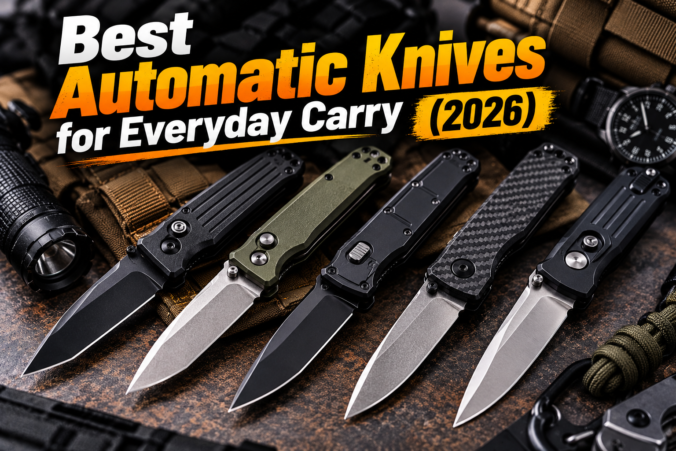
Best Automatic Knives for Everyday Carry (2026)

TL;DR: The best automatic knife for everyday carry depends on the cutting tasks, size, controls, and maintenance you prefer, plus the laws that apply to you. Start by distinguishing a side-opening automatic from an out-the-front (OTF) automatic. Then compare the exact model rather than treating every knife in a family as identical.

  • Compact side-opening option: Kershaw Launch 4 7500BLK, with a 1.9-inch CPM-154 blade and 1.8-ounce weight.
  • OTF option: Kershaw Livewire 9000BLK, with a 3.3-inch CPM MagnaCut blade and double-action operation.
  • Check before buying: Current price, availability, configuration, warranty, and applicable possession and carry rules.

Introduction

An everyday carry knife should suit ordinary cutting tasks and fit comfortably in your pocket. Automatic opening adds a powered mechanism, but it does not determine the best blade size or guarantee lawful carry. This guide focuses on carry considerations and accurately identified examples. For current shopping options, browse automatic knives.

What Makes an Automatic Knife Good for Everyday Carry?

An automatic knife deploys its blade through a powered mechanism operated by a button, slider, lever, or similar control. Side-opening automatics rotate around a pivot; OTF automatics move the blade through the front of the handle. A fixed blade has no opening mechanism and is not an automatic.

  • Blade: Match length, shape, edge type, and geometry to your cutting tasks and applicable restrictions.
  • Pocket fit: Compare weight, closed length, thickness, and clip placement. There is no universal comfort threshold.
  • Controls: Check switch position, operation, and any safety features. Follow the manufacturer’s handling instructions.
  • Support: Read the actual maintenance and warranty terms for the exact model.

An assisted-opening knife requires the user to begin opening the blade before its spring assists. Do not infer a model’s opening method or legal status from the presence of a lock bar or button alone.

There is no nationwide blade length that guarantees lawful automatic knife carry. State and local rules may distinguish possession, sale, concealed carry, transport, age, and restricted locations. Federal rules can also affect shipment and transport. A 1.9-inch blade does not make an automatic legal everywhere.

Consult the American Knife & Tool Institute summaries as a starting point, then verify current official law for your circumstances. This article provides general product information, not legal advice.

Automatic Knife Picks for Everyday Carry in 2026

These examples illustrate different carry formats. They are not a hands-on performance ranking, and prices and availability can change.

Compact Side-Opening Option: Kershaw Launch 4

The Launch 4 7500BLK has a 1.9-inch CPM-154 blade, a 6061-T6 aluminum handle, and a manufacturer-listed weight of 1.8 ounces. It opens with a push button and uses a push-button lock release. Kershaw lists its clip as single-position, right-hand tip-up. Do not assume a factory deep-carry clip or reversible carry arrangement.

Its short blade and 3.2-inch closed length make it an option when compact dimensions matter. Compare the usable cutting edge and handle fit with your intended tasks; a small knife is not automatically the best choice for every user.

Budget Options: Verify the Exact Model

The Boker Mini Strike is a side-opening automatic, not an OTF. Check the exact SKU before relying on a blade length, steel, weight, or price. The previous generic figures did not identify a configuration clearly enough to serve as a buying specification.

Choose a budget based on current listings, then compare materials and manufacturer support. Price alone does not establish heat treatment, tolerances, reliability, or expected life.

Premium Options: Compare Configuration and Carry Format

The Benchmade CLA is a side-opening automatic family. Its materials vary by configuration; the earlier S30V/aluminum specification should not be applied to the entire family. Verify the complete model number before comparing it with another automatic.

For an OTF alternative, the Kershaw Livewire 9000BLK has a 3.3-inch CPM MagnaCut blade with a black PVD finish, a 6061-T6 aluminum handle, and a listed weight of 3.1 ounces. Its slider both deploys and retracts the blade.

Comparison Table: Two Different Carry Formats

Model Opening Blade Steel Weight
Launch 4 7500BLK Side-opening automatic 1.9 inches CPM-154 1.8 oz
Livewire 9000BLK Double-action OTF 3.3 inches CPM MagnaCut 3.1 oz

Both configurations use aluminum handles. Check current product listings and applicable law before purchase. An unspecified Smith & Wesson OTF or SOG “Spec-XR” is not a sufficiently identified configuration for a verified comparison table.

Additional Premium Picks

Microtech Ultratech and Benchmade Infidel models are also worth comparing by exact configuration. The full-size Infidel 3300 is double-action, so its switch operates opening and retraction. Do not assume that every Ultratech generation or Infidel variant shares the same blade steel, dimensions, weight, or price.

For more OTF choices, see our OTF buying guide.

How Do You Choose the Right Blade Steel for Daily Use?

Evaluate steel alongside heat treatment, edge geometry, and the tasks you perform. Edge retention, corrosion resistance, toughness, and ease of sharpening involve trade-offs. A steel name or price tier alone cannot establish the best blade for every user.

CPM-154 and conventional 154CM are distinct materials. The verified Launch 4 configuration uses CPM-154. D2 requires attention to corrosion prevention, but “dry climates only” is too absolute: maintenance and exposure matter. Follow the manufacturer’s cleaning and storage guidance for any steel.

What Should You Know Before Buying an Automatic EDC Knife?

  1. Verify legality: Check ownership, purchase, shipment, transport, and carry requirements separately.
  2. Compare actual dimensions: Include closed size, weight, handle shape, and clip placement.
  3. Confirm configuration: Match the SKU, blade, finish, steel, and handle material with the listing.
  4. Read service terms: Warranty coverage and exclusions vary; do not infer lifetime coverage from price.

Handle weight depends on the complete design. Titanium is not automatically lighter than aluminum in an otherwise comparable handle, and material labels do not support a fixed weight or price difference.

Frequently Asked Questions About Automatic EDC Knives

No universal permission applies to every user and location. A short blade does not guarantee legal possession or carry. Verify current law and any relevant exceptions.

What is the difference between an automatic knife and a spring-assisted knife?

An automatic uses a control to initiate powered deployment. An assisted opener requires the user to start moving the blade before the assist engages. Verify the exact design and local rules for either type.

How much should you spend on an automatic EDC knife?

Set a budget and compare current products against your needs. There is no universal price range that guarantees better steel, reliable deployment, or a particular warranty.

What blade length is best for everyday carry use?

Choose a lawful size that suits your cutting tasks and grip. Also compare the closed dimensions and weight; no one length guarantees comfort or legal carry.

Can you take an automatic knife on a plane?

Do not put an automatic knife in carry-on baggage. Before travel, check current TSA knife guidance, airline policies, and the laws along your route and at your destination. Checked-baggage screening rules do not override possession or transport restrictions. Pack any permitted sharp item securely to protect handlers.

How do you maintain an automatic knife for reliable daily deployment?

Follow the exact model’s instructions for removing debris and applying the recommended lubricant. Different mechanisms can need different care. Routine OTF maintenance need not require disassembly. If cleaning does not resolve a malfunction, contact the manufacturer rather than adjusting springs without approved instructions.

Conclusion

Choose an automatic by its verified configuration, carry format, pocket fit, maintenance requirements, and lawful use. Browse automatic knives for current options and compare the exact SKU before ordering.

Manufacturer References

  • Kershaw catalog: Launch 4 7500BLK specifications
  • Kershaw catalog: Livewire 9000BLK specifications
  • Benchmade blade steel reference
  • Benchmade use and care

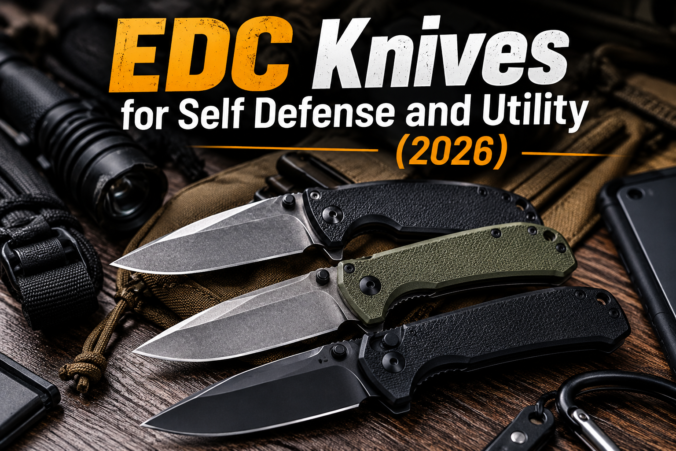
EDC Knives for Self Defense and Utility (2026)

TL;DR: – A 2.5–3.5 inch folding knife with a drop-point blade and assisted opening hits the legal and practical sweet spot for dual-purpose EDC across most U.S. jurisdictions

  • Budget picks ($30–$60) use 8Cr13MoV steel; mid-range ($60–$120) jumps to S30V; premium ($120–$250) adds refined ergonomics
  • Always verify local blade-length laws before purchasing – NYC and California have dramatically different thresholds than Texas or most other states

What Makes an EDC Knife Good for Both Defense and Utility?

Here’s the thing: not every knife that looks tactical actually works for both cutting tasks and defensive scenarios. (Texas.gov) (Ca.gov) You need to understand what separates a pure utility blade from one that can handle both jobs.

Based on our analysis of Knife Depot’s EDC guide and tactical knife resources, the ideal dual-purpose EDC knife has three core traits: a blade length between 2.5 and 3.5 inches, a geometry that balances tip strength with slicing belly, and a deployment mechanism you can operate under stress.

Blade length matters more than you think. [A blade between 2 and 3.5 inches is both legally defensible in most U.S. jurisdictions and long enough for effective defensive use]. Anything shorter and you lose utility reach; anything longer and you’re breaking laws in dozens of cities.

Blade geometry is where utility and defense diverge. Drop-point blades give you the best of both worlds – a strong tip for piercing, a curved belly for slicing, and versatility across cutting tasks. [Tanto blades feature a strong, angular tip ideal for piercing and tactical applications] but sacrifice the belly curve you need for opening packages or food prep. If you’re choosing between the two for EDC, drop-point wins for dual-purpose work.

Deployment speed matters under pressure. [Assisted-opening folders deploy in under 0.5 seconds], which is critical if you ever need the knife defensively. Here’s why: [under adrenaline, your fine motor skills degrade dramatically]. A flipper tab or wave-style opener is more reliable than a small thumb stud when your hands are shaking or gloved.

Key Takeaway: Target a 2.5–3.5 inch drop-point blade with assisted opening or flipper deployment. This geometry handles most utility tasks while remaining legal and deployable under stress.

How Do Blade Steel and Edge Type Affect EDC Performance?

Steel choice is where most people get confused – and where your budget directly impacts real-world performance.

The steel spectrum for EDC knives breaks down into four tiers. Budget picks ($30–$60) use 8Cr13MoV steel; mid-range ($60–$120) jumps to S30V; premium ($120–$250) adds refined ergonomics and materials. That price jump isn’t just marketing – it’s the difference between sharpening your knife every 3 weeks versus every 2 months.

8Cr13MoV is a Chinese stainless steel that works fine for occasional utility tasks but requires frequent sharpening. It’s adequate for EDC if your budget is tight, but expect to touch up the edge every 2–3 weeks if you use the knife daily.

S30V is the workhorse of mid-range and premium EDC knives. It holds an edge significantly longer than 8Cr13MoV and resists corrosion well. The tradeoff? It’s harder to sharpen and slightly more brittle under lateral stress – meaning if you pry with it, the tip can chip more easily than a tougher steel.

D2 tool steel offers excellent edge retention and corrosion resistance. Tough blade materials like D2 or SK-5 steel offer excellent edge retention and corrosion resistance. It’s popular in budget tactical knives but less ideal for true EDC where you might forget to wipe the blade down in humid environments.

Edge type changes how the knife performs. Plain edges excel at push-cutting and fine work – opening packages, food prep, clean slicing. Serrated edges cut rope, webbing, and seatbelts faster but leave rough cuts on thin materials. A combo edge offers both but is harder to sharpen and often leaves unclean cuts on delicate tasks.

For dual-purpose EDC, plain edge wins. You’ll use it most of the time for utility, and defensive cuts don’t require serration.

Key Takeaway: S30V steel at $80–$120 offers the best balance of edge retention and corrosion resistance for daily EDC. Budget 8Cr13MoV requires sharpening every 2–3 weeks; S30V stretches that to 6–8 weeks with daily use.

Top EDC Knives for Self Defense and Utility in 2026

You want specific recommendations, not theory. Here are the knives that score highest on both utility and defensive criteria, organized by budget tier.

Budget Pick: Best EDC Under $50

Kershaw Cryo (assisted-opening, 8Cr13MoV, 2.75-inch blade)

The Cryo is the most commonly recommended budget EDC under $50. At roughly $35–$40 street price, it gives you assisted opening (deploys in under 0.5 seconds), a stainless steel handle that won’t rust, and a blade short enough to be legal everywhere – including NYC. The 8Cr13MoV steel won’t hold an edge as long as premium options, but for occasional utility tasks and defensive carry, it’s solid.

The catch: you’ll sharpen it more often. If you use it 5 times a day for cutting tasks, expect to touch up the edge every 2–3 weeks.

Mid-Range Pick: Best EDC $80–$120

Spyderco Delica 4 (VG-10 steel, 2.90-inch blade, ~$90 MSRP)

The Delica 4 is the most recommended mid-range EDC across independent reviews. It’s a drop-point blade in VG-10 steel (roughly equivalent to 154CM in performance), with a four-way clip and full-flat grind. The blade length at 2.90 inches keeps it legal everywhere, and the ergonomics are excellent for extended carry.

VG-10 holds an edge significantly longer than 8Cr13MoV – you’re looking at 4–6 weeks of daily utility use before needing a touch-up. The Delica 4 is also lighter than many competitors, making it comfortable for all-day carry.

Premium Pick: Best EDC Over $150

Benchmade Griptilian 551 (CPM-S30V, 3.45-inch blade, ~$165–$180 MSRP)

If you want the best-in-class EDC and can justify the price, the Griptilian 551 is it. The 3.45-inch CPM-S30V blade holds an edge for 6–8 weeks of daily use, and the AXIS lock is bilateral and ambidextrous – one of the most reliable locking mechanisms in production knives. The blade length is legal in most U.S. states but check your local laws before carrying.

The Griptilian’s ergonomics are refined, and the Noryl GTX handle is durable and comfortable. This is the knife you buy once and carry for years.

Best for Pure Utility Tasks

CRKT Drifter (2.87-inch 8Cr13MoV, ~$30)

If your primary use is utility – opening packages, cutting rope, food prep – the CRKT Drifter is the most practical choice. At roughly $30, it’s affordable enough to not worry about, and the blade geometry is optimized for slicing and general cutting rather than defensive geometry. The 2.87-inch blade is legal everywhere, and the assisted opening is reliable.

You’re sacrificing some defensive capability for pure utility performance, but if you’re carrying a knife primarily for everyday tasks, this is the best value.

Best Defensive Geometry EDC

Cold Steel Recon 1 (3.5-inch tanto, CTS-XHP steel)

The Recon 1’s reinforced tanto blade is specifically designed for defensive use – the angular tip penetrates effectively, and the blade geometry prioritizes strength over slicing belly. CTS-XHP steel is a high-carbide stainless comparable to S30V in edge retention.

The tradeoff: the 3.5-inch blade exceeds legal limits in several jurisdictions (check your local laws), and the tanto geometry is less versatile for utility tasks. If you’re carrying primarily for self-defense with utility as secondary, this is your pick.

Key Takeaway: Spyderco Delica 4 ($90) is the best all-around EDC for most people – legal everywhere, excellent steel, proven ergonomics. Benchmale Griptilian 551 ($165) is the premium choice if you want maximum edge retention and refined handling.

Here’s where most people make a mistake: they buy a knife based on reviews, then discover it’s illegal to carry where they live.

Blade-length laws vary dramatically by state and municipality. Many states allow folding knives of any length, while others limit blade length to 3 or 4 inches for concealed carry. But it gets more granular than that.

New York State restricts gravity knives and switchblades but permits folding knives – except NYC enforcement has historically targeted pocket clips, creating a de facto environment where visible carry is risky. California defines a switchblade as any blade 2+ inches that opens automatically, but assisted-opening knives with a bias toward closure (thumb stud + detent) are generally NOT switchblades under CA law. Texas, by contrast, removed blade-length limits on most knives in 2017, making it one of the most permissive states.

Before you buy, ask yourself three questions:

  1. What’s the blade-length limit in your state? (Most common thresholds: 3 inches, 3.5 inches, 4 inches, or unlimited)
  2. Are assisted-opening knives legal where you live? ([Quick deployment mechanisms such as flippers or thumbstuds allow for rapid access], and these are generally legal federally, but some states restrict them)
  3. Is concealed carry legal, or do you need a visible clip? (Affects whether you can carry in a pocket without the clip showing)

One critical note on defensive use: Using a knife defensively is considered a use of deadly force in virtually all U.S. jurisdictions. This is justified only when facing imminent threat of death or serious bodily harm. Carrying a knife for self-defense creates significant legal liability – it’s a last resort, not a primary defense tool.

Key Takeaway: Verify your local blade-length limit and assisted-opening legality before purchasing. A 2.75–3-inch blade is legal in nearly all U.S. jurisdictions; anything over 3.5 inches requires local verification.

How to Maintain Your EDC Knife for Reliable Performance

A dull knife is a useless knife – and a useless defensive tool is worse than no tool at all.

Sharpening cadence depends on use frequency. If you use your EDC knife 5 times daily for utility tasks (box cutting, food prep, cord cutting), you’ll reach a dull threshold in approximately 2–4 weeks depending on steel hardness. A purely defensive carry knife used rarely may need sharpening only 1–2 times per year.

The paper-slice test is your go-to sharpness check: a sharp knife will cleanly slice printer paper with minimal effort. If the blade tears or snags, it needs sharpening.

Maintenance checklist for EDC knives:

  1. Wipe the blade after use – removes moisture and debris that cause corrosion
  2. Lubricate the pivot monthly – use thin oils like Tuf-Glide or Nano-Oil; avoid WD-40 (too thin, evaporates)
  3. Check the lock face – ensure the lock engages fully and doesn’t rattle
  4. Sharpen when the paper test fails – don’t wait until the blade is completely dull
  5. Inspect the clip – make sure it’s not bent or loose

When to retire a blade: if the tip is chipped beyond repair, the edge won’t hold after sharpening, or the lock is worn and unreliable, it’s time to replace the knife.

Key Takeaway: Touch up your EDC knife’s edge every 2–4 weeks if used daily for utility; sharpen fully every 2–3 months. A defensive carry knife used rarely needs sharpening only 1–2 times yearly.

Frequently Asked Questions About EDC Knives for Defense and Utility

Direct Answer: Carrying a knife for self-defense is legal in most U.S. states, but blade-length limits and carry restrictions vary significantly by jurisdiction. Using a knife defensively is considered deadly force and is justified only when facing imminent threat of death or serious bodily harm.

Verify your local blade-length limit and assisted-opening legality before purchasing. Many states allow folding knives of any length, while others limit blade length to 3 or 4 inches. NYC has a de facto 2-inch enforcement threshold; California restricts automatic blades but permits most assisted-opening knives. Always consult local counsel before carrying any knife for defensive purposes.

What blade length is best for both utility and self defense?

Direct Answer: [A blade between 2 and 3.5 inches is both legally defensible in most U.S. jurisdictions and long enough for effective defensive use]. The 2.75–3-inch range is ideal because it’s legal everywhere, including restrictive cities.

Anything shorter than 2.5 inches loses utility reach; anything longer than 3.5 inches exceeds legal limits in many jurisdictions. The sweet spot balances legal carry, utility versatility, and defensive capability.

How much should you spend on an EDC self defense knife?

Direct Answer: Budget $40–$90 for a reliable EDC knife that handles both utility and defensive tasks. Premium options at $150–$200 offer better steel and ergonomics but aren’t necessary for most users.

Budget picks ($30–$60) use 8Cr13MoV steel; mid-range ($60–$120) jumps to S30V; premium ($120–$250) adds refined ergonomics and materials. A $90 Spyderco Delica 4 outperforms a $40 budget knife in edge retention and reliability. Spending more than $200 is diminishing returns unless you’re a collector.

How does an EDC knife compare to pepper spray for personal defense?

Direct Answer: An EDC knife is a last-resort defensive tool; pepper spray is a primary deterrent. Knives require close proximity and carry legal liability as deadly force, while pepper spray can be deployed from distance and is legal in most jurisdictions.

If you’re choosing between a knife and pepper spray for self-defense, pepper spray is the better primary option. A knife is best carried as a utility tool that can serve defensively if needed, not as your primary self-defense strategy.

Do you need a serrated blade for an EDC self defense knife?

Direct Answer: No. Plain edges outperform serrated edges for most utility tasks and defensive use. Serrated edges cut rope and webbing faster but leave rough cuts on thin materials and are harder to sharpen.

For dual-purpose EDC, plain edge wins. You’ll use it most of the time for utility cutting, and defensive cuts don’t require serration. A combo edge is a compromise but sacrifices performance in both categories.

How often should you sharpen an EDC knife used for daily utility?

Direct Answer: If you use your EDC knife 5 times daily for utility tasks, expect to touch up the edge every 2–3 weeks depending on steel hardness. A defensive carry knife used rarely may need sharpening only 1–2 times per year.

The paper-slice test is your indicator: if the blade tears or snags printer paper, it needs sharpening. Don’t wait until the edge is completely dull – regular maintenance keeps the knife reliable.

Ready to Carry Confidently?

An EDC knife that handles both utility and defensive scenarios isn’t about choosing between two separate tools – it’s about finding the right balance. You want a blade long enough for real cutting work, steel that holds an edge through daily use, and a deployment mechanism you can operate under stress.

The Spyderco Delica 4 at $90 is the benchmark for most people: legal everywhere, excellent steel, proven ergonomics. If you want premium performance and can justify the cost, the Benchmade Griptilian 551 at $165 is the best-in-class option. And if you’re on a tight budget, the Kershaw Cryo at $35 is the most reliable sub-$50 pick.

Before you buy, verify your local blade-length laws. A 2.75–3-inch blade is legal in nearly all U.S. jurisdictions, but check your specific state and city. And remember: a knife is a utility tool first, a defensive option last. Carry it responsibly, maintain it regularly, and you’ll have a reliable companion for years.

Looking for your next EDC knife? Knife Depot carries a curated selection of proven EDC models across all budget tiers, with detailed specs and community reviews to help you choose the right blade for your needs.

Upgrade Your Everyday Carry
Built for performance. Designed to stand out. Shop knives ready for everyday carry, the outdoors, or your collection.
Free ground shipping on eligible continental U.S. orders over $99. Cannot be combined with other discounts. See shipping terms.
Shop Here

High Quality Chef Knives for Professional Kitchens 2026

TL;DR: – Professional-grade chef knives are defined by HRC 57–62 hardness, full-tang construction, and NSF-certified handles – not brand prestige.

  • German steel (X50CrMoV15 at 56–58 HRC) chips less under bone stress; Japanese steel (VG-10 at 60–62 HRC) holds an edge 3× longer between sharpenings.
  • Best value: Victorinox Fibrox Pro ($45, NSF-certified); mid-tier: Wüsthof Classic ($160); elite: Shun Premier (~$200).
  • Maintenance determines lifespan more than initial quality – neglect honing and monthly sharpening, and a $300 knife degrades to $50 performance within 18 months.

What Makes a Chef Knife “Professional Quality”?

You’re standing in a commercial kitchen evaluating two 8-inch chef knives. One costs $45; the other costs $300. The difference isn’t marketing – it’s measurable metallurgy and construction standards that directly impact your workflow.

For professional use, compare blade dimensions, handle comfort, maintenance needs, and the exact model’s specifications. Our chef knife selection provides a starting point for matching a knife to your prep tasks and budget.

Blade Steel: The Single Biggest Quality Factor

Steel hardness, measured on the Rockwell Hardness Scale (HRC), determines how long your knife stays sharp and how difficult it is to resharpen. According to The Cooking Guild, “For kitchen knives the useful window is narrow: 54–57 HRC is soft, very tough, dulls quickly; 57–59 HRC is the German sweet spot; 59–62 HRC is the Japanese sweet spot; 62+ HRC is specialist territory.”

Here’s what this means in practice:

  • German steel (X50CrMoV15) at 56–58 HRC: Tougher, more forgiving under lateral stress (like hitting bone), but requires sharpening every 2–3 weeks with heavy use.
  • Japanese steel (VG-10, AUS-10) at 59–62 HRC: Holds an edge significantly longer between sharpenings, but chips more easily if twisted or used on frozen items.

The Cooking Guild clarifies the trade-off: “Harder steel holds an edge longer but is more brittle; tougher steel forgives a careless twist but dulls sooner.”

Construction Standards: Full Tang, Bolster, and Handle Materials

Full-tang construction – where the steel runs the entire length of the handle – distributes weight evenly and prevents handle loosening after months of heavy use. Cozzini Bros notes that “with proper care, forged knives will last a lifetime,” but this assumes full-tang construction and appropriate materials.

NSF/ANSI Standard 2 certification is non-negotiable for commercial kitchens. Wood handles fail this standard because they absorb bacteria and moisture. Victorinox Fibrox Pro handles are NSF-certified, making them appropriate for use in commercial foodservice environments. Polypropylene and composite handles meet food safety requirements that wood cannot.

Key Takeaway: Professional knives require HRC 57–62 hardness, full-tang construction, and NSF-certified handles. German steel suits high-volume protein prep; Japanese steel suits precision vegetable work. Handle material matters more than blade aesthetics in commercial settings.

German vs Japanese Chef Knives: Which Is Right for Your Kitchen?

The German vs. Japanese knife debate isn’t about tradition – it’s about operational fit. Your choice depends on what you’re cutting, how often you sharpen, and whether your line cooks have access to professional sharpening services.

German-style knives (Wüsthof, Henckels) use lower hardness steel (56–58 HRC) with a 14° edge angle per side. They’re forgiving under stress and require less frequent sharpening. Japanese-style knives (MAC, Shun, Global) use harder steel (59–62 HRC) with a 15° edge angle or less, producing a more acute, sharper edge that dulls faster but cuts more cleanly.

Factor German (Wüsthof, Henckels) Japanese (MAC, Shun, Global)
Steel Hardness 56–58 HRC 59–62 HRC
Edge Angle 14° per side 15° per side
Edge Retention 2–3 weeks (heavy use) 4–6 weeks (heavy use)
Chip Resistance High (forgiving) Moderate (requires care)
Sharpening Frequency Monthly Every 4–6 weeks
Best For Bone work, high-volume prep Precision vegetable work, fine dining
Maintenance Difficulty Low Moderate

When German-Style Knives Win in Professional Settings

High-volume protein stations demand durability over edge retention. If your line cooks are breaking down 200 chickens per shift, a German knife’s toughness prevents chips and handle stress. Cozzini Bros emphasizes that “a Chef’s Knife will work great for meats, fish, vegetables and fruit, whether you’re chopping, mincing, slicing or dicing,” but German construction excels under repetitive bone contact.

German knives also tolerate inconsistent sharpening. If your kitchen lacks a professional sharpening service, a German knife at 56–58 HRC remains serviceable longer than a Japanese knife that chips when neglected.

When Japanese-Style Knives Are Worth the Investment

For a concrete Japanese chef-knife example, MAC’s MTH-80 specifications list a 7.88-inch blade, 2.5 mm thickness, and 6.5-ounce weight. Compare the whole blade design rather than treating nationality or one degree of edge angle as proof of better slicing.

Japanese knives also reduce fatigue on long shifts. Lighter weight and sharper edges mean less force required per cut – critical for preventing repetitive strain injuries.

Key Takeaway: German knives suit high-volume protein prep and inconsistent maintenance; Japanese knives suit precision work and kitchens with professional sharpening access. Choose based on your primary task, not tradition.

Top High Quality Chef Knives by Price Tier (2026)

Professional knife selection isn’t about finding the “best” – it’s about matching your budget to realistic durability and performance expectations. Here’s how to evaluate each tier.

$80–$150: Best Value Professional Chef Knives

Victorinox Fibrox Pro 8-inch (~$45–$50)

The Victorinox Fibrox Pro is one option to compare for routine kitchen prep. Check current availability and pricing against our chef knives, and verify the exact model’s blade dimensions, handle, and certification instead of relying on a review ranking.

Stamped construction (not forged) means lower hardness (~56 HRC) and softer steel, requiring more frequent honing. But the NSF-certified Fibrox handle meets commercial food safety standards, and the cost-per-year calculation is unbeatable: $45 ÷ 5 years = $9/year.

Mercer Culinary Genesis 8-inch (~$40–$55)

Cozzini Bros identifies Mercer as the primary supplier to US culinary schools. The Genesis features German X50CrMoV15 steel in a forged construction with full tang and NSF-certified Santoprene handle – appropriate for commercial compliance.

$150–$250: Mid-Tier Knives Used in Professional Kitchens

Wüsthof Classic 8-inch (~$160–$175)

Tech Gear Lab’s testing found that “the Wusthof Classic 8″ offers the best balance of cutting performance, practicality, and build quality.” Their lab measured the hardness of its X50CrMoV15 steel at 54 HRC (note: manufacturer specs vary slightly).

The Classic features a full bolster, triple-riveted handle, and precision-ground edge. Cost-per-year: $160 ÷ 5 years = $32/year. The higher cost reflects superior steel and construction that reduces sharpening labor costs over time.

MAC Professional Series MTH-80 (~$145–$165)

Bon Appétit identifies MAC as a top performer: “After years of testing this knife against other models, it’s continually come out on top.” The MTH-80 features high-carbon steel at approximately 59–61 HRC with a 15° edge angle and comfortable handle.

$250–$400+: Elite Chef Knives for Serious Professionals

Shun Premier 8-inch (~$180–$210)

The Shun Premier uses VG-MAX steel core (evolution of VG-10) at approximately 60–61 HRC clad in 68 layers of Damascus stainless. This is a Japanese precision knife for kitchens with professional sharpening access and fine-dining standards.

Miyabi Birchwood SG2 8-inch (~$300–$380)

Miyabi Birchwood knives feature SG2 micro-carbide powder steel core hardened to 63 HRC, surrounded by 100 layers of flower Damascus steel. This is specialist territory – SG2 requires diamond whetstones for field sharpening, making it impractical for most line cooks during service. Reserve this for head chefs or dedicated prep stations with professional sharpening infrastructure.

Key Takeaway: Victorinox Fibrox Pro ($45, 5-year cost = $9/yr) dominates culinary schools; Wüsthof Classic ($160, $32/yr) balances durability and cost; Shun Premier ($200) suits fine-dining precision work. Choose based on sharpening access and primary task, not prestige.

How Do You Maintain a Professional Chef Knife to Last 10+ Years?

Here’s the uncomfortable truth: maintenance determines lifespan more than initial quality. A $300 knife neglected for 18 months performs worse than a $50 knife maintained weekly.

Professional knife maintenance requires two distinct practices: honing (realigning the edge) and sharpening (removing steel to create a new edge). Most cooks conflate these, leading to under-sharpening and over-honing.

Honing vs Sharpening: What Professional Kitchens Actually Do

Honing realigns a bent edge without removing metal. Sharpening removes metal to create a new edge geometry. For a line cook using a knife 6 hours/day, the schedule is:

  • Before every shift: 2-minute honing on a honing rod (realigns edge)
  • Monthly: Whetstone sharpening session (creates new edge)
  • Quarterly: Professional sharpening service (if available)

Serious Eats’ guidance emphasizes: “For professional use, hone before each shift on a honing rod to maintain alignment. A whetstone sharpening session every 4-6 weeks is appropriate for daily professional use.”

The whetstone grit progression for professional maintenance:

  • 220–400 grit: Chipped edge repair
  • 1000 grit: Routine sharpening
  • 3000–6000 grit: Refinement
  • 8000+ grit: Polishing (fine-dining prep work)

Professional Knife Storage That Protects Your Investment

Storage method directly impacts blade longevity and kitchen safety. Food & Wine’s guidance identifies three professional approaches:

  • Knife rolls: Ideal for cooks moving between stations or kitchens. Protects blade and handle during transport.
  • Magnetic strips: Preferred for fixed workstations. Requires non-ferromagnetic wall surface.
  • Blade guards: Essential for transport and shared storage spaces. Prevents edge damage and cuts.

Never store knives loose in drawers – this dulls edges and creates injury hazards.

Key Takeaway: Hone before every shift (2 min); sharpen monthly on whetstones; use professional sharpening quarterly if available. Storage method (knife roll vs. magnetic strip) matters less than consistency. Neglect maintenance, and a $300 knife becomes a $50 performer within 18 months.

What Should You Look for When Buying a Chef Knife for a Commercial Kitchen?

Professional procurement differs from home cook shopping. You’re evaluating compliance, durability under high-volume use, and total cost of ownership – not aesthetics.

Your professional knife buying checklist:

  1. NSF/ANSI 2 certification: Verify the handle is NSF-certified. Wood handles fail commercial kitchen health inspections. Polypropylene and composite handles meet food safety standards.
  2. Full-tang construction: Ensures weight distribution and prevents handle loosening after months of heavy use. Avoid partial-tang or rat-tail designs.
  3. Steel hardness (HRC rating): Confirm the blade is 56–62 HRC. Below 56 HRC dulls too quickly; above 62 HRC requires diamond whetstones most line cooks lack access to.
  4. Edge angle: German knives (14° per side) suit high-volume protein work; Japanese knives (15° per side) suit precision vegetable work. Verify the angle matches your primary task.
  5. Weight and balance: Compare the knife’s listed dimensions and weight with your grip and cutting board. MAC lists the MTH-80 at 6.5 ounces with a 7.88-inch blade; use exact model specifications as a comparison point rather than assuming every 8-inch knife handles the same way.
  6. Handle ergonomics: OSHA identifies repetitive motion injuries as a top occupational hazard in food preparation. Ergonomic handle design reduces cumulative injury risk over long shifts.
  7. Sharpening accessibility: Can your kitchen sharpen this steel in-house? SG2 powder steel (63 HRC) requires diamond whetstones; German steel (56–58 HRC) works with standard water stones.
  8. Warranty and support: Professional knives should include a warranty covering manufacturing defects. Verify the manufacturer offers replacement or repair services.

Key Takeaway: Prioritize NSF certification, full-tang construction, and HRC 57–62 hardness. Match edge angle to your primary task (German for protein, Japanese for vegetables). Verify your kitchen can sharpen the steel in-house. Compliance and maintainability matter more than brand prestige.

Frequently Asked Questions

How much should a professional chef knife cost?

Direct Answer: Budget $45–$160 for a professional-grade knife that will last 5+ years with proper maintenance. Elite knives ($250–$400+) offer marginal performance gains unless you have professional sharpening access and fine-dining precision requirements.

The cost-per-year calculation reveals the true value. A Victorinox Fibrox Pro at $45 costs $9/year over 5 years; a Wüsthof Classic at $160 costs $32/year. The Wüsthof’s superior steel reduces sharpening labor costs, but for most commercial kitchens, the Victorinox delivers strong performance at a significantly lower cost.

What is the difference between a German and Japanese chef knife?

Direct Answer: German knives (56–58 HRC, 14° edge angle) are tougher and more forgiving under stress; Japanese knives (59–62 HRC, 15° edge angle) hold an edge longer but chip more easily. Choose German for high-volume protein prep; choose Japanese for precision vegetable work.

The Cooking Guild clarifies: “Harder steel holds an edge longer but is more brittle; tougher steel forgives a careless twist but dulls sooner.” German knives require sharpening every 2–3 weeks with heavy use; Japanese knives require sharpening every 4–6 weeks.

Which chef knife steel is best for professional kitchen use?

Direct Answer: German X50CrMoV15 (56–58 HRC) for high-volume protein stations; Japanese VG-10 or AUS-10 (59–62 HRC) for precision vegetable work. Avoid SG2 powder steel (63 HRC) unless your kitchen has professional diamond whetstone sharpening access.

The Cooking Guild recommends: “For most home cooks, a Japanese stainless steel in the 59–61 HRC range such as AUS-10 or 10Cr15CoMoV gives the best balance of sharpness, edge retention and low maintenance.” This guidance applies equally to professional kitchens with consistent sharpening access.

How often should a professional chef sharpen their knife?

Direct Answer: Hone before every shift (2 minutes); sharpen on whetstones monthly; use professional sharpening quarterly if available. Neglecting this schedule degrades even elite knives within 18 months.

The honing-vs-sharpening distinction is critical. Honing realigns the edge without removing steel; sharpening removes steel to create a new edge. Most cooks hone too often and sharpen too rarely, leading to premature dulling.

Are expensive chef knives worth it for home cooks?

Direct Answer: No. Home cooks use knives 2–3 hours per week; professionals use them 6+ hours per day. A $50 Victorinox Fibrox Pro meets home cook needs indefinitely. Spend $150+ only if you’re sharpening monthly and using the knife professionally.

A higher-priced knife can suit a home cook who values its design and will maintain it. Shun’s use-and-care guidance explains appropriate cutting technique, surfaces, and care. Choose according to your actual prep work and maintenance routine.

What chef knife brands do professional chefs actually use?

Direct Answer: Victorinox Fibrox Pro (culinary schools), Wüsthof Classic (high-volume kitchens), MAC Professional (fine-dining precision work), and Mercer Culinary (commercial training). Brand prestige matters less than NSF certification and steel hardness.

Compare brands by their specific models and your kitchen’s needs. Our chef knife collection lets you compare available options by price, blade dimensions, materials, and handle design; confirm any required certification on the exact product.

Can you put a high quality chef knife in the dishwasher?

Direct Answer: No. Never put any chef knife in the dishwasher. High heat, harsh detergents, and vibration damage the blade edge, dull the edge permanently, and loosen handle rivets. Hand wash immediately after use and dry with a cloth.

Dishwasher damage is irreversible and voids manufacturer warranties. This applies equally to $50 and $300 knives.

Conclusion

Professional-grade chef knives aren’t defined by brand prestige or price – they’re defined by measurable standards: HRC 57–62 hardness, full-tang construction, NSF-certified handles, and edge angles matched to your primary task.

The Victorinox Fibrox Pro at $45 delivers strong performance for a fraction of the cost of a $300 Shun Premier. The Wüsthof Classic at $160 balances durability and cost-per-year value. Elite knives ($250–$400+) offer marginal gains only if your kitchen has professional sharpening access and fine-dining precision requirements.

Maintenance determines lifespan more than initial quality. Hone before every shift, sharpen monthly on whetstones, and use professional sharpening quarterly. Neglect this schedule, and even a $300 knife degrades to $50 performance within 18 months.

Ready to upgrade your kitchen? Knife Depot offers professional-grade chef knives across all price tiers, with NSF-certified handles and verified steel specifications. Start with a Victorinox Fibrox Pro if you’re testing the waters, or invest in a Wüsthof Classic if you’re committing to professional-level maintenance.

Explore Professional Chef Knives
Discover our full selection of professional-grade chef knives, from budget-friendly Victorinox to premium Wüsthof and Japanese precision blades. NSF-certified handles and verified steel specifications for serious cooks.
Premium knives in stock now.
Free ground shipping on eligible continental U.S. orders over $99. Cannot be combined with other discounts. See shipping terms.
Shop Chef Knives

Best Japanese Kitchen Knives for Home Cooks (2026)

Product information reviewed November 9, 2026. Displayed prices are dated snapshots and can change.

At a glance: Choose a kitchen knife by its exact blade, size, handle and care requirements. Japanese origin alone does not establish hardness, edge angle or superior performance. Budget for storage and maintenance as well as the knife.

For home cooking, the useful question is how a knife fits your prep. Can you control it comfortably? Does the blade suit the ingredients and board space you use? Will you follow its care instructions? A well-matched knife is more useful than a national-style label or a speculative steel ranking.

Verified Japanese kitchen-knife examples

These two MAC models offer a concrete size and price comparison. Prices are from the linked manufacturer product pages on November 9, 2026; they are not Knife Depot offers. The maker’s SK-65 product name says 6½ inches, while its specification block lists a 6.75-inch blade. We preserve that distinction rather than treating the name as a precise measurement.

Model Maker-listed blade length Maker-listed weight Manufacturer displayed price
MAC Superior SK-65 santoku 6.75 inches in specification block 5.4 oz (about 153 g) $100.00
MAC Professional MTH-80 chef’s knife 7.88 inches 6.5 oz (about 184 g) $190.00

The SK-65 is the shorter, lighter comparison here. The MTH-80 has a bolster and dimples; its page lists a 2.5 mm blade thickness. Compare those features with your grip and prep work. Neither model is a universal winner for every home cook.

Earlier budget headings and other recommendations mixed unverified prices, steel assignments and handle descriptions. Those entries have been removed from the current comparison. In particular, do not assume that a family name such as Tojiro DP, Fujiwara FKM or Masamoto VG establishes an exact SKU’s alloy, weight or handle shape.

Choose a blade profile around your meals

Profile What to compare Buying question
Gyuto / chef’s knife Blade length, height, curve and balance Can I control this length on my cutting board?
Santoku Flatter cutting profile, length and knuckle clearance Does it suit my preferred slicing and push-cutting motion?
Nakiri Straight vegetable-oriented profile and blade height Do I want a dedicated vegetable knife alongside my all-purpose knife?

A profile name is a starting point. A shorter knife is not automatically better for small hands, and a longer knife is not reserved for professionals. Grip and board space matter alongside overall weight. Use a task-specific tool for bones or other hard materials rather than assuming a Western chef’s knife can safely handle them.

Compare the whole blade, not a country-wide hardness table

Alloy, heat treatment, geometry and edge finish work together. Hardness alone cannot rank all Japanese and Western knives for sharpness, retention or resistance to damage. Check the exact maker’s specifications, and keep decorative blade cladding separate from handle material.

Stainless steel still needs cleaning and drying. Reactive carbon steel requires particular attention to corrosion, but there is no universal number of wet minutes that predicts pitting. Similarly, a steel name does not establish a fixed sharpening interval or require diamond stones in every case. Choose an abrasive appropriate to the blade and task.

Care that follows the maker’s instructions

Shun’s use-and-care guidance is a useful manufacturer example: it calls for hand washing and prompt towel drying and cautions against bones, frozen foods and twisting a stuck blade. Follow the instructions for your own model, including the recommended cutting surface and storage.

Protect the edge during storage with a suitable rack, block or sheath arrangement. A drawer can be used with appropriate edge protection; loose contact with utensils is the problem. Inspect cutting performance and edge condition rather than promising a complete year of maintenance in a fixed number of minutes.

Shun’s sharpening and honing guide distinguishes maintenance from restoring a worn edge. Its standard technique specifies 16 degrees per side; that is maker guidance for the relevant knives, not a rule for every Japanese blade. Use the recommended technique and seek professional help for damage you cannot assess.

Frequently asked questions

How much should I budget?

Use a dated price for an exact model and add any storage, sharpening supplies or professional service you need. In this comparison MAC displays $100 for SK-65 and $190 for MTH-80; those are manufacturer prices, not a promise of local selling prices.

Is the SK-65 under $100?

The checked manufacturer page displays $100, so it should not be labeled an under-$100 manufacturer offer.

Do all Japanese knives have the same hardness and angle?

No. Verify the exact model. Country of origin is not enough to fill a specification table.

How often should I sharpen?

According to use, edge condition and the maker’s maintenance guidance. A universal 3–6 month schedule or 40-minute annual total is not established here.

Can I use the dishwasher?

Follow the maker’s instructions; hand washing and prompt drying are the guidance cited here. Do not leave an exposed knife loose in the sink.

Shop by exact specifications

Browse chef knives at Knife Depot and confirm each product’s origin, steel, size, price and stock. The collection includes different styles and origins; it should not be represented as an all-Japanese selection. Check current shipping and discount terms on the store rather than relying on an old promotional threshold.

Lightweight Camping Knives for Wilderness Survival (2026)

TL;DR: – The Morakniv Companion at 4.1 oz with sheath is the best weight-per-dollar ratio for lightweight survival camping.

  • Blade thickness of 3+ mm is the functional floor for batoning; anything thinner risks lateral fracture under stress.
  • Fixed blades dominate survival contexts over folders – no locking mechanism to fail, simpler deployment, proven reliability in emergencies.

Lightweight Camping Knives for Wilderness Survival (2026)

You’re standing at a trailhead with your pack already pushing 18 pounds. Every ounce matters. But you also know that a survival knife isn’t optional – the knife is the single most important survival tool. The tension is real: you need capability without sacrificing pack weight.

Based on our analysis of manufacturer specifications, outdoor retailer reviews, and wilderness community discussions collected through October 2026, we’ve identified the weight thresholds, steel choices, and real-world trade-offs that separate genuinely useful lightweight survival knives from gear-store compromises.

Here’s what you need to know: a lightweight survival knife isn’t about finding the smallest blade. It’s about finding the right blade-to-weight ratio for your specific trip length and terrain. A 2.9 oz ultralight knife performs differently than a 4.1 oz mid-weight option – and both outperform a 1.2 oz skeletonized titanium blade when you actually need to process firewood.

What Makes a Camping Knife Truly Lightweight?

Let’s define the categories first, because “lightweight” means different things depending on your baseline.

Ultralight: Under 2 oz (blade only, no sheath). These are specialized tools – often skeletonized handles or partial tangs – designed for minimalist backpackers who prioritize ounces above all else.

Lightweight: 2–4 oz (including sheath). This is the sweet spot for most wilderness campers. You get full-tang durability and reasonable blade geometry without sacrificing pack weight.

Standard: 4–8 oz (with sheath). These are your traditional camp knives – robust, capable, but heavier. They’re ideal for base camps or multi-week expeditions where weight matters less than reliability.

The variables that determine weight are straightforward: blade material (steel density), handle material (titanium vs. G10 vs. leather), and tang construction (full tang adds weight but increases durability). A proper survival knife needs a full tang construction, high-carbon steel and a blade length of 10-15 centimetres for maximum reliability, according to bushcraft experts. But full tang doesn’t have to mean heavy – it’s about material selection and blade geometry.

The Morakniv Companion exemplifies this balance. At 4.1 oz total with sheath, it carries a 3.2 mm spine (critical for batoning), uses 1095 carbon steel (easy to sharpen in the field), and costs $20–$25. That’s your baseline for what “lightweight” actually delivers.

Key Takeaway: Lightweight knives (2–4 oz) offer full-tang durability and functional blade geometry. Ultralight options under 2 oz sacrifice batoning capability; standard knives over 4 oz add weight without proportional performance gains for most camping scenarios.

How Do Lightweight Knives Perform for Survival Tasks?

Here’s the concern everyone has: does lighter mean weaker?

Not necessarily. But it does mean trade-offs. A 2 oz blade struggles with tasks that a 4 oz blade handles easily. The question is whether those tasks matter for your trip.

A four-inch fixed blade with a good edge and the skill to use it outperforms a twelve-inch blade in untrained hands on every survival task that matters. Skill and blade geometry matter more than raw weight.

Let’s break this down by task:

Batoning and Wood Processing

This is where lightweight knives reveal their limits. Batoning – using your knife spine as a wedge to split wood – requires a thick spine and full tang. A survival knife needs a thicker spine, typically .140″ or above, to handle the twisting, prying, and hard impacts that come with emergency use.

Ultralight blades under 2 oz typically have spines around 2–2.5 mm. They’ll split kindling, but hardwood? You’re risking a lateral fracture. Lightweight knives at 3–4 oz usually feature 3–3.5 mm spines, which is the functional floor for reliable batoning.

The geometry matters too. Blades under 3.5 inches are typically legal for hiking and camping in most regions, but they also limit your leverage on thick wood. A 4-inch blade gives you reach and force multiplication without crossing into illegality in most U.S. jurisdictions.

Food Prep and Foraging

This is where lightweight knives shine. Camping knives usually feature shorter blades with slimmer profiles, allowing for precise cutting and better control during food preparation and light carving. A 2–3 oz knife with a drop-point or clip-point blade handles mushroom foraging, fish cleaning, and vegetable prep with precision that heavier blades can’t match.

Steel choice affects this too. 1095 carbon resharpens in under 3 minutes on a basic whetstone; S30V requires 8–12 minutes with diamond equipment. If you’re on a multi-week trip and your edge dulls, 1095 carbon gets you back to work faster with minimal gear.

Key Takeaway: Lightweight knives excel at food prep and carving; they struggle with hardwood batoning. A 3+ mm spine and 4-inch blade length are the functional minimums for reliable camp tasks. Steel choice determines field-sharpening speed – 1095 carbon is fastest, S30V holds edge longest.

Top 8 Lightweight Camping Knives for Wilderness Survival (2026)

Here’s the practical breakdown. We’ve organized these by price tier and weight, with honest trade-offs for each.

Knife Weight Blade Length Steel Price Best For
Morakniv Companion (Carbon) 4.1 oz 4.1″ 1095 Carbon $22–$25 Budget ultralight, food prep
Morakniv Companion (Stainless) 3.4 oz 4.1″ 14C28N $20–$22 Wet climates, minimal maintenance
ESEE Izula II 5.3 oz (with scales) 2.6″ 1095 Carbon $99 Ultralight full-tang, removable scales
Condor Bushlore 5.5 oz 4.3″ 1075 Carbon $45–$55 Budget full-tang, bushcraft
Fallkniven F1 3.5 oz 3.9″ Laminated VG-10 $150–$170 Premium lightweight, military-grade
Spyderco Puukko 3.5 oz 4.0″ CPM S30V $220 Premium sub-4 oz, edge retention
Benchmade Bushcrafter 5.0 oz 4.4″ CPM S30V $180–$200 Premium mid-weight, corrosion resistance
RUIKE P801-SF 3.0 oz 3.5″ 14C28N $35–$45 Lightweight stainless, compact

Best Budget Lightweight Pick (Under $50)

The Morakniv Companion is the reference point for value. At $22–$25, you’re getting a full-tang 1095 carbon blade with a 3.2 mm spine, included polymer sheath, and proven field performance across decades of use. The carbon version requires occasional maintenance (wipe it dry after wet conditions), but that’s the trade-off for a blade that resharpens in minutes on any stone.

The stainless variant (14C28N steel) costs roughly the same but weighs 3.4 oz with sheath – lighter and corrosion-resistant. If you’re hiking in wet climates, the stainless version saves you maintenance headaches without sacrificing capability.

Why this knife? Full-tang construction, meaning the steel of the blade extends all the way through the handle, makes it reliable for batoning and camp tasks. The 4–5 inch blade length covers ~90% of camping tasks while remaining legal in most U.S. jurisdictions.

Best Mid-Range Lightweight Pick ($50–$120)

The ESEE Izula II at $99 is a full-tang 1095 carbon blade that weighs just 2.9 oz (blade only). With G10 handle scales, it hits 5.3 oz – still in the lightweight category. The unique feature: scales are removable. Strip them off and you’re carrying a 2.9 oz full-tang blade with a bare tang for grip. This is the ultralight configuration that serious backpackers use.

The trade-off: bare tang reduces grip security in wet or cold conditions. But if you’re on a 3-day trip in dry weather, this configuration saves nearly 2.5 oz compared to the scaled version. That’s equivalent to dropping a full aluminum water bottle cap from your pack.

Batoning requires a full tang (the blade steel extending the full length of the handle) and a spine strong enough to absorb repeated impact. The Izula II delivers both. The 2.6-inch blade is compact, but the spine is robust enough for moderate batoning on softwood.

Best Premium Lightweight Pick ($120+)

The Fallkniven F1 at $150–$170 weighs 3.5 oz with its included Zytel sheath. It uses laminated VG-10 steel – a Japanese stainless that holds an edge longer than 1095 carbon while remaining field-sharpenable. The 3.9-inch blade is Scandi-ground, which means a flat spine and convex edge geometry optimized for carving and slicing.

This knife is trusted by Swedish armed forces. That’s not marketing – it’s a functional endorsement. If you’re on a multi-week expedition where edge retention matters and you can’t resharpen frequently, the VG-10 steel justifies the premium.

The Spyderco Puukko at $220 is another premium option at 3.5 oz with sheath. It uses CPM S30V steel, which holds an edge 2–3x longer than 1095 carbon. For thru-hikers or expedition campers, the extended edge life and corrosion resistance offset the higher cost.

RUIKE P801-SF: Compact Lightweight Stainless Option

The RUIKE P801-SF at $35–$45 weighs just 3.0 oz and uses 14C28N stainless steel with a 3.5-inch blade. This knife bridges the gap between ultralight and mid-range options. It’s compact enough for minimalist packs but robust enough for genuine camp tasks. The stainless steel resists corrosion in wet environments, making it ideal for humid climates or extended water-based trips. At this price point and weight, it’s an excellent alternative to the Morakniv Companion if you prioritize corrosion resistance over field-sharpening speed.

Key Takeaway: Budget picks ($20–$50) deliver full-tang reliability and field-sharpenability; mid-range ($50–$120) adds ultralight configurations and specialized geometry; premium ($120+) prioritizes edge retention and corrosion resistance for extended trips.

What Blade Steel Should a Lightweight Survival Knife Use?

Steel choice is where most people get confused. You’ll hear debates about hardness ratings (HRC), carbide content, and edge retention. But for a lightweight survival knife, the practical question is simpler: how easy is it to sharpen in the field?

Here’s the breakdown:

1095 High Carbon Steel: Easy to sharpen on any stone. Rusts if wet. Resharpens in 2–3 minutes. Best for: budget knives, multi-week trips where you’ll sharpen frequently, dry climates.

14C28N (Sandvik): Moderate corrosion resistance. Sharpens on basic stones but slower than 1095. Resharpens in 5–7 minutes. Best for: wet climates, minimal maintenance, good edge retention.

VG-10 (Japanese Stainless): Excellent corrosion resistance. Requires finer abrasives (ceramic or leather strop). Resharpens in 8–10 minutes. Best for: humid environments, extended trips, premium knives.

CPM S30V: Exceptional edge retention and corrosion resistance. Requires diamond or ceramic abrasives. Resharpens in 10–15 minutes. Best for: premium knives, thru-hikers, high-consequence trips where edge failure isn’t an option.

The trade-off is real. S30V holds an edge 2–3x longer than 1095 carbon, but you need better sharpening equipment to maintain it. On a 3-day trip, 1095 carbon is faster and simpler. On a 30-day expedition, S30V’s edge retention saves you time and frustration.

One often-overlooked detail: blade geometry affects sharpening too. A Scandi grind (flat spine, convex edge) is easier to sharpen than a hollow grind because you’re working with a larger surface area. If you’re planning field sharpening, geometry matters as much as steel type.

Key Takeaway: 1095 carbon resharpens fastest (2–3 min) but rusts; 14C28N balances corrosion resistance and field-sharpenability; S30V holds edge 2–3x longer but requires diamond abrasives. Choose based on trip length and climate, not just hardness ratings.

How to Choose the Right Lightweight Survival Knife for Your Trip

This is where the decision tree matters. Weight isn’t the only variable – trip length, terrain, and your skill level all factor in.

Weekend trips (2–3 days): A 3–4 oz lightweight knife is overkill. You could carry a 2 oz ultralight blade or even a folding knife. The risk of needing serious batoning capability is low. Prioritize food prep and fire prep.

Multi-week expeditions (14+ days): A 4–5 oz mid-weight knife with a robust spine and full tang is worth the extra ounce. You’ll process more firewood, build more shelter, and need reliability over extended use.

Emergency-only carry: If you’re carrying a knife purely as a backup tool, weight matters less than accessibility. A 2–3 oz blade on your belt loop is better than a 5 oz knife left in your pack.

Here’s a practical weight calculation: if your base pack weight is 15 pounds (240 oz), a 3 oz knife represents 1.25% of total pack weight. Swapping from an 8 oz knife to a 3 oz knife saves 5 oz – roughly 2% of your base weight. That’s meaningful on a thru-hike but negligible on a weekend trip.

Don’t forget system weight. A Kydex sheath adds 0.8–1.2 oz; a leather sheath adds 1.0–1.8 oz. A ferro rod attachment adds another 0.6–0.9 oz. Your “2.4 oz knife” becomes a 4+ oz carried system once you account for carry gear. Fixed blades are generally more robust, while folding knives offer portability.

For genuine wilderness survival scenarios, fixed blades are the community consensus. No locking mechanism to fail under stress, no pivot to corrode, simpler one-handed deployment. A folder is great for food prep on a casual hike. A fixed blade is what you want if conditions deteriorate and you need reliability.

Key Takeaway: Weekend trips justify ultralight (2–3 oz); multi-week expeditions warrant mid-weight (4–5 oz) for batoning reliability. Account for sheath and carry system weight – often 30–60% of advertised blade weight. Fixed blades dominate survival contexts; folders excel at multi-purpose utility.

Frequently Asked Questions About Lightweight Survival Knives

How much does a good lightweight survival knife cost?

Direct Answer: Budget lightweight knives start at $20–$25 (Morakniv Companion); mid-range options run $50–$120 (ESEE Izula II, Condor Bushlore); premium lightweight knives cost $150–$220 (Fallkniven F1, Spyderco Puukko).

The Morakniv Companion at $22–$25 is genuinely adequate for most camping scenarios. It’s a full-tang blade with proven field performance. If you’re on a tight budget, this is your answer. Mid-range knives ($50–$120) add specialized geometry, better steel, or ultralight configurations. Premium options ($150+) prioritize edge retention and corrosion resistance for extended expeditions.

What is the lightest fixed blade knife for wilderness survival?

Direct Answer: The ESEE Izula II blade-only weighs 2.9 oz; the RUIKE P801-SF weighs 3.0 oz; the Fallkniven F1 with sheath weighs 3.5 oz.

The Izula II is exceptional because it’s a full-tang blade at ultralight weight. Removing the G10 scales drops it to 2.9 oz, making it one of the lightest full-tang options available. The trade-off: bare tang reduces grip security. For dry-weather trips, this configuration is ideal. For wet or cold conditions, the scaled version (5.3 oz) is more practical.

Is a folding knife or fixed blade better for wilderness survival?

Direct Answer: Fixed blades are superior for survival contexts due to no lock-failure risk, simpler operation under stress, and proven reliability in emergencies.

Folders are excellent for multi-purpose utility and legal carry in restrictive jurisdictions. But in a genuine survival scenario – building shelter, processing firewood, emergency first aid – a fixed blade’s simplicity and durability are unmatched. There’s no locking mechanism to fail, no pivot to corrode, and no fine motor skills required to deploy it under stress or cold conditions.

Can an ultralight knife handle batoning and heavy camp tasks?

Direct Answer: Ultralight knives under 2 oz struggle with hardwood batoning due to thin spines (typically 2–2.5 mm). They excel at food prep and carving but risk lateral fracture under repeated impact.

A survival knife needs a thicker spine, typically .140″ or above, to handle the twisting, prying, and hard impacts that come with emergency use. Ultralight blades prioritize weight savings over batoning capability. If hardwood processing is part of your trip, a 3–4 oz lightweight knife with a 3+ mm spine is the practical minimum.

What are the limitations of knives under 2 oz for survival use?

Direct Answer: Ultralight knives under 2 oz have thin spines (2–2.5 mm), limited leverage for batoning, and reduced durability under repeated impact. They’re specialized tools for minimalist backpackers, not general-purpose survival knives.

These knives excel at food prep, carving, and light tasks. But if your 3-day trip becomes 6 days due to weather, and you need to process firewood for shelter or warmth, an ultralight blade becomes a liability. The spine is too thin to absorb lateral stress. You’re risking fracture. For genuine wilderness survival capability, a 3–4 oz lightweight knife with a robust spine is the practical floor.

How do I sharpen a lightweight camping knife in the field?

Direct Answer: 1095 carbon steel resharpens in 2–3 minutes on any stone; 14C28N requires 5–7 minutes with a ceramic rod; S30V requires 10–15 minutes with diamond abrasives.

Carry a basic whetstone or ceramic rod. For 1095 carbon, even a smooth river stone works in a pinch. The key is a 90-degree spine if you’re using a ferro rod for fire prep – many modern knives have rounded spines that won’t generate adequate sparks. The Morakniv Companion’s carbon version has a usable 90-degree spine; the stainless version has a slightly rounded spine.

Does blade length matter for lightweight survival knives?

Direct Answer: Yes. 3–4 inches is the sweet spot for versatility. Shorter blades (under 3 inches) sacrifice leverage and reach; longer blades (over 5 inches) add weight without proportional performance gains for camping tasks.

Blades under 3.5 inches are typically legal for hiking and camping in most regions, but they also limit your leverage on thick wood. A 4-inch blade gives you reach and force multiplication without crossing into illegality. The 4–5 inch blade length covers ~90% of camping tasks while remaining legal in most U.S. jurisdictions.

Conclusion

A lightweight survival knife isn’t about finding the smallest blade. It’s about finding the right balance between weight, capability, and reliability for your specific trip.

The Morakniv Companion at 4.1 oz with sheath is the reference point – proven, affordable, and genuinely capable. If you’re starting out or on a tight budget, this is your answer. For ultralight backpackers willing to trade some grip security for ounces, the ESEE Izula II with scales removed is exceptional. For extended expeditions where edge retention matters, the Fallkniven F1 or Spyderco Puukko justify their premium pricing.

The key variables are blade thickness (3+ mm for batoning), steel choice (1095 for field-sharpenability, S30V for edge retention), and tang construction (full tang for reliability). Weight matters, but not at the expense of functional capability.

Ready to upgrade your camp kit? Knife Depot carries all the lightweight options discussed here, with detailed specs and community reviews to help you make the right choice for your next trip.

Upgrade Your Everyday Carry
Built for performance. Designed to stand out. Shop knives ready for everyday carry, the outdoors, or your collection.
Free ground shipping on eligible continental U.S. orders over $99. Cannot be combined with other discounts. See shipping terms.
Shop Here
« Older posts Newer posts »

© 2026 The Cutting Edge

Theme by Anders Noren — Up ↑