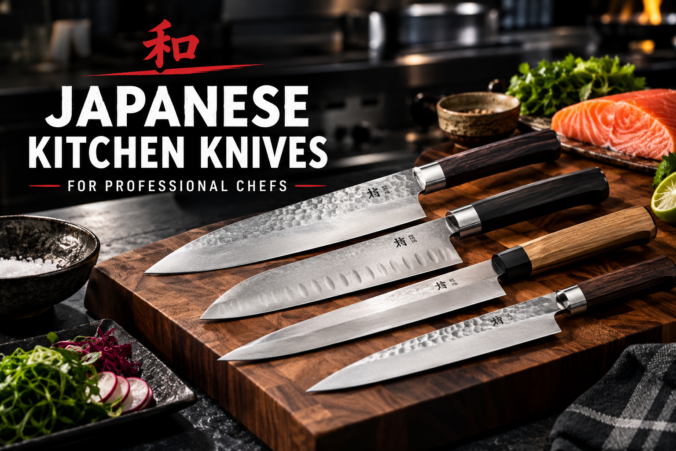
TL;DR: – Japanese knives reach 60–67 HRC hardness vs. 56–58 HRC for German knives, delivering superior edge retention but requiring careful maintenance
- Steel type matters most: Aogami (Blue Steel) achieves exceptional sharpness but needs honing every 2–3 shifts; VG-10 stainless tolerates a full week of moderate use
- Budget tiers: under $150 (workhorse), $150–$350 (professional standard), $350+ (artisan/collector)
- Six knife styles cover all professional kitchen stations: gyuto, santoku, nakiri, yanagiba, deba, and petty
Why Professional Chefs Choose Japanese Knives
Here’s the reality: Japanese knives are typically harder, rating 60 to 67 on the Rockwell scale, compared to 56 to 58 for German knives. That hardness difference isn’t academic – it’s the foundation of everything that makes Japanese blades different.
The higher hardness enables thinner edge geometry. Every knife that ships out the door is treated to the three-stage “honbazuke” honing process that gives Japanese blades their exceptional sharpness, with edge angles of 9.5° to 12°. Compare that to your average factory edge angle of 15° or more. Thinner edges slice cleaner, hold their sharpness longer, and require less pressure – critical when you’re processing 100+ covers per service.
But here’s the trade-off: that hardness comes with brittleness. Japanese knives are prone to chipping under lateral stress or twisting. Drop one on a hard surface, use it to pry open a can, or apply sideways pressure, and you’ll damage the blade. German knives are more forgiving because they’re softer. They dull faster, but they’re harder to break.
For professional kitchens, this means discipline. You’re not using the knife as a pry bar or scraper. You’re using it for its intended purpose: slicing, dicing, and chopping. When you do that, Japanese knives outperform German alternatives by a significant margin.
Key Takeaway: Japanese knives reach 60–67 HRC vs. 56–58 HRC for German knives, enabling thinner edges and superior sharpness – but requiring careful technique and regular maintenance to avoid chipping.
What Steel Types Should Professional Chefs Know About?
Steel selection is the single most consequential purchasing decision. Different steels perform differently under kitchen conditions, and understanding the trade-offs between edge retention, corrosion resistance, and maintenance burden will determine whether your knife investment pays off.
High-carbon stainless hybrids, such as VG10 or SG2 powder steels, provide the surgical edge of carbon steel with the corrosion resistance of stainless. This is why they dominate professional kitchens. But pure high-carbon steel options – Aogami (Blue Steel) and Shirogami (White Steel) – take even sharper edges at the cost of reactivity.
Here’s what you need to know about each:
Aogami (Blue Steel) No. 2: This is the steel of choice for sushi chefs and Japanese-trained professionals. It achieves exceptional sharpness and holds an edge longer than stainless alternatives. The catch? It oxidizes rapidly. You’ll see rust spots within hours if you don’t dry the blade immediately after use. In a high-volume kitchen, this means honing every 2–3 service shifts to maintain performance. Budget-conscious professionals often choose this because the edge quality justifies the maintenance burden.
Shirogami (White Steel) No. 1: The purest carbon steel available, taking the sharpest edge of all options. But it’s also the most reactive – oxidizing faster than Aogami. Reserve this for specialized work (sashimi, delicate garnish) rather than all-purpose kitchen use.
VG-10 Stainless: VG-10 has 15–16% Cr, 59–60 HRC. This is the workhorse steel. It holds an edge well for everyday professional use, resists corrosion, and requires minimal maintenance. You’ll sharpen it weekly in moderate-use kitchens, but you won’t worry about rust. Most factory-produced Japanese knives (MAC, Shun, Global) use VG-10 or equivalent stainless variants.
SG2/R2 Powder Steel: High-carbon steels like White Steel (#1) and Blue Steel (#2) are capable of achieving and retaining an incredibly sharp edge, prized by culinary professionals. SG2 combines premium hardness with high stain resistance – an ideal combination for professional environments. The trade-off? Price. SG2 knives typically start at $300+.
ZDP-189: The hardest commonly available knife steel, reaching 67–68 HRC. But it’s brittle enough that it’s best reserved for careful, precision-focused users rather than high-volume kitchen work. Not recommended for line cooks doing rough prep.
Carbon Steel vs Stainless: Which Works in a Professional Kitchen?
The answer depends on your kitchen’s environment and your maintenance capacity.
Carbon steel (Aogami/Shirogami) wins on edge quality. You get a sharper blade that holds its edge longer. But you’re committing to immediate drying after every use, regular honing, and accepting visible patina development over time.
Stainless steel (VG-10, SG2) wins on practicality. You can leave it wet for a few minutes without panicking. You can run it through a busy service without obsessing over rust. The edge isn’t quite as sharp, but it’s sharp enough for professional work, and the maintenance burden is lower.
For most professional kitchens – especially high-volume operations – stainless steel makes more sense. The edge quality difference is real but not dramatic enough to justify the maintenance overhead. For specialized roles (sushi, sashimi, fine dining garde manger), carbon steel is worth the discipline.
Key Takeaway: VG-10 stainless (59–60 HRC) suits high-volume kitchens with minimal maintenance; Aogami carbon steel achieves superior sharpness but requires honing every 2–3 shifts and immediate drying after use.
The 6 Essential Japanese Knife Styles for Professional Use
Each knife style is optimized for specific cutting tasks and kitchen stations. Choosing the right combination for your role determines efficiency and precision.
Gyuto (Chef’s Knife): The gyuto’s name literally means “beef sword” – a nod to its original use butchering meat. Today it’s the all-purpose workhorse. The dimensions of Gyuto knives range between 150-390mm, but the most frequent ones are between 210-270mm long. Double-bevel geometry makes it compatible with Western pinch grip. Use it for protein, vegetables, and anything that doesn’t require a specialized blade. The thickness of gyuto spines usually ranges from 1.5 to 3.5mm, at the handle even as much as 5mm.
Santoku: “Santoku” means “three virtues,” referring to its use on meat, fish, and vegetables. Shorter and wider than a gyuto (typically 165–180mm), it excels at vegetable prep and fine dicing. Santoku literally means a ‘knife of three virtues’ – it is used for vegetables, fish and meat. The flat blade profile makes it ideal for garde manger stations.
Nakiri: A completely flat-edged vegetable knife. The straight up-and-down push-cut technique eliminates rocking motion, ensuring full contact with the cutting board. Not suited for protein work – purely vegetable-focused.
Yanagiba (Sashimi Knife): The yanagi is designed to cut thin, clean slices of fish for sushi and sashimi. Its length lets it pass through the fish in one uninterrupted stroke instead of several sawing cuts, which keeps the texture of the flesh intact. Typical Yanagiba knives are between 240-360mm long. Single-bevel geometry means left-handed versions must be special-ordered – critical for sushi chefs.
Deba (Fish Butcher’s Knife): The deba is a heavy, single-bevel knife built to break down whole fish — its weight lets it get through fish heads and small bones, while the pointed tip filets flesh cleanly off the frame. Thick spine (3–5mm) provides leverage. Not designed for hard bones like beef vertebrae.
Petty (Utility Knife): 120–150mm utility knife for garnish, detail work, and precision tasks. Essentially a miniature gyuto. Useful for every station but not essential if you have a gyuto and santoku.
| Knife Type | Length | Best For | Bevel | Station |
|---|---|---|---|---|
| Gyuto | 210–270mm | All-purpose, protein | Double | Sauté, grill, prep |
| Santoku | 165–180mm | Vegetables, fine dicing | Double | Garde manger |
| Nakiri | 165–180mm | Vegetables only | Double | Garde manger |
| Yanagiba | 240–360mm | Raw fish, sashimi | Single | Sushi bar |
| Deba | 165–210mm | Whole fish breakdown | Single | Fish station |
| Petty | 120–150mm | Garnish, detail | Double | All stations |
Key Takeaway: Gyuto (210–270mm, double-bevel) covers most professional kitchen needs; add a santoku or nakiri for vegetable-focused stations; yanagiba and deba only if your kitchen does sushi or whole fish prep.
Top Japanese Knife Brands: How Do They Compare?
Brand selection matters less than steel type and blade geometry, but production method (factory vs. handcrafted) and price tier significantly affect your experience.
MAC: This great knife from Japanese brand Mac checked all of the boxes in head-to-head knife tests: It’s sharp enough to glide through food and produce paper-thin slices, lightweight enough to allow for nimble movements, and comfortable enough for you to make your way through a mountain of onions without your hand cramping up. Factory-produced in Seki using VG-10 steel. Retails around $175 for the 8-inch gyuto. Best value for high-volume kitchens.
Shun: Factory-produced by Kai Corporation in Seki using VG-MAX steel. Shun blades are sharpened to a 16-degree angle per side. Retails $155–$185 for the 8-inch chef’s knife. Shun offers free lifetime sharpening – a significant value-add for professionals. Bridges German manufacturing infrastructure with Japanese aesthetics.
Global: German knives have Rockwell hardnesses (HRC) of 57—while a Japanese chef knife might start at HRC60 and go up from there. Global uses CROMOVA 18 stainless at ~56–58 HRC, prioritizing durability over maximum hardness. Designed for high-volume durability. Retails $80–$120. Best for busy kitchens that can’t afford downtime for maintenance.
Masamoto: Tokyo-based house founded in 1866. VG series uses VG-10 equivalent steel. Retails around $220 for the 240mm gyuto. Preferred by sushi chefs and Japanese-trained professionals. Handcrafted quality with institutional reputation.
Miyabi: High-end Japanese chef knives are priced at $1000+ USD. Miyabi’s 5000 MCD series uses MC63 micro-carbide powder steel hardened to 63 HRC via CRYODUR ice-hardening technology, produced at Zwilling’s Seki facility. Bridges German manufacturing with Japanese aesthetics. Retails $250–$400.
Sakai Takayuki: Artisan producer. Aogami line ranges from approximately $150 for entry-level kurouchi finish to $300+ for kasumi-polished versions. Handcrafted quality. Best for professionals seeking artisan-level blades without custom-order wait times.
| Brand | Steel | HRC | Price | Best For |
|---|---|---|---|---|
| MAC | VG-10 | 60–61 | ~$175 | High-volume, value-conscious |
| Shun | VG-MAX | 61 | $155–$185 | Professionals wanting warranty |
| Global | CROMOVA 18 | 56–58 | $80–$120 | Busy kitchens, low maintenance |
| Masamoto | VG-10 equiv. | 60–61 | ~$220 | Sushi chefs, Japanese-trained |
| Miyabi | MC63 | 63 | $250–$400 | Premium factory production |
| Sakai Takayuki | Aogami | 62–65 | $150–$300 | Artisan quality, carbon steel |
Key Takeaway: MAC MTH-80 (~$175, VG-10) offers best value for high-volume kitchens; Shun ($155–$185) includes lifetime sharpening; Sakai Takayuki ($150–$300) suits professionals seeking carbon steel edge quality.
How to Choose the Right Japanese Knife for Your Kitchen Role
Your decision framework should map three variables: kitchen volume, protein focus, and maintenance capacity.
Budget Tier 1: Under $150 (Workhorse) Choose this if you’re a line cook in a high-volume kitchen, you’re learning Japanese knife technique, or you need a backup blade. MAC and Global dominate this tier. You’re prioritizing durability and cost-per-use over premium edge quality. Expect to sharpen weekly. Acceptable for all kitchen roles except sushi.
Budget Tier 2: $150–$350 (Professional Standard) This is where most working professionals land. You get factory-produced quality with premium steel (VG-10, VG-MAX, or entry-level Aogami). Shun, Masamoto, and mid-range Sakai Takayuki fit here. Edge retention is noticeably better than Tier 1. Maintenance is still manageable (weekly honing for stainless, every 2–3 shifts for carbon). Suitable for all kitchen roles.
Budget Tier 3: $350+ (Artisan/Collector) Handcrafted blades from established makers. Premium carbon steels (Aogami, Shirogami) or powder metallurgy (SG2). Exceptional edge quality and aesthetic finish. Maintenance burden is higher. Reserve this for specialized roles (sushi, fine dining) or collectors who prioritize craftsmanship over practicality.
Role-Specific Recommendations:
Line Cook (Sauté/Grill): 210mm gyuto, stainless steel (VG-10), $150–$250. You need speed and durability. Carbon steel’s maintenance burden isn’t worth it at high volume.
Sushi Chef: 270mm yanagiba, carbon steel (Aogami), $200–$400. Single-bevel geometry and carbon steel’s superior sharpness are non-negotiable. Maintenance is part of the craft.
Garde Manger: 165mm santoku or nakiri, stainless steel, $120–$200. Vegetable work doesn’t demand premium edge retention. Flat blade geometry is essential.
Sous Chef/Butcher: 240mm gyuto, stainless steel, $200–$350. You’re working with diverse proteins and need versatility. Premium stainless (VG-MAX, SG2) justifies the investment.
Handle style matters too. Hinoki is exceptionally gentle on knife edges. Wa (Japanese) handles allow more wrist rotation than Western bolstered handles – important if you’re transitioning from German knives. But verify handle material compliance with your local health code. FDA Food Code 4-101.11 requires food-contact surfaces to be smooth, nonporous, and easily cleanable. Untreated natural wood fails this standard in inspected commercial kitchens. Pakkawood and G-10 composite handles are compliant.
Key Takeaway: Budget $150–$250 for a professional-grade 210mm gyuto in stainless steel; add $100–$150 for carbon steel if you’re willing to commit to honing every 2–3 shifts; verify handle material compliance with local health codes.
Maintaining Japanese Knives in a Professional Kitchen
Maintenance determines whether your knife investment pays off. Neglect it, and a $300 blade becomes a $300 paperweight.
Sharpening Progression:
For most home cooks, sharpening once or twice a year is sufficient. Professional kitchens operate at a different scale. Use 1000-grit for repairing damaged edges or restoring bevel; 3000–6000 for regular maintenance; and 8000–12000 for finishing and polishing a refined edge.
For stainless steel (VG-10), sharpen weekly during moderate use. For carbon steel (Aogami), hone every 2–3 service shifts. The difference in edge retention is dramatic – carbon steel’s superior sharpness degrades faster under kitchen conditions.
Critical Maintenance Rules:
Never use a grooved honing steel on Japanese knives – the serrations remove too much metal and can damage hard, brittle edges. Use a fine ceramic rod instead for light in-service maintenance. Some professionals use leather strops – a valid alternative.
Never put a professional knife in the dishwasher. The heat and harsh chemicals will ruin the edge and damage the handle. Hand wash and dry your blade immediately after use. This is non-negotiable for carbon steel. Even stainless steel benefits from immediate drying.
Single-bevel knives (yanagiba, deba) require specialized sharpening. You sharpen exclusively on the flat omote (front) face; the ura (back) is lightly flattened on a finishing stone to maintain a mirror surface. Sharpening both faces destroys the blade geometry.
Cost of Ownership:
Professional sharpening service costs approximately $10–$25 per knife per session. DIY whetstone entry cost is $60–$150 one-time. For a single knife sharpened 12 times per year professionally, the annual cost ranges from approximately $120–$300. DIY whetstone pays for itself after 5–8 sharpenings. For working professionals, learning to sharpen is financially material.
Storage matters. Magnetic strips, knife rolls, or saya covers all work. Avoid drawers where blades bang against other utensils. Protect the edge.
Key Takeaway: Sharpen stainless steel weekly; carbon steel every 2–3 shifts. DIY whetstone ($60–$150) pays for itself vs. professional service ($10–$25/knife) within 5–8 sharpenings. Never use grooved honing steels; never dishwash; dry immediately after use.
Frequently Asked Questions
How much should a professional chef spend on a Japanese knife?
Direct Answer: Budget $150–$250 for a professional-grade stainless steel gyuto; $200–$400 for carbon steel or artisan options.
For most home cooks, an 8-inch chef knife provides an excellent balance between cutting ability and control. Professional kitchens operate at higher volume, so edge retention matters more. A $175 MAC (VG-10 stainless) will serve a line cook well for 2–3 years with proper maintenance. A $250 Shun includes lifetime sharpening, reducing long-term cost. Artisan blades ($350+) are investments in craftsmanship, not necessities.
What is the difference between a gyuto and a Western chef knife?
Direct Answer: Gyuto knives reach 60–67 HRC hardness vs. 56–58 HRC for German knives, enabling thinner edges and superior sharpness – but requiring careful technique to avoid chipping.
German knives have Rockwell hardnesses (HRC) of 57—while a Japanese chef knife might start at HRC60 and go up from there. Japanese knives are sharpened to 9.5–12° edge angles vs. 15°+ for German knives. This means less pressure required, cleaner cuts, and longer edge retention. The trade-off: Japanese knives are more brittle and require immediate drying after use (especially carbon steel). German knives are more forgiving but dull faster.
Are Japanese knives too fragile for professional kitchen use?
Direct Answer: No. Japanese knives are durable for their intended use (slicing, dicing, chopping) but will chip if used as pry bars, dropped on hard surfaces, or twisted sideways.
Japanese chef knives have become popular among home cooks and professional chefs because of their sharpness, precision, and lightweight design. Thousands of professional kitchens worldwide rely on Japanese knives daily. The brittleness concern is overblown – it only manifests if you abuse the blade. Use it for its intended purpose, and it will outlast German alternatives.
Which Japanese knife is best for a beginner professional chef?
Direct Answer: A 210mm gyuto in stainless steel (VG-10 or VG-MAX) at $150–$200 is the ideal starting point.
Try to find a Rockwell Hardness (HRC) of 58 to 60. This is the global benchmark for a daily driver. MAC MTH-80 or Shun Classic fit this profile perfectly. Stainless steel eliminates the maintenance burden of carbon steel while delivering professional-grade performance. Once you’ve mastered technique and maintenance, upgrade to carbon steel or artisan options if desired.
How often do professional chefs sharpen Japanese knives?
Direct Answer: Stainless steel knives (VG-10) require weekly sharpening in moderate-use kitchens; carbon steel (Aogami) needs honing every 2–3 service shifts.
The difference is dramatic. Carbon steel’s superior edge retention degrades faster under kitchen conditions because the steel is more reactive. Stainless steel holds an acceptable edge longer but still requires weekly maintenance. High-volume kitchens (100+ covers per service) may need daily honing for carbon steel.
Can you use Japanese knives on frozen food or hard vegetables like butternut squash?
Direct Answer: No. Japanese knives are optimized for fresh ingredients. Frozen food and hard vegetables risk chipping the blade.
Japanese knives excel at fresh, delicate work – that’s their design purpose. Use a German knife or dedicated utility knife for those tasks.
What is the best Japanese knife brand for a high-volume restaurant kitchen?
Direct Answer: MAC (VG-10, ~$175) offers the best value for high-volume kitchens; Global ($80–$120) prioritizes durability over edge quality; Shun ($155–$185) includes lifetime sharpening.
After years of testing this knife against other models, it’s continually come out on top. MAC knives are factory-produced, affordable, and reliable. They’re the workhorse choice for busy kitchens that can’t afford downtime. If budget is tighter, Global sacrifices edge quality for durability. If you want warranty support and free sharpening, Shun justifies the premium.
Conclusion
Japanese kitchen knives represent a different philosophy than Western blades. They prioritize edge quality and precision over durability and forgiveness. For professional chefs willing to commit to proper technique and maintenance, they deliver measurable advantages: thinner edges, superior sharpness, and longer edge retention.
Start with a 210mm gyuto in stainless steel (VG-10 or VG-MAX) at $150–$250. Learn to sharpen on a whetstone – the skill pays for itself within months. Once you’ve mastered maintenance and technique, explore carbon steel or artisan options if your kitchen’s workflow justifies the additional care.
The knife you choose should match your kitchen’s volume, your role, and your maintenance capacity. There’s no universal “best” blade – only the right blade for your specific context. Knife Depot offers a curated selection of professional-grade Japanese knives across all price tiers and steel types, with expert guidance to match your needs.
Your knife is an extension of your technique. Choose wisely, maintain it religiously, and it will serve you for years.

Leave a Reply