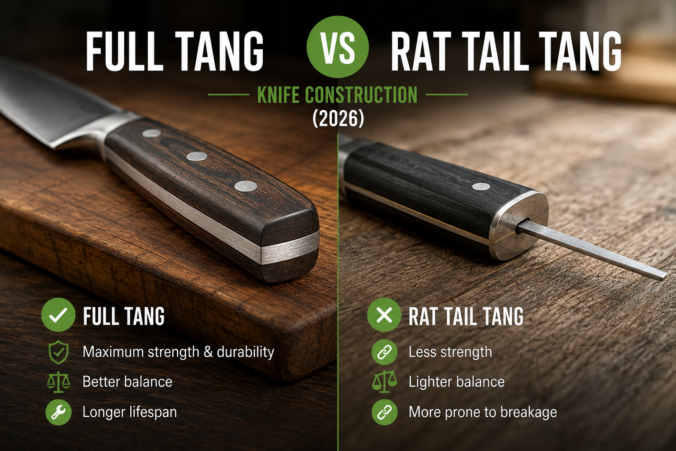
TL;DR: – Full tang extends steel the entire length and width of the handle – the strongest construction for heavy-duty tasks like batoning and survival work
- Rat tail tang is a narrow steel rod threaded through the handle, 70–100g lighter, and the traditional choice for Japanese kitchen knives
- For bushcraft, hunting, or prying: full tang is non-negotiable. For precision culinary work: rat tail is often the correct engineering choice, not a compromise
- At budget price points ($40–80), steel quality matters more than tang type; above $100, tang construction becomes a meaningful durability differentiator
What Is a Knife Tang? (The 30-Second Version)
A knife tang is the unsharpened part of the metal blade that reaches back into the handle. Think of it as the structural backbone connecting your blade to the grip. Without a tang, your knife would be just a floating piece of steel with nothing to hold onto.
The tang matters because the weakest point on any knife is where the tang meets the handle. How that transition is engineered – whether the steel runs the full length of the handle or tapers to a narrow rod – determines how much stress the knife can handle before failing.
There are roughly five common tang types: full tang, partial tang, rat tail (stick) tang, hidden tang, and integral tang. This article focuses on the two you’ll encounter most often: full tang and rat tail. Understanding the difference between them will help you choose the right knife for your actual use case – not just what marketing claims sound impressive.
Key Takeaway: The tang is the steel extension running into your handle. Where it’s engineered to be strongest or lightest determines whether your knife survives batoning or excels at precision slicing.
How Does Full Tang Construction Work?
A full tang extends the entire length and width of the handle. The steel doesn’t taper or narrow – it runs from the blade tip all the way through to the butt of the handle, typically sandwiched between two handle scales (the side pieces) that are glued and riveted in place.
This design distributes stress evenly. When you apply force to the blade – whether you’re chopping, prying, or batoning – that stress travels across the entire width and length of the steel. A full tang is the strongest tang construction because there’s no abrupt narrowing where stress can concentrate and cause failure.
The manufacturing process: A full tang blank is forged or stamped as one piece. Handle scales are then attached using epoxy, rivets, or pins that pass through both the tang and the scales. This creates a monolithic structure – one integrated unit rather than a blade glued to a separate handle rod.
Weight trade-off: A full tang knife is relatively heavy because the knife has been enhanced with more steel to give it its solidity. A typical 9-inch fixed blade with full tang construction weighs 6–10 oz, depending on blade thickness and handle material. That extra steel adds durability but also adds heft.
Where full tang excels: Bushcraft, survival, hunting, heavy-duty kitchen work, and any task involving lateral stress like prying or batoning. If a knife is used in lifesaving operations or survival situations, a full tang knife is highly recommended.
Knife Depot’s fixed-blade survival knives are built with full tang construction as the standard. It’s the industry standard for tools that need to survive hard use.
Full Tang Variations: Skeletonized, Tapered, and Encapsulated
Full tang isn’t monolithic – there are three main variants:
Skeletonized full tang: Holes or cutouts are drilled into the tang steel to reduce weight while maintaining structural integrity. The steel still runs the full length and width, but material is removed strategically. Common in tactical and survival knives where weight matters.
Tapered full tang: The steel narrows slightly from the blade spine toward the butt, shifting the balance point rearward. This reduces weight while keeping the stress-distribution advantage of a full tang.
Encapsulated full tang: The handle material is molded or wrapped completely around the tang steel, with no visible metal edges. Provides a seamless look and can improve ergonomics, though it’s harder to inspect for damage.
Key Takeaway: Full tang variants exist to balance weight, cost, and durability. Skeletonized saves 1–2 oz; tapered shifts balance; encapsulated improves aesthetics. All remain stronger than rat tail.
How Does Rat Tail Tang Construction Work?
A stick tang is also called a rat tang, because it resembles a rat tail coming from the knife. Instead of the steel extending the full width of the handle, it tapers to a narrow rod – typically 3/8 to 1/2 inch in diameter – that’s threaded through the handle material and secured with epoxy, a nut, or both.
The handle material (wood, G10, Micarta, or other composites) surrounds this narrow rod. The rod itself provides minimal structural support; most of the handle’s rigidity comes from the surrounding material and the epoxy bond.
Why manufacturers use rat tail tang: Cost and weight. Compared to full tang, rat tang knives are cheaper and lighter. Rat tail tang knives use less steel in the handle zone, reducing both material cost and final weight.
Weight advantage: One of the advantages of a stick tang is that it is often lighter than a comparable knife with a different construction. A 240mm Japanese gyuto with a wa handle typically weighs 140–175g, while a comparable Western full-tang chef’s knife weighs 180–220g. That’s a 1–3 oz savings – meaningful for precision culinary work where fatigue matters.
Where rat tail actually excels: Traditional Japanese kitchen knives (gyuto, nakiri, yanagiba) almost always use rat tail construction with wooden wa handles. This isn’t a budget compromise – it’s the correct engineering choice for those knives. The lighter handle and forward balance point suit chopping and slicing tasks. One of the advantages of a stick tang is that it is often lighter than a comparable knife with a different construction, which is intentional for culinary precision.
The failure mode: When steel narrows abruptly from blade to tang rod, stress concentrates at that transition point. Lateral stress – prying, batoning, or twisting – can snap the narrow rod or cause the handle to loosen as epoxy fails over time.
Key Takeaway: Rat tail tang saves 1–3 oz and reduces manufacturing cost. It’s the traditional choice for Japanese kitchen knives, not a sign of cheapness. But it concentrates stress at the transition point.
Full Tang vs Rat Tail Tang: Side-by-Side Comparison
| Factor | Full Tang | Rat Tail Tang |
|---|---|---|
| Strength | Distributes stress across entire handle surface | Concentrates stress at narrow rod transition |
| Weight | 6–10 oz (9-inch blade) | 4–7 oz (9-inch blade) |
| Balance Point | Neutral to handle-heavy | Blade-heavy (forward) |
| Best For | Batoning, prying, survival, hunting | Precision culinary, Japanese knives, light tasks |
| Failure Risk | Low under lateral stress | High under prying/batoning |
| Repairability | Handle can be re-scaled; tang damage is catastrophic | Handle can be replaced; tang damage is catastrophic |
| Cost | $15–30 more at mid-range price points | Lower manufacturing cost |
Strength: A full tang incorporates the most amount of steel into the handle, meaning it’s less likely to bend or fail while in use. The stress distribution is superior. Rat tail tang concentrates force at a single narrow point, making it vulnerable to lateral loads.
Weight and balance: Rat tail saves 1–3 oz. That lighter handle shifts the balance point forward, toward the blade tip – ideal for chopping motions in culinary work. Full tang’s extra weight shifts balance rearward, giving you more control during prying or sustained cutting.
Real-world failure scenario: Batoning a 4-inch diameter log puts roughly 3x more lateral stress on a tang than normal cutting. A rat tail tang knife is significantly more likely to fail under this load. A full tang distributes that stress across the entire handle, making failure unlikely unless the handle material itself delaminates.
Repairability: Both can be re-handled if the handle breaks. But if the tang itself cracks or snaps, the knife is done. Full tang damage is rare; rat tail damage is more common under hard use.
Key Takeaway: Full tang wins on durability and stress handling. Rat tail wins on weight and balance for precision tasks. Choose based on your actual use case, not marketing claims.
Which Tang Type Should You Actually Choose?
Here’s the decision framework mapped to real use cases:
Bushcraft, survival, camping: Full tang is non-negotiable. You’ll be batoning, prying, and using your knife as a tool, not just a blade. If a knife is used in lifesaving operations or survival situations, a full tang knife is highly recommended.
Japanese kitchen knives (gyuto, nakiri, wa-handle styles): Rat tail is the correct choice. This is traditional construction optimized for precision slicing and chopping. A premium Yoshihiro or Tojiro gyuto with a wa handle uses rat tail construction – and that’s intentional engineering, not cost-cutting.
Western kitchen knives (chef knives, carving knives, boning knives): Full tang is preferred for longevity. Western knives see more lateral stress (carving, breaking down poultry) than Japanese knives. Full-tang knives are a must-have when working with thick skins or tough cuts of meat.
Hunting and field dressing: Full tang strongly preferred. You’ll be applying lateral force, and the knife needs to survive impact and stress without failing.
Budget buyers ($40–80 price range): Rat tail vs full tang matters less than steel quality and edge geometry. At this price point, steel quality and grind geometry matter far more than tang construction. A $45 rat tail camp knife with good steel can outperform a $45 full tang with mediocre steel.
Premium buyers ($100+): Tang type becomes a meaningful differentiator. At this price point, you’re paying for durability and hard-use capability. Full tang makes sense for outdoor/tactical knives; rat tail makes sense for high-end Japanese culinary knives.
EDC pocket knives: Tang type is less critical because folding mechanisms distribute stress differently than fixed blades. Focus on blade steel and lock strength instead.
Key Takeaway: Match tang type to task. Batoning = full tang. Precision slicing = rat tail. Budget = steel matters more. Premium = tang construction matters more.
Does Tang Type Affect Knife Price and Resale Value?
Full tang construction uses more raw steel. A full tang incorporates the most amount of steel into the handle, which increases material cost. At mid-range price points, this translates to a $15–30 retail price difference between a full tang and rat tail knife with identical blade steel and handle material.
Mid-range market impact: A $60 rat tail fixed blade might cost $75–90 in full tang. A $120 full tang might cost $90–105 as rat tail. The percentage difference shrinks as price increases.
Collector value: Full tang knives generally hold resale value better in tactical and outdoor categories. A used full tang fixed blade retains 60–70% of retail value; a comparable rat tail might retain 50–60%.
Kitchen knife exception: High-end Japanese knives with rat tail wa-handles command premium prices and retain value well. A $300 Yoshihiro gyuto with rat tail construction holds its value because collectors and chefs specifically seek that construction for its culinary performance.
Counterfeit identification: Be skeptical of “full tang” claims on budget knives. On a full tang knife, you’ll typically see the steel running along the spine edge of the handle scales. If the handle appears seamless with no visible metal edge, it’s likely a hidden or partial tang mislabeled as full tang.
Key Takeaway: Full tang adds $15–30 to production cost at mid-range prices. Resale value favors full tang in outdoor/tactical categories; Japanese rat tail knives hold value in culinary markets.
Frequently Asked Questions About Knife Tang Construction
Is a full tang knife always stronger than a rat tail tang knife?
Direct Answer: Full tang is structurally stronger for lateral stress and impact. But “stronger” depends on context – a premium rat tail Japanese knife outperforms a budget full tang in precision tasks.
Full tang distributes stress across the entire handle, making it superior for batoning, prying, and survival use. Rat tail concentrates stress at a narrow rod, making it vulnerable to lateral loads. However, improved manufacturing techniques and better epoxies have led to an array of well-made partial tang knives and a general change of opinion. A well-made rat tail with quality epoxy can handle moderate use without failure. The question is: what’s your actual use case?
Why do Japanese kitchen knives use rat tail tangs?
Direct Answer: Rat tail construction is traditional and functionally correct for Japanese knives – it reduces weight, shifts balance forward for chopping, and allows handle replacement when worn.
Japanese knives are optimized for precision slicing and chopping, not prying or batoning. The lighter handle and forward balance point suit these tasks. Additionally, one of the advantages of a stick tang is that it is often lighter than a comparable knife with a different construction, which reduces hand fatigue during long prep sessions. The wa handle can be replaced when it wears, extending the knife’s life indefinitely – a feature full tang handles don’t offer.
How can you tell if a knife is truly full tang without disassembling it?
Direct Answer: Look for visible steel running along the top and bottom edges of the handle scales. Genuine full tang knives show a steel line; hidden or partial tang knives appear seamless.
On a full tang knife, you’ll typically see the steel running along the spine edge of the handle scales. Rivets or pins pass through both the tang and the scales to secure them. If you see no metal edge and the handle looks like one continuous piece, it’s likely a hidden tang mislabeled as full tang. Check the manufacturer’s spec sheet – reputable brands clearly state tang type.
Does tang type affect how you sharpen or maintain a knife?
Direct Answer: Tang type doesn’t affect sharpening technique. Both full and rat tail knives sharpen the same way – the tang is unsharpened steel inside the handle.
Maintenance differs slightly: full tang knives can be cleaned more aggressively since the entire handle is steel. Rat tail knives with wooden wa handles require gentler care – avoid prolonged soaking and dry immediately after washing. The USDA recommends sanitizing knives between tasks regardless of tang type, so follow standard food safety protocols for both.
Are rat tail tang knives safe for camping and outdoor use?
Direct Answer: Rat tail tang knives can handle light to moderate outdoor tasks, but they’re not ideal for batoning or prying – the primary stress points in survival use.
Rat tang knives are generally suitable for light to moderate tasks in indoor, outdoor, and survival settings due to their lightweight and versatile nature. However, they may not offer the same level of durability and strength as full tang knives, particularly in more demanding conditions. If you’re planning serious bushcraft or survival work, full tang is the safer choice. For car camping or day hikes where you’re mostly cutting food and cordage, a quality rat tail knife works fine.
How much more does full tang construction add to a knife’s price?
Direct Answer: Full tang typically adds $15–30 to the retail price at mid-range price points ($50–150 range).
The difference shrinks as a percentage at higher price points. A $300 full tang might only cost $20–30 more than the same knife in rat tail. At budget price points ($30–50), the difference is smaller in absolute terms but larger as a percentage. Premium Japanese rat tail knives ($200+) often cost more than comparable Western full tang knives because of blade steel quality and craftsmanship, not tang type.
Can a rat tail tang knife be re-handled if the handle breaks?
Direct Answer: Yes. The handle slides off the narrow tang rod, allowing you to install a new handle without affecting the blade – a major advantage of rat tail construction.
This is why Japanese knives are designed for rat tail: the handle is replaceable. A bladesmith or skilled user can remove the old handle, clean the tang, and install a new one. Full tang handles can also be replaced, but it requires more work – the old scales must be removed and new ones fitted and riveted. For traditional Japanese knives, handle replacement is a feature, not a repair.
Key Takeaway: Full tang is stronger for hard use. Rat tail is lighter and allows handle replacement. Neither is universally “better” – context determines the right choice.
Conclusion
Full tang and rat tail tang represent two different engineering philosophies. Full tang prioritizes durability and stress distribution – essential for survival, hunting, and heavy-duty work. Rat tail prioritizes weight reduction and balance – intentional for precision culinary tasks and traditional Japanese knife design.
The mistake most buyers make is treating rat tail as universally inferior. It’s not. A premium Japanese gyuto with rat tail construction outperforms a budget full tang in its intended use case. Conversely, a full tang survival knife outperforms a rat tail in batoning and prying.
Match the tang type to your actual use case. If you’re batoning wood or prying, full tang is non-negotiable. If you’re slicing vegetables or fish with a Japanese knife, rat tail is the correct choice. At budget price points, steel quality matters more than tang type. At premium price points, tang construction becomes a meaningful durability differentiator.
When you’re ready to upgrade your knife collection, Knife Depot carries both full tang and rat tail options across multiple categories – from bushcraft fixed blades to Japanese kitchen knives. Their product pages clearly state tang type and construction details, so you can make an informed decision based on your actual needs.
Related Reading
Explore these guides to deepen your knife knowledge:
- Fixed blade knife types and their applications
- Best camping knives for bushcraft and survival
- Japanese nakiri knives for vegetable chopping
- Carving knives for roasts and turkey
- Knife blade shapes guide: drop point vs tanto vs clip


Leave a Reply